
Pulp Fiction, 1912 · page 70 of 238
The Argosy, April 1912 — page 70: what you’re looking at
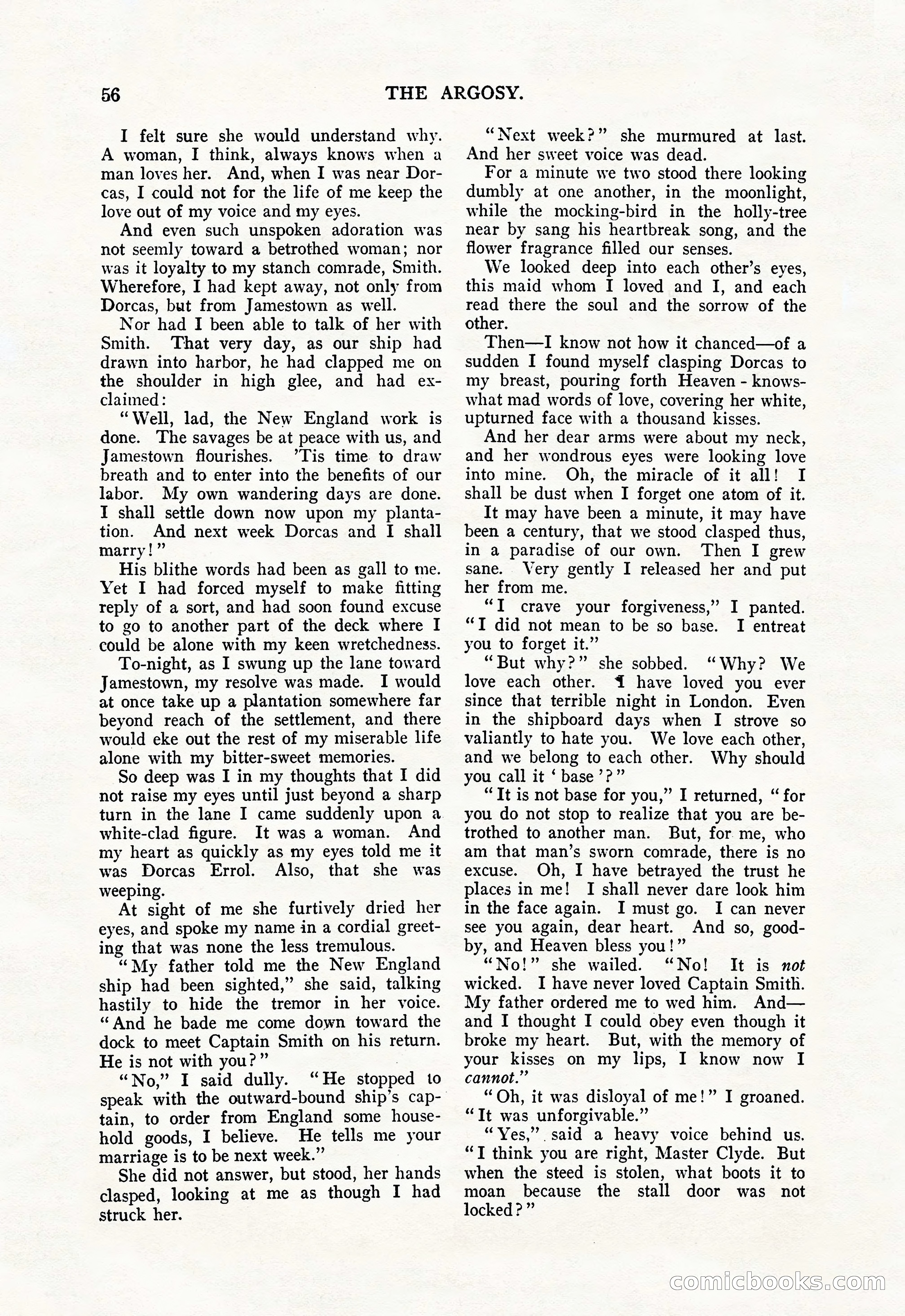
A restored page from Pulp Fiction, 1912. Page through the whole issue in the reader above.
📄 Transcribed text from this page (OCR, searchable)
Machine-transcribed from the original scan — historical spelling and the odd misread are preserved.
a6 I felt sure she would understand why. A woman, I think, always knows when a man loves her. And, when I was near Dor- cas, I could not for the life of me keep the love out of my voice and my eyes. And even such unspoken adoration was not seemly toward a betrothed woman; nor was it loyalty to my stanch comrade, Smith. Wherefore, I had kept away, not only from Dorcas, but from Jamestown as well. Nor had I been able to talk of her with Smith. That very day, as our ship had drawn into harbor, he had clapped me on the shoulder in high glee, and had ex- claimed: “Well, lad, the New England work is done. The savages be at peace with us, and Jamestown flourishes. ’Tis time to draw breath and to enter into the benefits of our labor. My own wandering days are done. I shall settle down now upon my planta- tion. And next week Dorcas and I shall marry!” His blithe words had been as gall to me. Yet I had forced myself to make fitting reply of a sort, and had soon found excuse to go to another part of the deck where I could be alone with my keen wretchedness. To-night, as I swung up the lane toward Jamestown, my resolve was made. I would at once take up a plantation somewhere far beyond reach of the settlement, and there would eke out the rest of my miserable life alone with my bitter-sweet memories. So deep was I in my thoughts that I did not raise my eyes until just beyond a sharp turn in the lane I came suddenly upon a white-clad figure. It was a woman. And my heart as quickly as my eyes told me it was Dorcas Errol. Also, that she was weeping. At sight of me she furtively dried her eyes, and spoke my name in a cordial greet- ing that was none the less tremulous. “My father told me the New England ship had been sighted,” she said, talking hastily to hide the tremor in her voice. “And he bade me come down toward the dock to meet Captain Smith on his return. He is not with you?” “No,” I said dully. “He stopped to speak with the outward-bound ship’s cap-— tain, to order from England some house- hold goods, I believe. He tells me your marriage is to be next week.” She did not answer, but stood, her hands clasped, looking at me as though I had struck her. THE ARGOSY. “Next week?” she murmured at last. And her sweet voice was dead. For a minute we two stood there looking dumbly at one another, in the moonlight, while the mocking-bird in the holly-tree near by sang his heartbreak song, and the flower fragrance filled our senses. We looked deep into each other’s eyes, this maid whom I loved and I, and each read there the soul and the sorrow of the other. Then—I know not how it chanced—of a sudden I found myself clasping Dorcas to my breast, pouring forth Heaven - knows- what mad words of love, covering her white, upturned face with a thousand kisses. And her dear arms were about my neck, and her wondrous eyes were looking love into mine. Qh, the miracle of it all! I shall be dust when I forget one atom of it. It may have been a minute, it may have been a century, that we stood clasped thus, in a paradise of our own. Then I grew sane. Very gently I released her and put her from me. “T crave your forgiveness,” I panted. “I did not mean to be so base. I entreat you to forget it.” “But why?” she sobbed. “Why? We love each other. YZ have loved you ever since that terrible night in London. Even in the shipboard days when I strove so valiantly to hate you. We love each other, and we belong to each other. Why should you call it ‘ base ’?” “It is not base for you,” I returned, “ for you do not stop to realize that you are be- trothed to another man. But, for. me, who am that man’s sworn comrade, there is no excuse. Oh, I have betrayed the trust he places in me! I shall never dare look him in the face again. I must go. I can never see you again, dear heart. And so, good- by, and Heaven bless you!” “No!” she wailed. “No! It is not wicked. I have never loved Captain Smith. My father ordered me to wed him. And— and I thought I could obey even though it broke my heart. But, with the memory of your kisses on my lips, I know now I cannot.” “Oh, it was disloyal of me!” I groaned. “Tt was unforgivable.” “Yes,” said a heavy voice behind us. “T think you are right, Master Clyde. But when the steed is stolen, what boots it to moan because the stall door was not locked ?” cComicoool<