
Pulp Fiction, 1912 · page 69 of 238
The Argosy, April 1912 — page 69: what you’re looking at
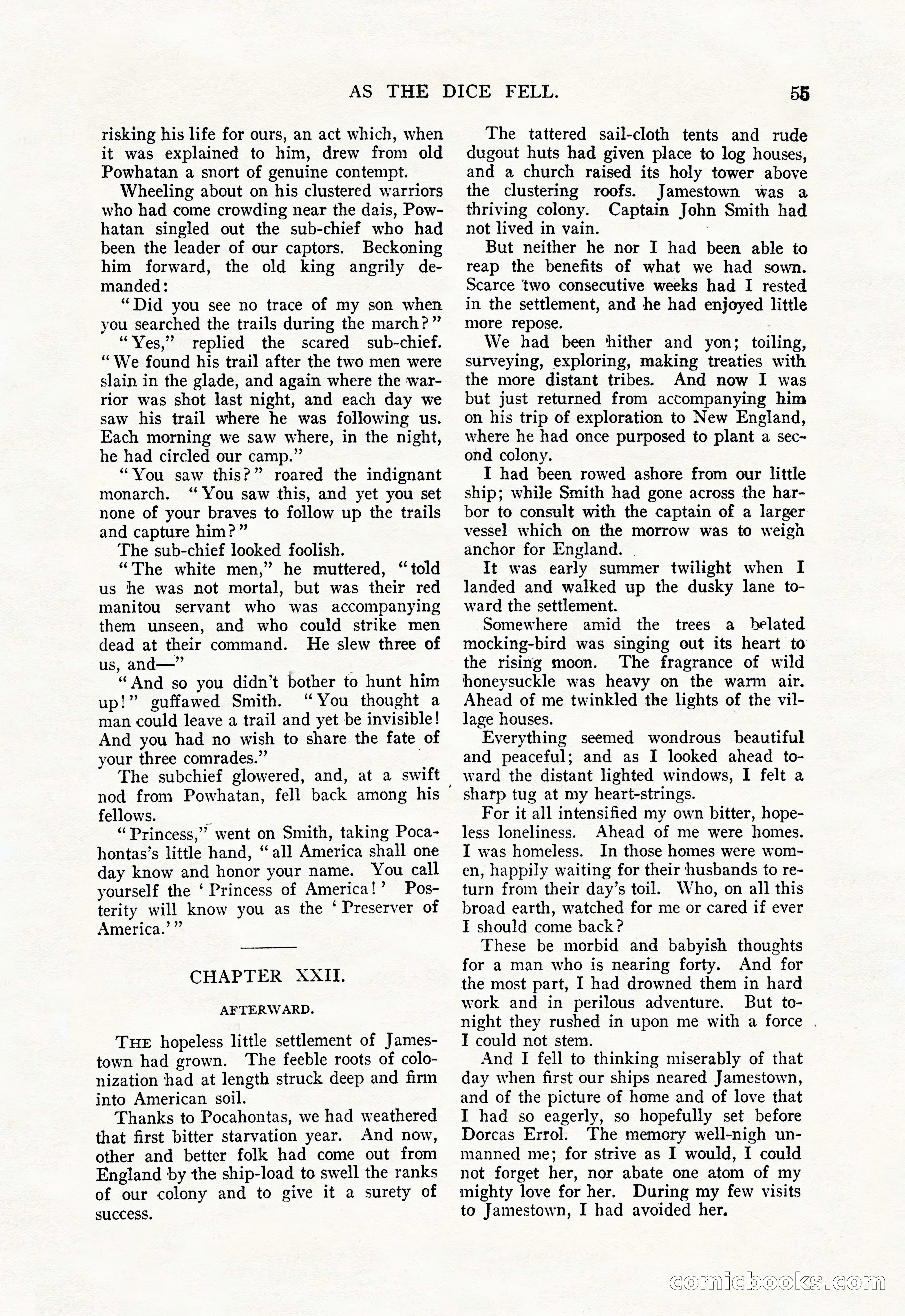
A restored page from Pulp Fiction, 1912. Page through the whole issue in the reader above.
📄 Transcribed text from this page (OCR, searchable)
Machine-transcribed from the original scan — historical spelling and the odd misread are preserved.
AS THE DICE FELL. risking his life for ours, an act which, when it was explained to him, drew from old Powhatan a snort of genuine contempt. Wheeling about on his clustered warriors who had come crowding near the dais, Pow- hatan singled out the sub-chief who had been the leader of our captors. Beckoning him forward, the old king angrily de- manded: “Did you see no trace of my son when you searched the trails during the march?” “Yes,” replied the scared sub-chief. “We found his trail after the two men were slain in the glade, and again where the war- rior was shot last night, and each day we saw his trail where he was following us. Each morning we saw where, in the night, he had circled our camp.” “You saw this?” roared the indignant monarch. ‘ You saw this, and yet you set none of your braves to follow up the trails and capture him?” The sub-chief looked foolish. “The white men,” he muttered, “told us the was not mortal, but was their red manitou servant who was accompanying them unseen, and who could strike men dead at their command. He slew three of us, and—” “And so you didn’t bother to hunt him up!” guffawed Smith. “You thought a man could leave a trail and yet be invisible! And you had no wish to share the fate of your three comrades.” The subchief glowered, and, at a swift nod from Powhatan, fell back among his ~ fellows. : “Princess,”? went on Smith, taking Poca- hontas’s little hand, “all America shall one day know and honor your name. You call yourself the ‘ Princess of America!’ Pos- terity will know you as the ‘ Preserver of America.’ ” CHAPTER XXII. AFTERWARD. TuE hopeless little settlement of James- town had grown. The feeble roots of colo- nization had at length struck deep and firm into American soil. Thanks to Pocahontas, we had weathered that first bitter starvation year. And now, other and better folk had come out from England by the ship-load to swell the ranks of our colony and to give it a surety of success. 55 The tattered sail-cloth tents and rude dugout huts had given place to log houses, and a church raised its holy tower above the clustering roofs. Jamestown was a thriving colony. Captain John Smith had not lived in vain. But neither he nor I had been able to reap the benefits of what we had sown. Scarce two consecutive weeks had I rested in the settlement, and he had enjoyed little more repose. We had been hither and yon; toiling, surveying, exploring, making treaties with the more distant tribes. And now I was but just returned from actompanying him on his trip of exploration to New England, where he had once purposed to plant a sec- ond colony. I had been rowed ashore from our little ship; while Smith had gone across the har- bor to consult with the captain of a larger vessel which on the morrow was to weigh anchor for England. | It was early summer twilight when I landed and walked up the dusky lane to- ward the settlement. Somewhere amid the trees a_ belated mocking-bird was singing out its heart to the rising moon. The fragrance of wild honeysuckle was heavy on the warm air. Ahead of me twinkled the lights of the vil- lage houses. Everything seemed wondrous beautiful and peaceful; and as I looked ahead to- ward the distant lighted windows, I felt a sharp tug at my heart-strings. For it all intensified my own bitter, hope- less loneliness. Ahead of me were homes. I was homeless. In those homes were wom- en, happily waiting for their husbands to re- turn from their day’s toil. Who, on all this broad earth, watched for me or cared if ever I should come back ? These be morbid and babyish thoughts for a man who is nearing forty. And for the most part, I had drowned them in hard work and in perilous adventure. But to- night they rushed in upon me with a force . I could not stem. And I fell to thinking miserably of that day when first our ships neared Jamestown, and of the picture of home and of love that I had so eagerly, so hopefully set before Dorcas Errol. The memory well-nigh un- manned me; for strive as I would, I could not forget her, nor abate one atom of my mighty love for her. During my few visits to Jamestown, I had avoided her. nn (©) Clooolk< CO