
Pulp Fiction, 1912 · page 71 of 238
The Argosy, April 1912 — page 71: what you’re looking at
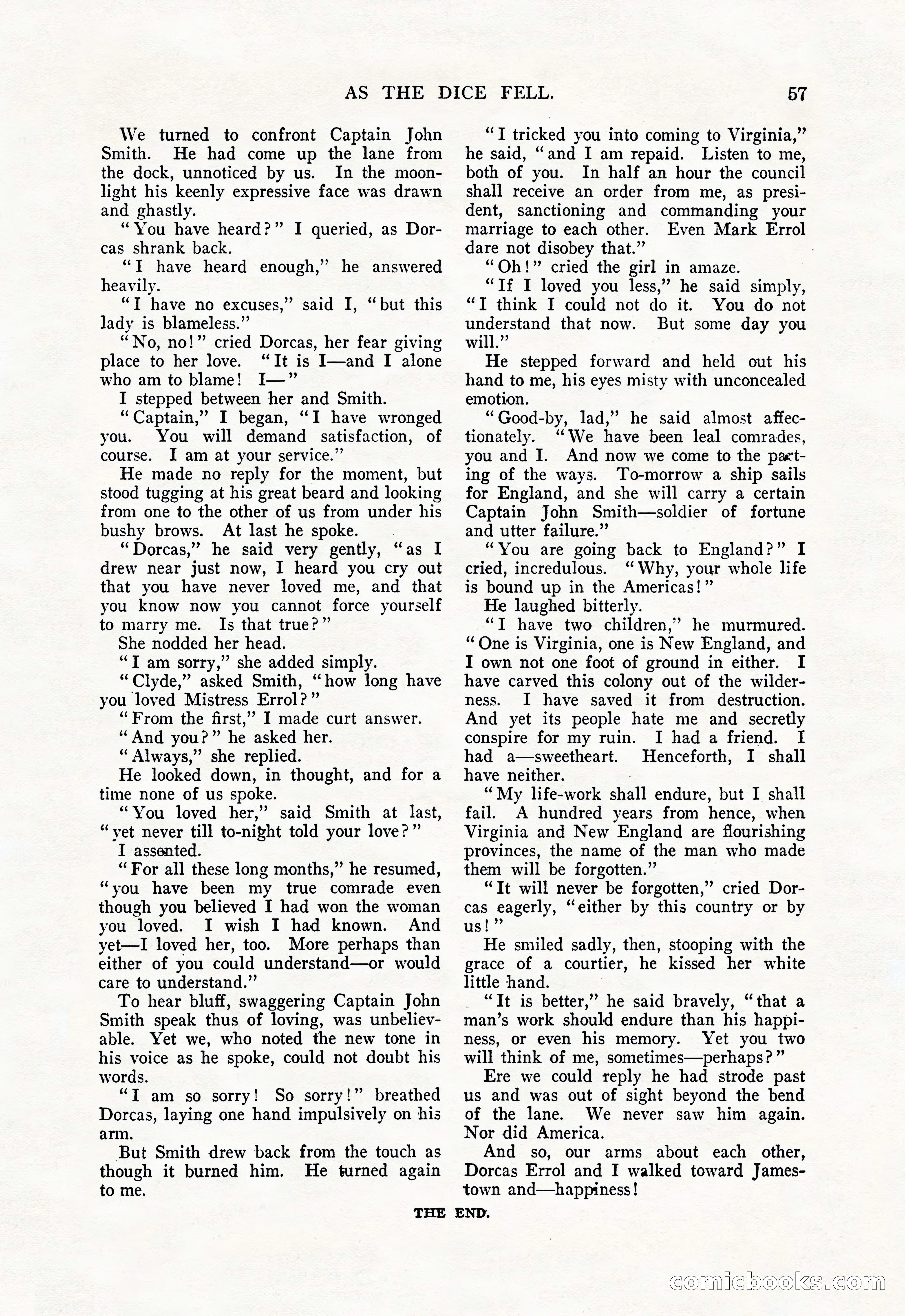
A restored page from Pulp Fiction, 1912. Page through the whole issue in the reader above.
📄 Transcribed text from this page (OCR, searchable)
Machine-transcribed from the original scan — historical spelling and the odd misread are preserved.
AS THE DICE FELL. We turned to confront Captain John Smith. He had come up the lane from the dock, unnoticed by us. In the moon- light his keenly expressive face was drawn and ghastly. “You have heard?” I queried, as Dor- cas shrank back. - “T have heard enough,” he answered heavily. “T have no excuses,” said I, “but this lady is blameless.” “No, no!” cried Dorcas, her fear giving place to her love. “It is I—and I alone who am to blame! I—” I stepped between her and Smith. “Captain,” I began, “I have wronged you. You will demand satisfaction, of course. I am at your service.” He made no reply for the moment, but stood tugging at his great beard and looking from one to the other of us from under his bushy brows. At last he spoke. 7 “Dorcas,” he said very gently, “as I drew near just now, I heard you cry out that you have never loved me, and that you know now you cannot force yourself to marry me. Is that true?” She nodded her head. “I am sorry,” she added simply. “Clyde,” asked Smith, “how long have you loved Mistress Errol?” “From the first,’”’ I made curt answer. “And youre” he asked her. “Always,” she replied. He looked down, in thought, and for a time none of us spoke. “You loved her,” said Smith at last, “vet never till to-night told your love?” I assented. “For all these long months,” he resumed, “you have been my true comrade even though you believed I had won the woman you loved. I wish I had known. And yet—I loved her, too. More perhaps than either of you could understand—or would care to understand.” To hear bluff, swaggering Captain John Smith speak thus of loving, was unbeliev- able. Yet we, who noted the new tone in his voice as he spoke, could not doubt his words. “J am so sorry! So sorry!” breathed Dorcas, laying one hand impulsively on his arm. But Smith drew back from the touch as though it burned him. He turned again to me. THE 57 “I tricked you into coming to Virginia,” he said, “and I am repaid. Listen to me, both of you. In half an hour the council shall receive an order from me, as presi- dent, sanctioning and commanding your marriage to each other. dare not disobey that.”’ “Oh!” cried the girl in amaze. “Tf I loved you less,” he said simply, “T think I could not do it. You do not understand that now. But some day you will.” He stepped forward and held out his hand to me, his eyes misty with unconcealed emotion. “Good-by, lad,” he said almost affec- tionately. “‘We have been leal comrades, you and J. And now we come to the past- ing of the ways. ‘To-morrow a ship sails for England, and she will carry a certain Captain John Smith—soldier of fortune and utter failure.” “You are going back to England?” I cried, incredulous. ‘Why, your whole life 1s bound up in the Americas!” He laughed bitterly. “T have two children,’ he murmured. “One is Virginia, one is New England, and I own not one foot of ground in either. I have carved this colony out of the wilder- ness. I have saved it from destruction. And yet its people hate me and secretly conspire for my ruin. [I had a friend. I had a—sweetheart. Henceforth, I shall have neither. : “My life-work shall endure, but I shall fail. A hundred years from hence, when Virginia and New England are flourishing provinces, the name of the man who made them will be forgotten.” “Tt will never be forgotten,” cried Dor- cas eagerly, “either by this country or by us!” He smiled sadly, then, stooping with the grace of a courtier, he kissed her white little hand. : “Tt is better,” he said bravely, “that a man’s work should endure than his happi- ness, or even his memory. Yet you two will think of me, sometimes—perhaps?” Ere we could reply he had strode past us and was out of sight beyond the bend of the lane. We never saw him again. Nor did America. And so, our arms about each other, Dorcas Errol and I walked toward James- town and—happiness! END. CoOMmiclboool< Even Mark Frrol CO