
Pulp Fiction, 1912 · page 68 of 238
The Argosy, April 1912 — page 68: what you’re looking at
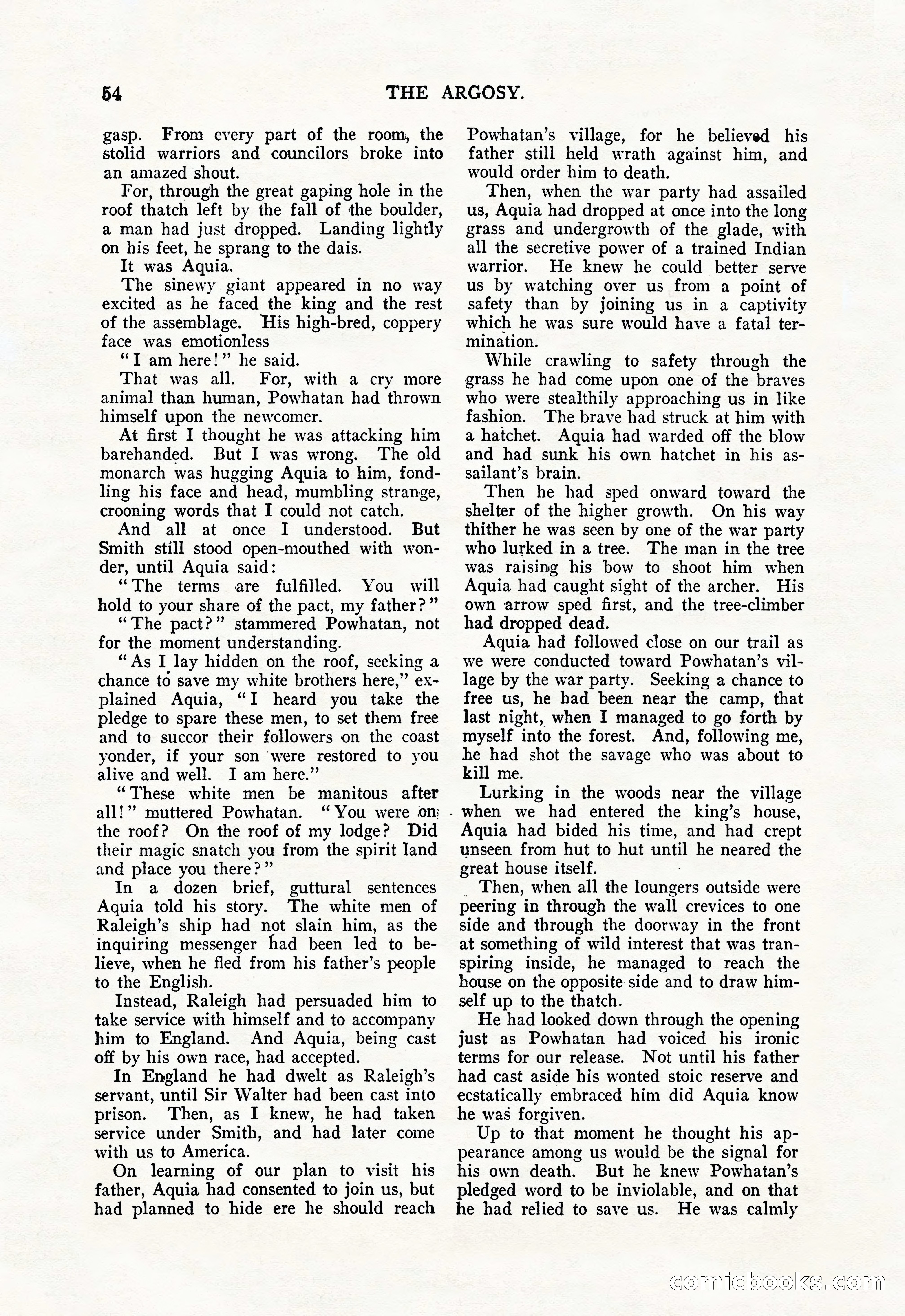
A restored page from Pulp Fiction, 1912. Page through the whole issue in the reader above.
📄 Transcribed text from this page (OCR, searchable)
Machine-transcribed from the original scan — historical spelling and the odd misread are preserved.
54 gasp. From every part of the room, the stolid warriors and councilors broke into an amazed shout. For, through the great gaping hole in the roof thatch left by the fall of the boulder, a man had just dropped. Landing lightly on his feet, he sprang to the dais. It was Aquia. The sinewy giant appeared in no way excited as he faced the king and the rest of the assemblage. His high-bred, coppery face was emotionless “T am here!” he said. That was all. For, with a cry more animal than human, Powhatan had thrown himself upon the newcomer. At first I thought he was attacking him barehanded. But I was wrong. The old monarch was hugging Aquia to him, fond- ling his face and head, mumbling strange, crooning words that I could not catch. And all at once I understood. But Smith still stood open-mouthed with won- der, until Aquia said: “The terms are fulfilled. You will hold to your share of the pact, my father?” “The pact?’’ stammered Powhatan, not for the moment understanding. “As I lay hidden on the roof, seeking a chance to save my white brothers here,” ex- plained Aquia, “I heard you take the pledge to spare these men, to set them free and to succor their followers on the coast yonder, if your son were restored to you alive and well. I am here.” “These white men be manitous after all!” muttered Powhatan. “ You were on: the roof? On the roof of my lodge? Did their magic snatch you from the spirit land and place you there?” In a dozen brief, guttural sentences Aquia told his story. The white men of Raleigh’s ship had not slain him, as the inquiring messenger had been led to be- lieve, when he fled from his father’s people to the English. Instead, Raleigh had persuaded him to take service with himself and to accompany him to England. And Aquia, being cast off by his own race, had accepted. In England he had dwelt as Raleigh’s servant, until Sir Walter had been cast into prison. Then, as I knew, he had taken service under Smith, and had later come with us to America. On learning of our plan to visit his father, Aquia had consented to join us, but had planned to hide ere he should reach THE ARGOSY. Powhatan’s village, for he believed his father still held wrath against him, and would order him to death. Then, when the war party had assailed us, Aquia had dropped at once into the long grass and undergrowth of the glade, with all the secretive power of a trained Indian warrior. He knew he could better serve us by watching over us from a point of safety than by joining us in a captivity which he was sure would have a fatal ter- mination. While crawling to safety through the grass he had come upon one of the braves who were stealthily approaching us in like fashion. The brave had struck at him with a hatchet. Aquia had warded off the blow and had sunk his own hatchet in his as- sailant’s brain. Then he had sped onward toward the shelter of the higher growth. On his way thither he was seen by one of the war party who lurked in a tree. The man in the tree was raising his bow to shoot him when Aquia had caught sight of the archer. His own arrow sped first, and the tree-climber had dropped dead. Aquia had followed close on our trail as we were conducted toward Powhatan’s vil- lage by the war party. Seeking a chance to free us, he had been near the camp, that last night, when I managed to go forth by myself into the forest. And, following me, he had shot the savage who was about to kill me. Lurking in the woods near the village - when we had entered the king’s house, Aquia had bided his time, and had crept unseen from hut to hut until he neared the great house itself. _ Then, when all the loungers outside were peering in through the wall crevices to one side and through the doorway in the front at something of wild interest that was tran- spiring inside, he managed to reach the house on the opposite side and to draw him- self up to the thatch. He had looked down through the opening just as Powhatan had voiced his ironic terms for our release. Not until his father had cast aside his wonted stoic reserve and ecstatically embraced him did Aquia know he was forgiven. Up to that moment he thought his ap- pearance among us would be the signal for his own death. But he knew Powhatan’s pledged word to be inviolable, and on that he had relied to save us. He was calmly co NOOK (CO