
Pulp Fiction, 1912 · page 67 of 238
The Argosy, April 1912 — page 67: what you’re looking at
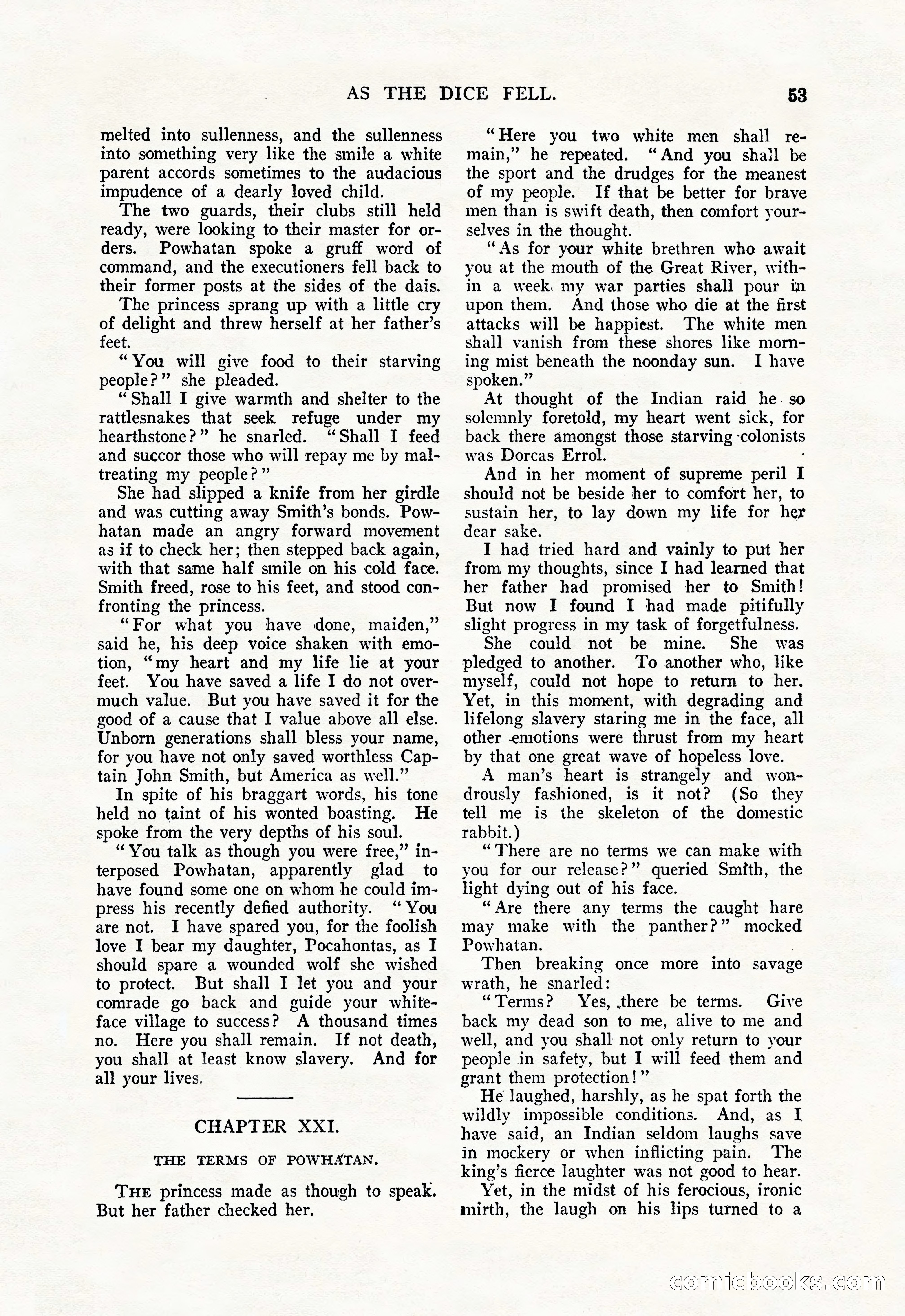
A restored page from Pulp Fiction, 1912. Page through the whole issue in the reader above.
📄 Transcribed text from this page (OCR, searchable)
Machine-transcribed from the original scan — historical spelling and the odd misread are preserved.
AS THE DICE FELL. melted into sullenness, and the sullenness into something very like the smile a white parent accords sometimes to the audacious impudence of a dearly loved child. The two guards, their clubs still held ready, were looking to their master for or- ders. Powhatan spoke a gruff word of command, and the executioners fell back to their former posts at the sides of the dais. The princess sprang up with a little cry of delight and threw herself at her father’s feet. “You will give food to their starving people?” she pleaded. “Shall I give warmth and shelter to the rattlesnakes that seek refuge under my hearthstone?” he snarled. ‘Shall I feed and succor those who will repay me by mal- treating my people?” She had slipped a knife from her girdle and was cutting away Smith’s bonds. Pow- hatan made an angry forward movement as if to check her; then stepped back again, with that same half smile on his cold face. Smith freed, rose to his feet, and stood con- fronting the princess. “For what you have done, maiden,” said he, his deep voice shaken with emo- tion, “my heart and my life lie at your feet. You have saved a life I do not over- much value. But you have saved it for the good of a cause that I value above all else. Unborn generations shall bless your name, for you have not only saved worthless Cap- tain John Smith, but America as well.” In spite of his braggart words, his tone held no taint of his wonted boasting. He spoke from the very depths of his soul. “You talk as though you were free,” in- terposed Powhatan, apparently glad to have found some one on whom he could im- press his recently defied authority. “You are not. I have spared you, for the foolish love I bear my daughter, Pocahontas, as I should spare a wounded wolf she wished to protect. But shall I let you and your comrade go back and guide your white- face village to success? A thousand times no. Here you shall remain. If not death, you shall at least know slavery. And for all your lives. CHAPTER XXI. THE TERMS OF POWHATAN. THE princess made as though to speak. But her father checked her. 53 “Here you two white men shall re- main,” he repeated. ‘And you shail be the sport and the drudges for the meanest of my people. If that be better for brave men than is swift death, then comfort your- selves in the thought. “As for your white brethren who await you at the mouth of the Great River, with- in a week. my war parties shall pour in upon them. And those who die at the first attacks will be happiest. The white men shall vanish from these shores like morn- ing mist beneath the noonday sun. I have spoken.” At thought of the Indian raid he. so solemnly foretold, my heart went sick, for back there amongst those starving colonists was Dorcas Errol. And in her moment of supreme peril I should not be beside her to comfort her, to sustain her, to lay down my life for her dear sake. I had tried hard and vainly to put her from my thoughts, since I had learned that her father had promised her to Smith! But now I found I had made pitifully slight progress in my task of forgetfulness. She could not be mine. She was pledged to another. ‘To another who, like myself, could not hope to return to her. Yet, in this moment, with degrading and lifelong slavery staring me in the face, all other -emotions were thrust from my heart by that one great wave of hopeless love. A man’s heart is strangely and won- drously fashioned, is it not? (So they tell me is the skeleton of the domestic rabbit. ) “There are no terms we can make with you for our release?” queried Smith, the light dying out of his face. “Are there any terms the caught hare may make with the panther?” mocked Powhatan. Then breaking once more into savage wrath, he snarled : . Terms? Yes, there be terms. Give back my dead son to me, alive to me and well, and you shall not only return to your people in safety, but I will feed them and grant them protection!” He laughed, harshly, as he spat forth the wildly impossible conditions. And, as I have said, an Indian seldom laughs save in mockery or when inflicting pain. The king’s fierce laughter was not good to hear. Yet, in the midst of his ferocious, ironic mirth, the laugh on his lips turned to a CONMUC NOOK CO