
Pulp Fiction, 1912 · page 66 of 238
The Argosy, April 1912 — page 66: what you’re looking at
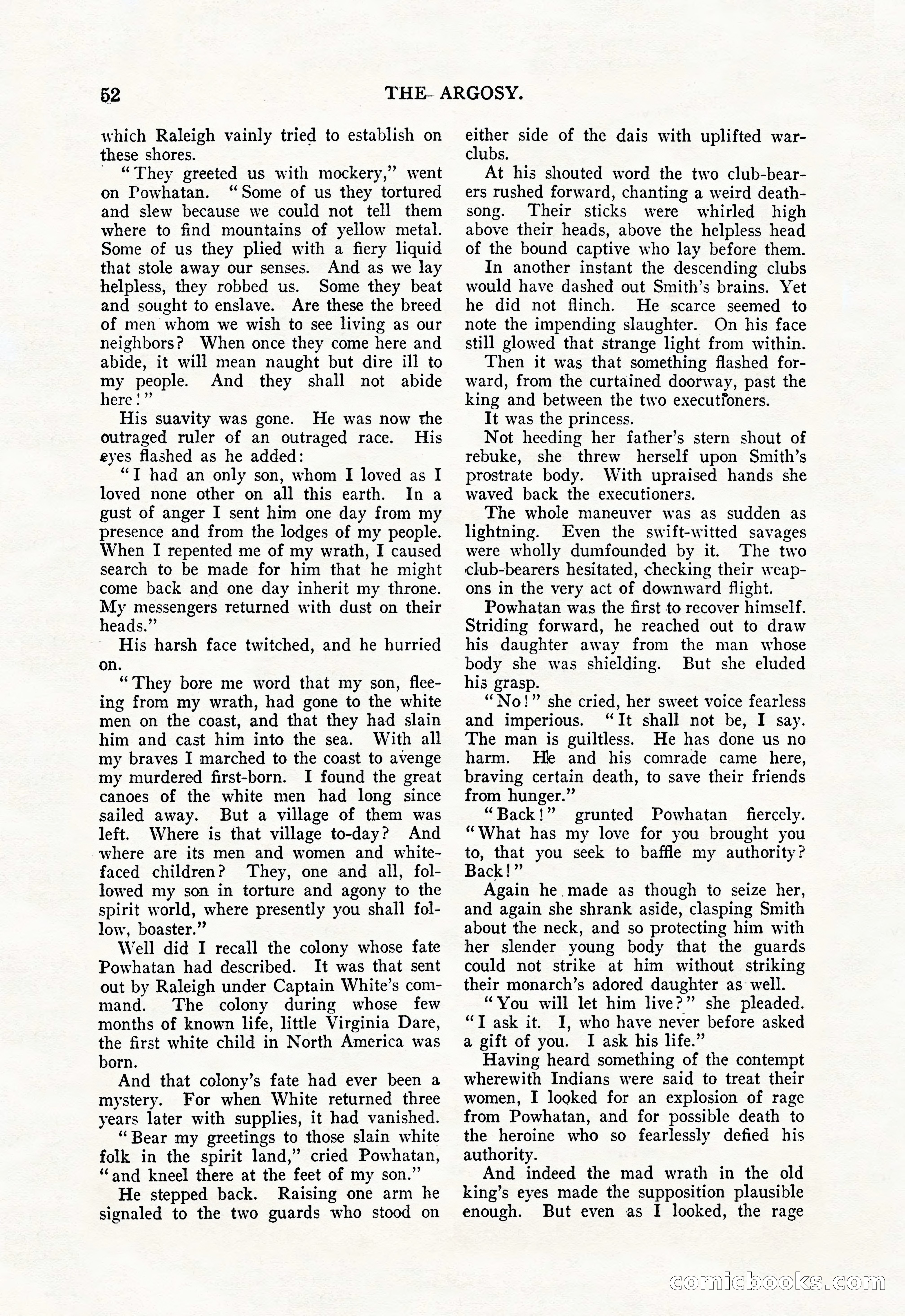
A restored page from Pulp Fiction, 1912. Page through the whole issue in the reader above.
📄 Transcribed text from this page (OCR, searchable)
Machine-transcribed from the original scan — historical spelling and the odd misread are preserved.
52 which Raleigh vainly tried to establish on these shores. ' “They greeted us with mockery,” went on Powhatan. ‘Some of us they tortured and slew because we could not tell them where to find mountains of yellow metal. Some of us they plied with a fiery liquid that stole away our senses. And as we lay helpless, they robbed us. Some they beat and sought to enslave. Are these the breed of men whom we wish to see living as our neighbors? When once they come here and abide, it will mean naught but dire ill to my people. And they shall not abide here!” His suavity was gone. outraged ruler of an outraged race. eyes flashed as he added: “T had an only son, whom I loved as I loved none other on all this earth. In a gust of anger I sent him one day from my presence and from the lodges of my people. When I repented me of my wrath, I caused search to be made for him that he might come back and one day inherit my throne. My messengers returned with dust on their heads.” His harsh face twitched, and he hurried He was now the His on. “They bore me word that my son, flee- ing from my wrath, had gone to the white men on the coast, and that they had slain him and cast him into the sea. With all my braves I marched to the coast to avenge my murdered first-born. I found the great canoes of the white men had long since sailed away. But a village of them was left. Where is that village to-day? And where are its men and women and white- faced children? They, one and all, fol- lowed my son in torture and agony to the spirit world, where presently you shall fol- low, boaster.” Well did I recall the colony whose fate Powhatan had described. It was that sent out by Raleigh under Captain White’s com- mand. The colony during whose few months of known life, little Virginia Dare, the first white child in North America was born. And that colony’s fate had ever been a mystery. For when White returned three years later with supplies, it had vanished. “Bear my greetings to those slain white folk in the spirit land,” cried Powhatan, “and kneel there at the feet of my son.” He stepped back. Raising one arm he signaled to the two guards who stood on THE- ARGOSY. either side of the dais with uplifted war- clubs. At his shouted word the two club-bear- ers rushed forward, chanting a weird death- song. Their sticks were whirled high above their heads, above the helpless head of the bound captive who lay before them. In another instant the descending clubs would have dashed out Smith’s brains. Yet he did not flinch. He scarce seemed to note the impending slaughter. On his face still glowed that strange light from within. Then it was that something flashed for- ward, from the curtained doorway, past the king and between the two executioners. It was the princess. Not heeding her father’s stern shout of rebuke, she threw herself upon Smith’s prostrate body. With upraised hands she waved back the executioners. The whole maneuver was as sudden as lightning. Even the swift-witted savages were wholly dumfounded by it. The two club-bearers hesitated, checking their weap- ons in the very act of downward flight. Powhatan was the first to recover himself. Striding forward, he reached out to draw his daughter away from the man whose body she was shielding. But she eluded his grasp. “No!” she cried, her sweet voice fearless and imperious. “It shall not be, I say. The man is guiltless. He has done us no harm. He and his comrade came here, braving certain death, to save their friends from hunger.” “Back!” grunted Powhatan fiercely. “What has my love for you brought you to, that you seek to baffle my authority? Back!” Again he made as though to seize her, and again she shrank aside, clasping Smith about the neck, and so protecting him with her slender young body that the guards could not strike at him without striking their monarch’s adored daughter as well. “You will let him live?” she pleaded. “Task it. I, who have never before asked a gift of you. I ask his hfe.” Having heard something of the contempt wherewith Indians were said to treat their women, I looked for an explosion of rage from Powhatan, and for possible death to the heroine who so fearlessly defied his authority. And indeed the mad wrath in the old king’s eyes made the supposition plausible enough. But even as I looked, the rage comicoool< CO