
Pulp Fiction, 1912 · page 34 of 238
The Argosy, April 1912 — page 34: what you’re looking at
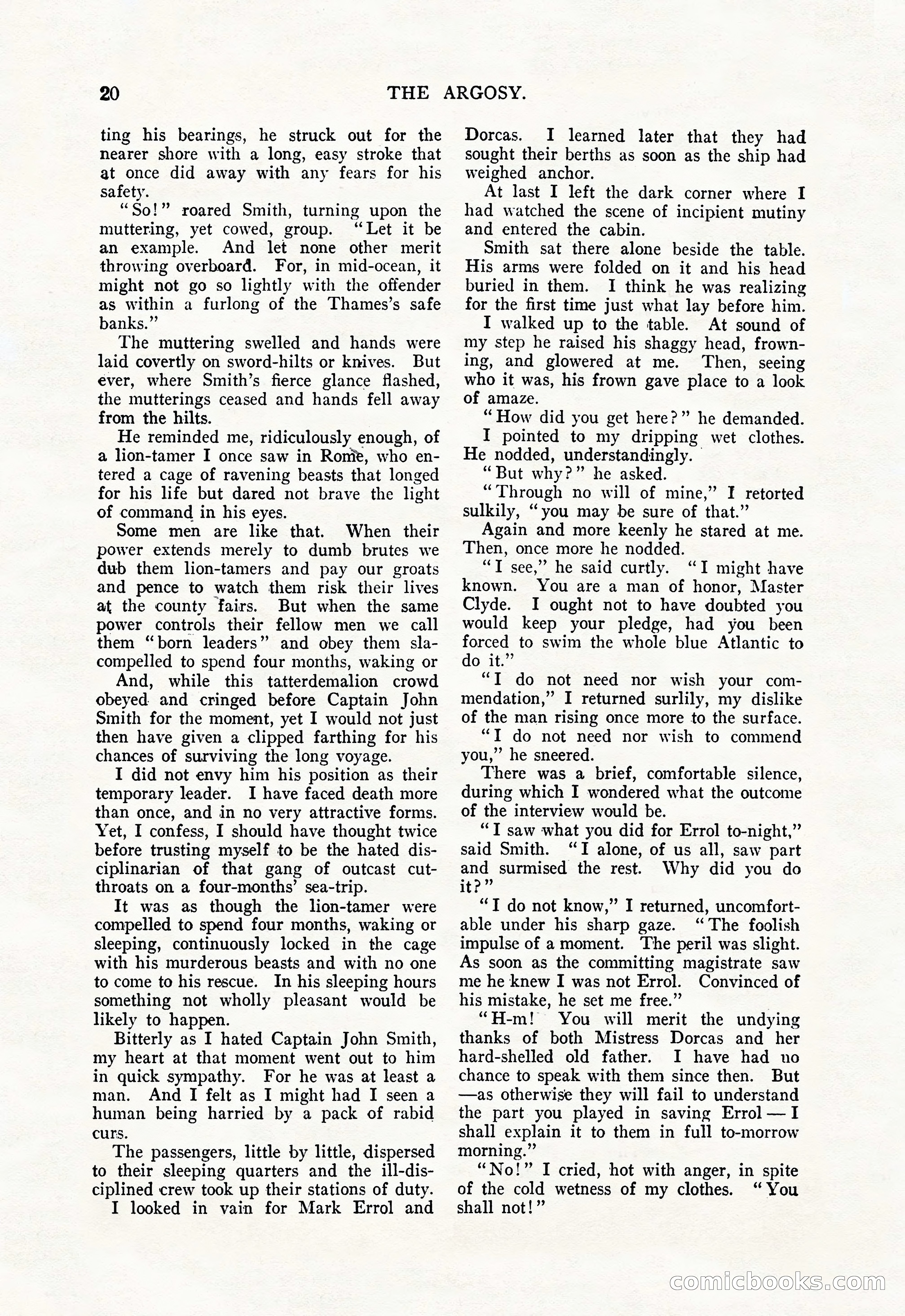
A restored page from Pulp Fiction, 1912. Page through the whole issue in the reader above.
📄 Transcribed text from this page (OCR, searchable)
Machine-transcribed from the original scan — historical spelling and the odd misread are preserved.
20 ting his bearings, he struck out for the nearer shore with a long, easy stroke that at once did away with any fears for his safety. “So!” roared Smith, turning upon the muttering, yet cowed, group. “Let it be an example. And let none other merit throwing overboard. For, in mid-ocean, it might not go so lightly with the offender as within a furlong of the Thames’s safe banks.” The muttering swelled and hands were laid covertly on sword-hilts or knives. But ever, where Smith’s fierce glance flashed, the mutterings ceased and hands fell away from the hilts. He reminded me, ridiculously enough, of a lion-tamer I once saw in Ronie, who en- tered a cage of ravening beasts that longed for his life but dared not brave the light of command in his eyes. Some men are like that. When their power extends merely to dumb brutes we dub them lion-tamers and pay our groats and pence to watch them risk their lives at the county fairs. But when the same power controls their fellow men we call them “born leaders” and obey them sla- compelled to spend four months, waking or And, while this tatterdemalion crowd obeyed and cringed before Captain John smith for the moment, yet I would not just then have given a clipped farthing for his chances of surviving the long voyage. I did not envy him his position as their temporary leader. I have faced death more than once, and in no very attractive forms. Yet, I confess, I should have thought twice before trusting myself to be the hated dis- ciplinarian of that gang of outcast cut- throats on a four-months’ sea-trip. It was as though the lion-tamer were compelled to spend four months, waking or sleeping, continuously locked in the cage with his murderous beasts and with no one to come to his rescue. In his sleeping hours something not wholly pleasant would be likely to happen. Bitterly as I hated Captain John Smith, my heart at that moment went out to him in quick sympathy. For he was at least a man. And I felt as I might had I seen a human being harried by a pack of rabid curs. The passengers, little by little, dispersed to their sleeping quarters and the ill-dis- ciplined crew took up their stations of duty. I looked in vain for Mark Errol and THE ARGOSY. Dorcas. I learned later that they had sought their berths as soon as the ship had weighed anchor. At last I left the dark corner where I had watched the scene of incipient mutiny and entered the cabin. Smith sat there alone beside the table. His arms were folded on it and his head buried in them. I think he was realizing for the first time just what lay before him. I walked up to the table. At sound of my step he raised his shaggy head, frown- ing, and glowered at me. Then, seeing who it was, his frown gave place to a look of amaze. “How did you get here?” he demanded. I pointed to my dripping wet clothes. He nodded, understandingly. | “But why?” he asked. “Through no will of mine,” I retorted sulkily, “you may be sure of that.” Again and more keenly he stared at me. Then, once more he nodded. “T see,” he said curtly. “I might have known. You are a man of honor, Master Clyde. I ought not to have doubted you would keep your pledge, had you been forced to swim the whole blue Atlantic to do it.” “I do not need nor wish your com- mendation,” I returned surlily, my dislike of the man rising once more to the surface. “T do not need nor wish to commend you,” he sneered. There was a brief, comfortable silence, during which I wondered what the outcome of the interview would be. “I saw what you did for Errol to-night,” said Smith. “I alone, of us all, saw part and surmised the rest. Why did you do te “T do not know,” I returned, uncomfort- able under his sharp gaze. “The foolish impulse of amoment. The peril was slight. As soon as the committing magistrate saw me he knew I was not Errol. Convinced of his mistake, he set me free.” | “H-m! You will merit the undying thanks of both Mistress Dorcas and her hard-shelled old father. I have had no chance to speak with them since then. But —as otherwise they will fail to understand the part you played in saving Errol — I shall explain it to them in full to-morrow morning.” “No!” I cried, hot with anger, in spite of the cold wetness of my clothes. “You shall not!” COM Ghook (CO