
Pulp Fiction, 1912 · page 35 of 238
The Argosy, April 1912 — page 35: what you’re looking at
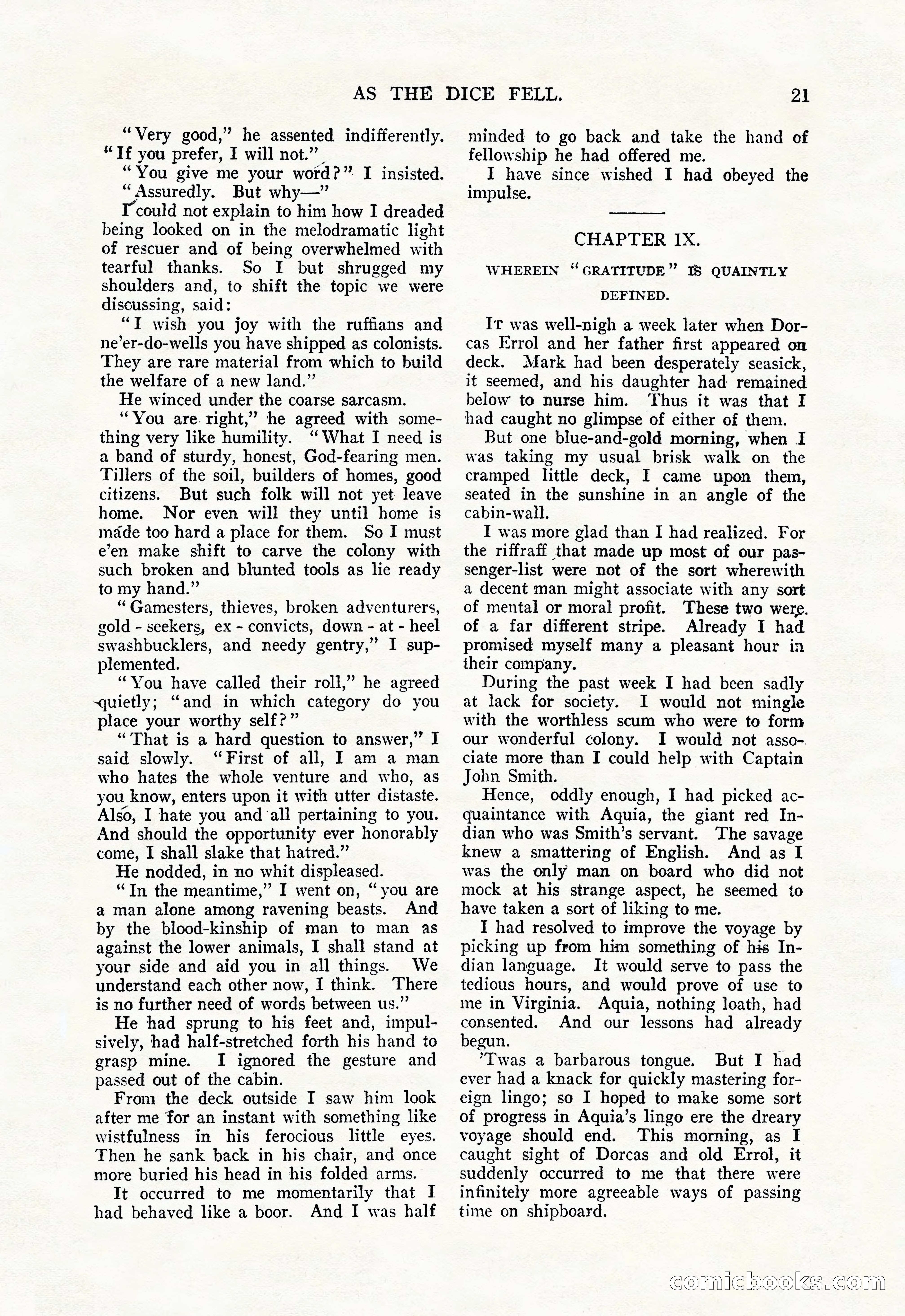
A restored page from Pulp Fiction, 1912. Page through the whole issue in the reader above.
📄 Transcribed text from this page (OCR, searchable)
Machine-transcribed from the original scan — historical spelling and the odd misread are preserved.
AS THE DICE FELL. “Very good,” he assented indifferently. “Tf you prefer, T will not.” “ You give me your word?” I insisted. “ Assuredly. But why—” Tcould not explain to him how I dreaded being looked on in the melodramatic light of rescuer and of being overwhelmed with tearful thanks. So I but shrugged my shoulders and, to shift the topic we were discussing, said: “TI wish you joy with the ruffians and ne’er-do-wells you have shipped as colonists. They are rare material from which to build the welfare of a new land.”’ He winced under the coarse sarcasm. “You are. right,” he agreed with some- thing very like humility. “What I need is a band of sturdy, honest, God-fearing men. Tillers of the soil, builders of homes, good citizens. But such folk will not yet leave home. Nor even will they until home is made too hard a place for them. So I must e’en make shift to carve the colony with such broken and blunted tools as lie ready to my hand.” ““Gamesters, thieves, broken adventurers, gold - seekers, ex - convicts, down - at - heel swashbucklers, and needy gentry,’’ I sup- plemented. “You have called their roll,” he agreed quietly; “and in which category do you place your worthy self?” “That is a hard question to answer,’ I said slowly. “First of all, I am a man who hates the whole venture and who, as you know, enters upon it with utter distaste. Also, I hate you and all pertaining to you. And should the opportunity ever honorably come, I shall slake that hatred.” He nodded, in no whit displeased. “In the meantime,” I went on, “you are a man alone among ravening beasts. And by the blood-kinship of man to man as against the lower animals, I shall stand at your side and aid you in all things. We understand each other now, I think. There is no further need of words between us.”’ He had sprung to his feet and, impul- sively, had half-stretched forth his hand to grasp mine. I ignored the gesture and passed out of the cabin. From the deck outside I saw him look after me for an instant with something like wistfulness in his ferocious little eyes. Then he sank back in his chair, and once more buried his head in his folded arms. It occurred to me momentarily that I had behaved like a boor. And I was half 21 minded to go back and take the hand of fellowship he had offered me. I have since wished I had obeyed the impulse, CHAPTER IX. WHEREIN “GRATITUDE” IS QUAINTLY DEFINED. It was well-nigh a week later when Dor- cas Errol and her father first appeared on deck. Mark had been desperately seasick, it seemed, and his daughter had remained below to nurse him. Thus it was that I had caught no glimpse of either of them. But one blue-and-gold morning, when I was taking my usual brisk walk on the cramped little deck, I came upon them, seated in the sunshine in an angle of the cabin-wall. I was more glad than I had realized. For the riffraff that made up most of our pas- senger-list were not of the sort wherewith a decent man might associate with any sort of mental or moral profit. of a far different stripe. Already I had promised myself many a pleasant hour in their company. During the past week I had been sadly at lack for society. I would not mingle with the worthless scum who were to form our wonderful colony. ciate more than I could help with Captain John Smith. Hence, oddly enough, I had picked ac- quaintance with Aquia, the giant red In- dian who was Smith’s servant. The savage knew a smattering of English. And as I was the only man on board who did not mock at his strange aspect, he seemed to have taken a sort of liking to me. I had resolved to improve the voyage by picking up from him something of his In- dian language. It would serve to pass the tedious hours, and would prove of use to me in Virginia. Aquia, nothing loath, had consented. And our lessons had already begun. i "Iwas a barbarous tongue. But I had ever had a knack for quickly mastering for- eign lingo; so I hoped to make some sort of progress in Aquia’s lingo ere the dreary voyage should end. This morning, as I caught sight of Dorcas and old Errol, it suddenly occurred to me that there were infinitely more agreeable ways of passing time on shipboard. CONMUC ‘These two were. I would not asso-. NOOK CO