
Pulp Fiction, 1912 · page 33 of 238
The Argosy, April 1912 — page 33: what you’re looking at
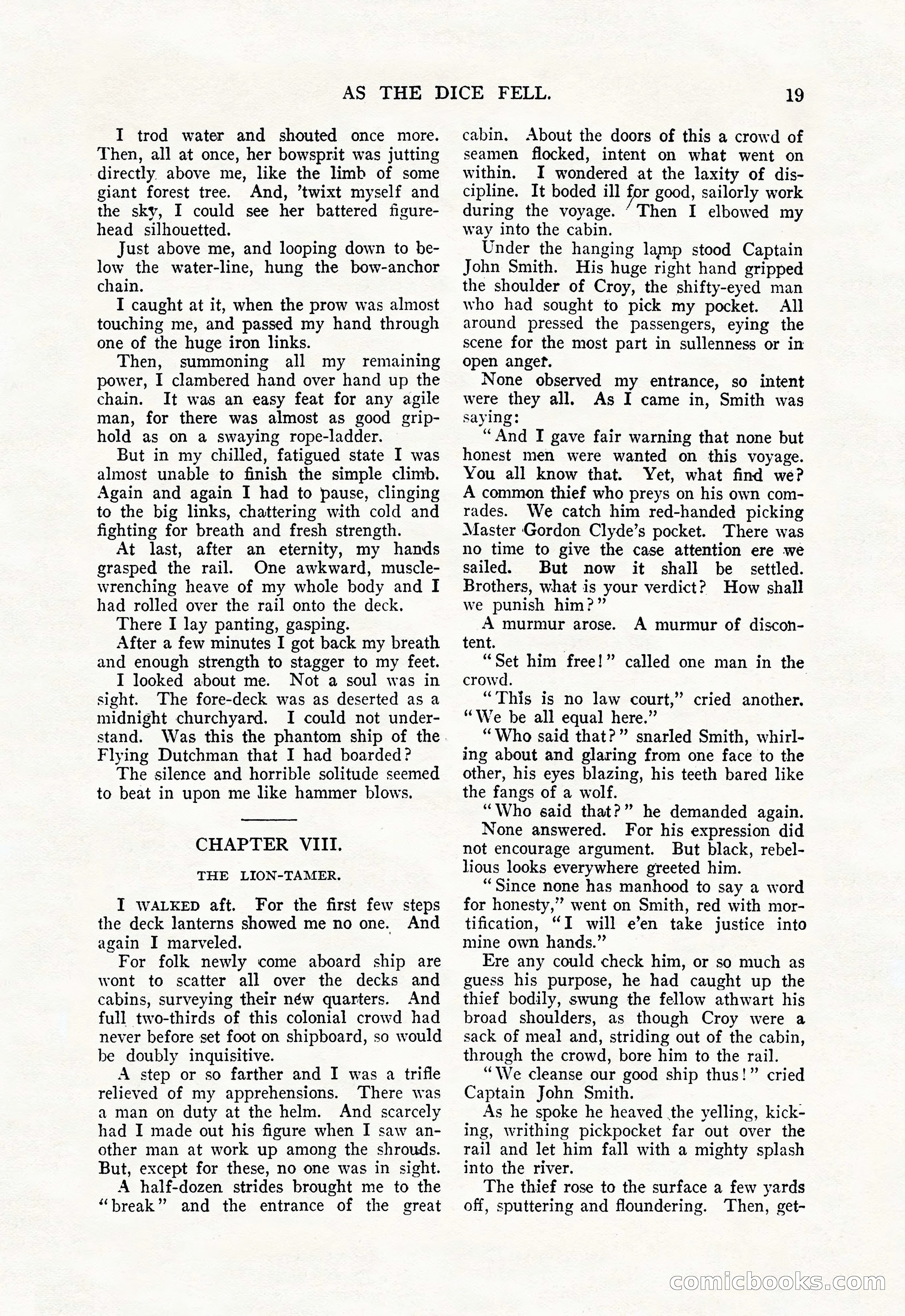
A restored page from Pulp Fiction, 1912. Page through the whole issue in the reader above.
📄 Transcribed text from this page (OCR, searchable)
Machine-transcribed from the original scan — historical spelling and the odd misread are preserved.
AS THE DICE FELL. I trod water and shouted once more. Then, all at once, her bowsprit was jutting directly. above me, like the limb of some giant forest tree. And, ’twixt myself and the sky, I could see her battered figure- head silhouetted. Just above me, and looping down to be- low the water-line, hung the bow-anchor chain. I caught at it, when the prow was almost touching me, and passed my hand through one of the huge iron links. Then, summoning all my remaining power, I clambered hand over hand up the chain. It was an easy feat for any agile man, for there was almost as good grip- hold as on a swaying rope-ladder. But in my chilled, fatigued state I was almost unable to finish the simple climb. Again and again I had to pause, clinging to the big links, chattering with cold and fighting for breath and fresh strength. At last, after an eternity, my hands grasped the rail. One awkward, muscle- wrenching heave of my whole body and I had rolled over the rail onto the deck. There I lay panting, gasping. After a few minutes I got back my breath and enough strength to stagger to my feet. I looked about me. Not a soul was in sight. The fore-deck was as deserted as a midnight churchyard. I could not under- stand. Was this the phantom ship of the Flying Dutchman that I had boarded? The silence and horrible solitude seemed to beat in upon me like hammer blows. CHAPTER VIII. THE LION-TAMER. I WALKED aft. For the first few steps the deck lanterns showed me no one. And again I marveled. For folk newly come aboard ship are wont to scatter all over the decks and cabins, surveying their néw quarters. And full two-thirds of this colonial crowd had never before set foot on shipboard, so would be doubly inquisitive. A step or so farther and I was a trifle relieved of my apprehensions. ‘There was a man on duty at the helm. And scarcely had I made out his figure when I saw an- other man at work up among the shrouds. But, except for these, no one was in sight. A half-dozen strides brought me to the “break” and the entrance of the great 19 cabin. About the doors of this a crowd of seamen flocked, intent on what went on within. I wondered at the laxity of dis- cipline. It boded ill for good, sailorly work during the voyage. ‘ Then I elbowed my way into the cabin. Under the hanging lamp stood Captain John Smith. His huge right hand gripped the shoulder of Croy, the shifty-eyed man who had sought to pick my pocket. All around pressed the passengers, eying the scene for the most part in sullenness or in open angef. None observed my entrance, so intent were they all, As I came in, Smith was saying: “And I gave fair warning that none but honest men were wanted on this voyage. You all know that. Yet, what find weP A common thief who preys on his own com- rades. We catch him red-handed picking Master Gordon Clyde’s pocket. There was no time to give the case attention ere we sailed. But now it shall be settled. Brothers, what is your verdict? How shall we punish him?” A murmur arose. tent. A murmur of discon- “Set him free!” called one man in the crowd. “This is no law court,” cried another, “We be all equal here.” “Who said that?” snarled Smith, whirl- ing about and glaring from one face to the other, his eyes blazing, his teeth bared like the fangs of a wolf. “Who said that?” he demanded again. None answered. For his expression did not encourage argument. But black, rebel- lious looks everywhere greeted him. “Since none has manhood to say a word for honesty,” went on Smith, red with mor- tification, “I will e’en take justice into mine own hands.” Ere any could check him, or so much as guess his purpose, he had caught up the thief bodily, swung the fellow athwart his broad shoulders, as though Croy were a sack of meal and, striding out of the cabin, through the crowd, bore him to the rail. “We cleanse our good ship thus!” cried Captain John Smith. As he spoke he heaved the yelling, kick- ing, writhing pickpocket far out over the rail and let him fall with a mighty splash into the river. The thief rose to the surface a few yards off, sputtering and floundering. Then, get- CoOmicloool< CO