
Pulp Fiction, 1912 · page 17 of 238
The Argosy, April 1912 — page 17: what you’re looking at
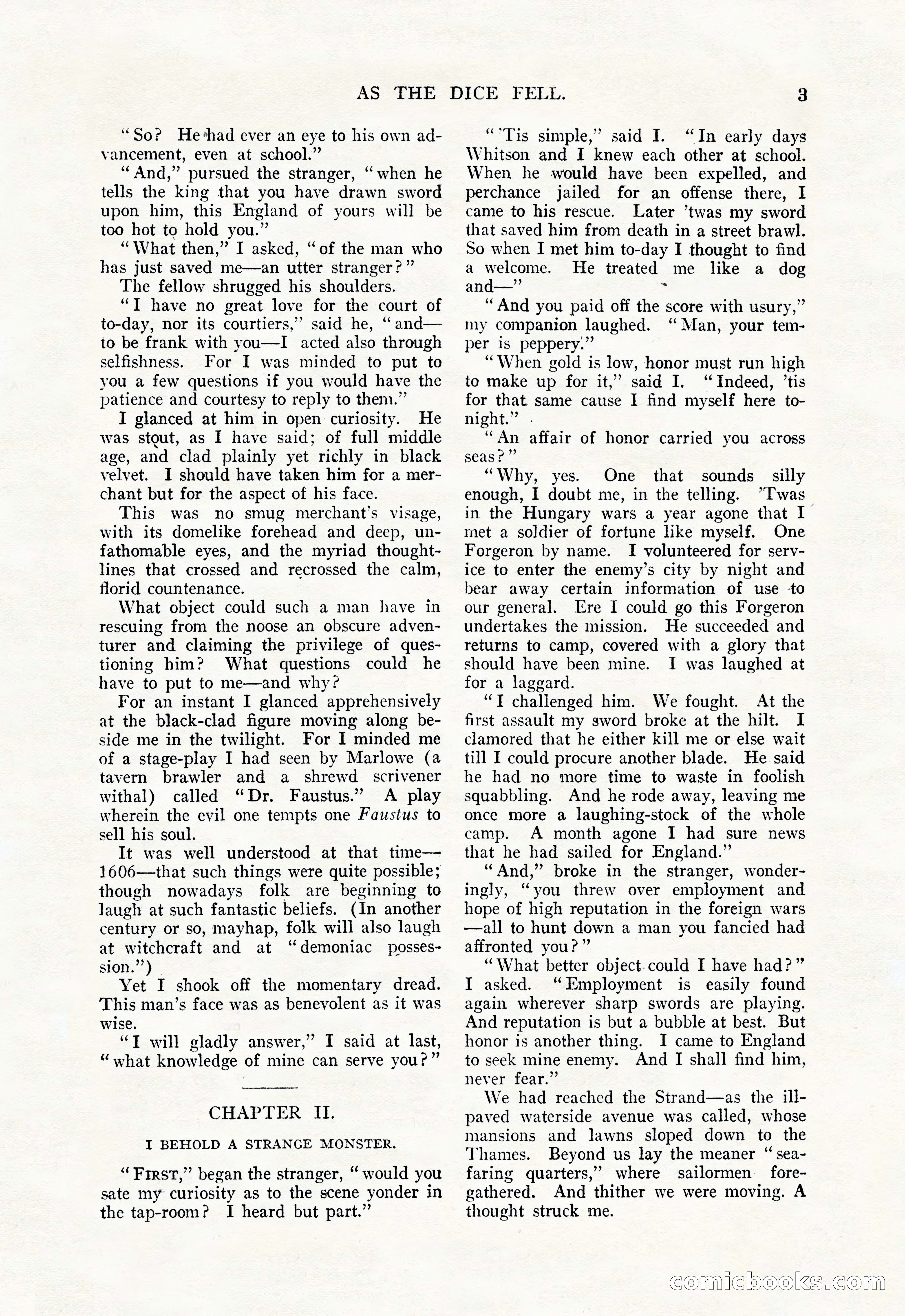
A restored page from Pulp Fiction, 1912. Page through the whole issue in the reader above.
📄 Transcribed text from this page (OCR, searchable)
Machine-transcribed from the original scan — historical spelling and the odd misread are preserved.
AS THE DICE FELL. 3 ‘So? Hevhad ever an eye to his own ad- vancement, even at school.” “And,” pursued the stranger, “when he tells the king that you have drawn sword upon him, this England of yours will be too hot to hold you.” “What then,” I asked, “of the man who has just saved me—an utter stranger?” The fellow shrugged his shoulders. “T have no great love for the court of to-day, nor its courtiers,” said he, “ and— to be frank with you—I acted also through selfishness. For I was minded to put to you a few questions if you would have the patience and courtesy to reply to them.” I glanced at him in open curiosity. He was stout, as I have said; of full middle age, and clad plainly yet richly in black velvet. I should have taken him for a mer- chant but for the aspect of his face. This was no smug merchant’s visage, with its domelike forehead and deep, un- fathomable eyes, and the myriad thought- lines that crossed and recrossed the calm, Horid countenance. What object could such a man have in rescuing from the noose an obscure adven- turer and claiming the privilege of ques- tioning him? What questions could he have to put to me—and why? For an instant I glanced apprehensively at the black-clad figure moving along be- side me in the twilight. For I minded me of a stage-play I had seen by Marlowe (a tavern brawler and a shrewd scrivener withal) called “Dr. Faustus.” A play wherein the evil one tempts one Faustus to sell his soul. It was well understood at that time— 1606—that such things were quite possible; though nowadays folk are beginning to laugh at such fantastic beliefs. (In another century or so, mayhap, folk will also laugh at witchcraft and at ‘“demoniac posses- sion.’’) — Yet I shook off the momentary dread. This man’s face was as benevolent as it was Wise. “T will gladly answer,” I said at last, “what knowledge of mine can serve your” CHAPTER II. I BEHOLD A STRANGE MONSTER. “First,” began the stranger, “ would you sate my curiosity as to the scene yonder in the tap-room? I heard but part.” “"Tis simple,” said I. “In early days Whitson and I knew each other at school. When he would have been expelled, and perchance jailed for an offense there, I came to his rescue. Later twas my sword that saved him from death in a street brawl. So when I met him to-day I thought to find a welcome. He treated me like a dog and—”’ ~~ “And you paid off the score with usury,” my companion laughed. ‘Man, your tem- per is peppery.” “When gold is low, honor must run high to make up for it,’ said I, “Indeed, ’tis for that same cause I find myself here to- night.” . ‘An affair of honor carried you across seas?” “Why, yes. One that sounds enough, I doubt me, in the telling. silly "Twas in the Hungary wars a year agone that I met a soldier of fortune like myself. One Forgeron by name. I volunteered for serv- ice to enter the enemy’s city by night and bear away certain information of use +to our general. [Ere I could go this Forgeron undertakes the mission. He succeeded and returns to camp, covered with a glory that should have been mine. I was laughed at for a laggard. “T challenged him. We fought. At the first assault my sword broke at the hilt. I clamored that he either kill me or else wait till I could procure another blade. He said he had no more time to waste in foolish squabbling. And he rode away, leaving me once more a laughing-stock of the whole camp. A month agone I had sure news that he had sailed for England.” “And,” broke in the stranger, wonder- ingly, “you threw over employment and hope of high reputation in the foreign wars —all to hunt down a man you fancied had affronted your?” “What better object-could I have had?” I asked. “Employment is easily found again wherever sharp swords are playing. And reputation is but a bubble at best. But honor is another thing. I came to England to seek mine enemy. And I shall find him, never fear.~ We had reached the Strand—as the ill- paved waterside avenue was called, whose mansions and lawns sloped down to the Thames. Beyond us lay the meaner “ sea- faring quarters,” where sailormen fore- gathered. And thither we were moving. A thought struck me. CoOmicoool.