
Pulp Fiction, 1912 · page 18 of 238
The Argosy, April 1912 — page 18: what you’re looking at
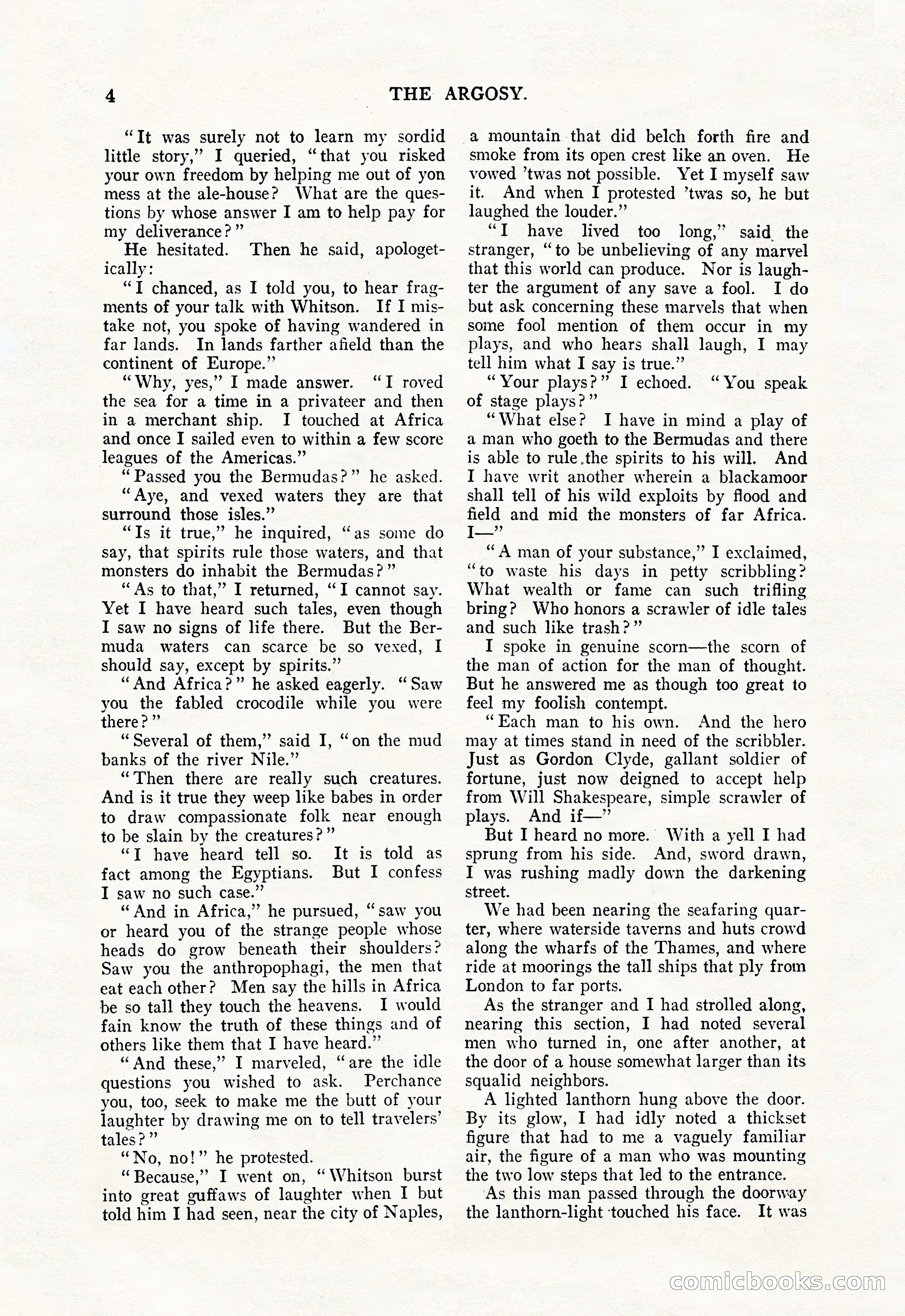
A restored page from Pulp Fiction, 1912. Page through the whole issue in the reader above.
📄 Transcribed text from this page (OCR, searchable)
Machine-transcribed from the original scan — historical spelling and the odd misread are preserved.
4 _ THE ARGOSY. “Tt was surely not to learn my sordid little story,” I queried, “that you risked your own freedom by helping me out of yon mess at the ale-house? What are the ques- tions by whose answer I am to help pay for my deliverance?” He hesitated. Then he said, apologet- ically: “I chanced, as I told you, to hear frag- ments of your talk with Whitson. If I mis- take not, you spoke of having wandered in far lands. In lands farther afield than the continent of Europe.”’ “Why, yes,” I made answer. “I roved the sea for a time in a privateer and then in a merchant ship. I touched at Africa and once I sailed even to within a few score leagues of the Americas.” “Passed you the Bermudas?” he asked. “Aye, and vexed waters they are that surround those isles.” “Ts it true,” he inquired, “as some do say, that spirits rule those waters, and that monsters do inhabit the Bermudas?” “As to that,” I returned, “I cannot say. Yet I have heard such tales, even though I saw no signs of life there. But the Ber- muda waters can scarce be so vexed, I should say, except by spirits.” ‘And Africa?” he asked eagerly. “Saw you the fabled crocodile while you were there?” “Several of them,” said I, “on the mud banks of the river Nile.” “Then there are really such creatures. And is it true they weep like babes in order to draw compassionate folk near enough to be slain by the creatures?” “T have heard tell so. It is told as fact among the Egyptians. But I confess I saw no such case.” “ And in Africa,” he pursued, “saw you or heard you of the strange people whose heads do grow beneath their shoulders? Saw you the anthropophagi, the men that eat each other? Men say the hills in Africa be so tall they touch the heavens. I would fain know the truth of these things and of others like them that I have heard.”’ “ And these,” I marveled, “are the idle questions you wished to ask. Perchance you, too, seek to make me the butt of your laughter by drawing me on to tell travelers’ tales?” “No, no!” he protested. “Because,” I went on, “ Whitson burst into great guffaws of laughter when I but told him I had seen, near the city of Naples, @ mountain that did belch forth fire and smoke from its open crest like an oven. He vowed ’twas not possible. Yet I myself saw it. And when I protested ’twas so, he but laughed the louder.” “I have lived too long,” said the stranger, “to be unbelieving of any marvel that this world can produce. Nor is laugh- ter the argument of any save a fool. I do but ask concerning these marvels that when some fool mention of them occur in my plays, and who hears shall laugh, I may tell him what I say is true.” “Your plays?” I echoed. of stage plays?” “What else? I have in mind a play of a man who goeth to the Bermudas and there is able to rule.the spirits to his will. And I have writ another wherein a blackamoor shall tell of his wild exploits by flood and field and mid the monsters of far Africa. 5 PR: “A man of your substance,” I exclaimed, “to waste his days in petty scribbling? What wealth or fame can such trifling bring? Who honors a scrawler of idle tales and such like trash?” I spoke in genuine scorn—the scorn of the man of action for the man of thought. But he answered me as though too great to feel my foolish contempt. “Each man to his own. And the hero may at times stand in need of the scribbler. Just as Gordon Clyde, gallant soldier of fortune, just now deigned to accept help from Will Shakespeare, simple scrawler of plays. And if—” But I heard no more. With a yell I had sprung from his side. And, sword drawn, I was rushing madly down the darkening street. We had been nearing the seafaring quar- ter, where waterside taverns and huts crowd along the wharfs of the Thames, and where ride at moorings the tall ships that ply from London to far ports. As the stranger and I had strolled along, nearing this section, I had noted several men who turned in, one after another, at the door of a house somewhat larger than its squalid neighbors. A lighted lanthorn hung above the door. By its glow, I had idly noted a thickset figure that had to me a vaguely familiar air, the figure of a man who was mounting the two low steps that led to the entrance. ‘As this man passed through the doorway the lanthorn-light ‘touched his face. It was “You speak CoOmicoool.