
Pulp Fiction, 1912 · page 16 of 238
The Argosy, April 1912 — page 16: what you’re looking at
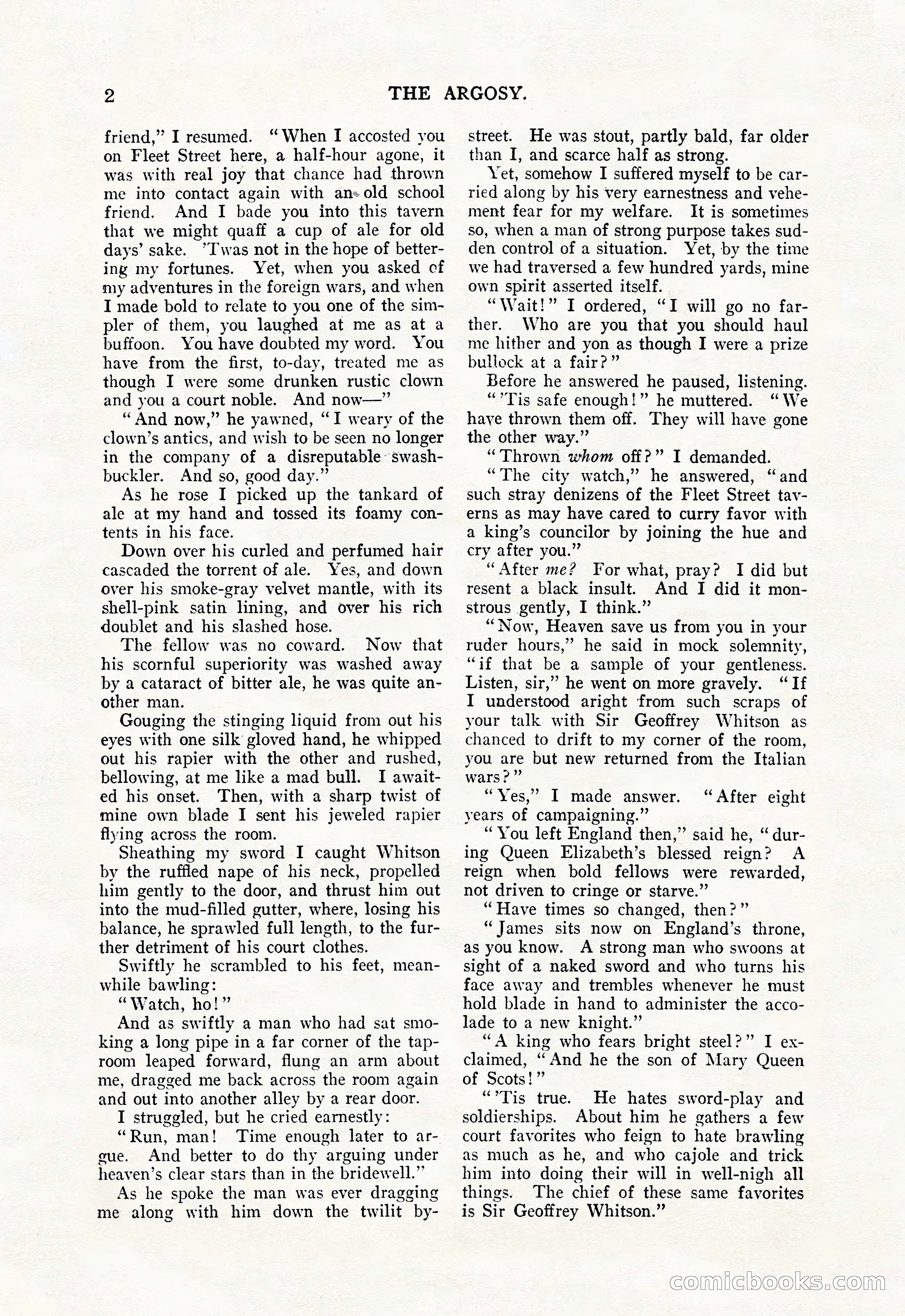
A restored page from Pulp Fiction, 1912. Page through the whole issue in the reader above.
📄 Transcribed text from this page (OCR, searchable)
Machine-transcribed from the original scan — historical spelling and the odd misread are preserved.
2 THE ARGOSY. friend,’ I resumed. ‘When I accosted you on Fleet Street here, a half-hour agone, it was with real joy that chance had thrown me into contact again with ansold school friend. And I bade you into this tavern that we might quaff a cup of ale for old days’ sake. ’Iwas not in the hope of better- ing my fortunes. Yet, when you asked cf my adventures in the foreign wars, and when I made bold to relate to you one of the sim- pler of them, you laughed at me as at a buffoon. You have doubted my word. You have from the first, to-day, treated me as though I were some drunken rustic clown and you a court noble. And now—’”’ “And now,” he yawned, “I weary of the clown’s antics, and wish to be seen no longer in the company of a disreputable swash- buckler. And so, good day.” As he rose I picked up the tankard of ale at my hand and tossed its foamy con- tents in his face. Down over his curled and perfumed hair cascaded the torrent of ale. Yes, and down over his smoke-gray velvet mantle, with its shell-pink satin lining, and over his rich doublet and his slashed hose. The fellow was no coward. Now that his scornful superiority was washed away by a cataract of bitter ale, he was quite an- other man. Gouging the stinging liquid from out his eyes with one silk gloved hand, he whipped out his rapier with the other and rushed, bellowing, at me like a mad bull. I await- ed his onset. Then, with a sharp twist of mine own blade I sent his jeweled rapier flying across the room. Sheathing my sword I caught Whitson by the ruffled nape of his neck, propelled him gently to the door, and thrust him out into the mud-filled gutter, where, losing his balance, he sprawled full length, to the fur- ther detriment of his court clothes. Swiftly he scrambled to his feet, mean- while bawling: “Watch, ho!” And as swiftly a man who had sat smo- king a long pipe in a far corner of the tap- room leaped forward, flung an arm about me, dragged me back across the room again and out into another alley by a rear door. I struggled, but he cried earnestly: “Run, man! Time enough later to ar- gue. And better to do thy arguing under heaven’s clear stars than in the bridewell.” As he spoke the man was ever dragging me along with him down the twilit by- street. He was stout, partly bald, far older than I, and scarce half as strong. Yet, somehow I suffered myself to be car- ried along by his very earnestness and vehe- ment fear for my welfare. It is sometimes so, when a man of strong purpose takes sud- den control of a situation. Yet, by the time we had traversed a few hundred yards, mine own spirit asserted itself. “Wait!” I ordered, “I will go no far- ther. Who are you that you should haul me hither and yon as though I were a prize bullock at a fair?” Before he answered he paused, listening. “?’Tis safe enough!” he muttered. “We have thrown them off. They will have gone the other way.” “Thrown whom off?” I demanded. “The city watch,” he answered, “and such stray denizens of the Fleet Street tav- erns as may have cared to curry favor with a king’s councilor by joining the hue and cry after you.” “After me? For what, pray? I did but resent a black insult. And I did it mon- strous gently, I think.” “Now, Heaven save us from you in your ruder hours,” he said in mock solemnity, “if that be a sample of your gentleness. Listen, sir,” he went on more gravely. “If I understood aright from such scraps of your talk with Sir Geoffrey Whitson as chanced to drift to my corner of the room, you are but new returned from the Italian wars?” “Yes,” I made answer. “After eight years of campaigning.” “You left England then,” said he, “ dur- ing Queen Elizabeth’s blessed reign? A reign when bold fellows were rewarded, not driven to cringe or starve.” ““Have times so changed, then?” “James sits now on England’s throne, as you know. A strong man who swoons at sight of a naked sword and who turns his face away and trembles whenever he must hold blade in hand to administer the acco- lade to a new knight.” ‘““A king who fears bright steel?” I ex- claimed, “And he the son of Mary Queen of Scots!” “’Tis true. He hates sword-play and soldierships. About him he gathers a few court favorites who feign to hate brawling as much as he, and who cajole and trick him into doing their will in well-nigh all things. The chief of these same favorites is Sir Geoffrey Whitson.”