
Pulp Fiction, 1912 · page 160 of 238
The Argosy, April 1912 — page 160: what you’re looking at
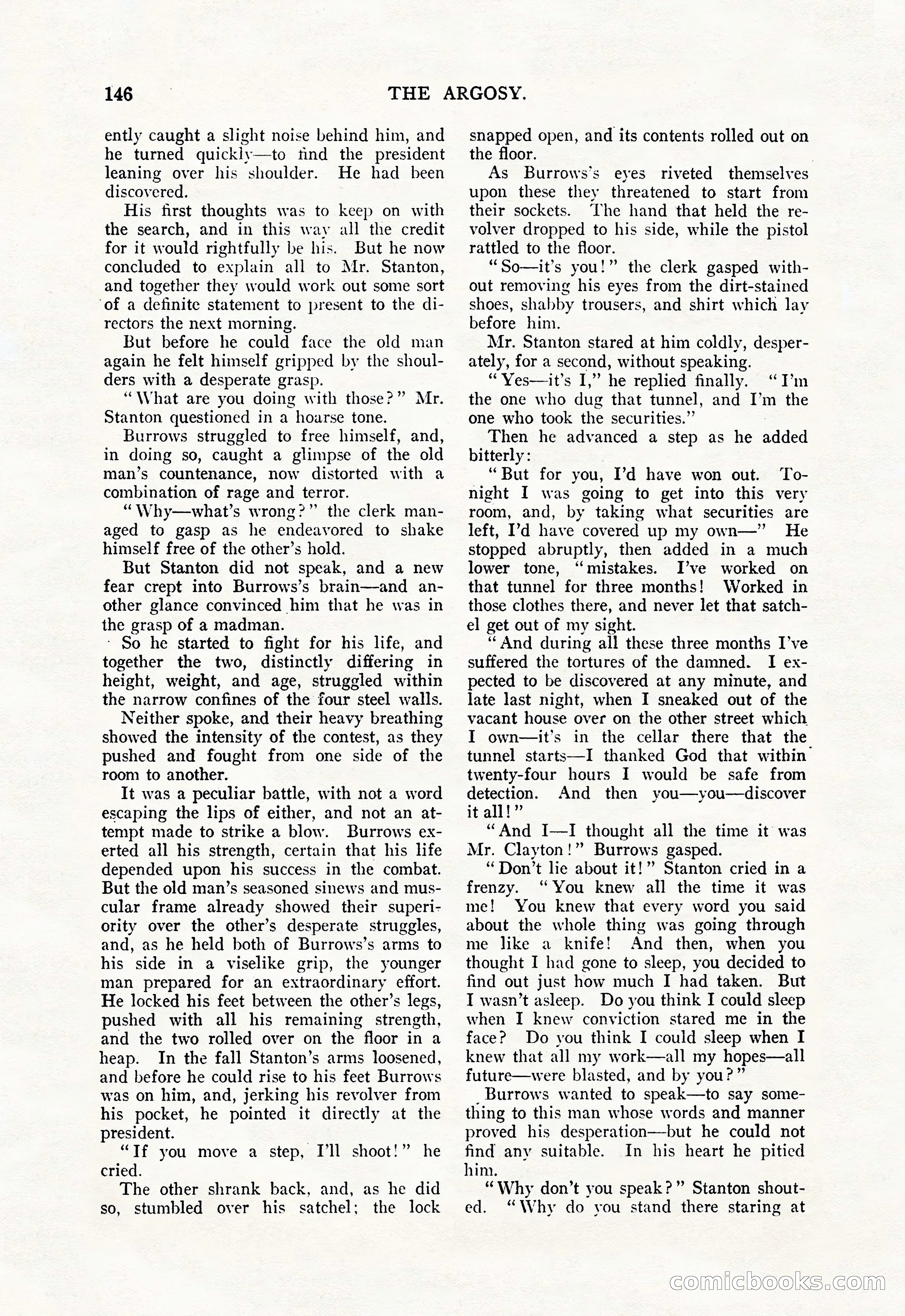
A restored page from Pulp Fiction, 1912. Page through the whole issue in the reader above.
📄 Transcribed text from this page (OCR, searchable)
Machine-transcribed from the original scan — historical spelling and the odd misread are preserved.
146 ently caught a slight noise behind him, and he turned quickly—to tind the president leaning over his shoulder. He had been discovered. His first thoughts was to keep on with the search, and in this way all the credit for it would rightfully be his. But he now concluded to explain all to Mr. Stanton, and together they would work out some sort ‘of a definite statement to present to the di- rectors the next morning. But before he could face the old man again he felt himself gripped by the shoul- ders with a desperate grasp. “What are you doing with those?” Mr. Stanton questioned in a hoarse tone. Burrows struggled to free himself, and, in doing so, caught a glimpse of the old man’s countenance, now distorted with a combination of rage and terror. “Why—what’s wrong?” the clerk man- aged to gasp as he endeavored to shake himself free of the other’s hold. But Stanton did not speak, and a new fear crept into Burrows’s brain—and an- other glance convinced him that he was in the grasp of a madman. ' So he started to fight for his life, and together the two, distinctly differing in height, weight, and age, struggled within the narrow confines of the four steel walls. Neither spoke, and their heavy breathing showed the intensity of the contest, as they pushed and fought from one side of the room to another. It was a peculiar battle, with not a word escaping the lips of either, and not an at- tempt made to strike a blow. Burrows ex- erted all his strength, certain that his life depended upon his success in the combat. But the old man’s seasoned sinews and mus- cular frame already showed their superi- ority over the other’s desperate struggles, and, as he held both of Burrows’s arms to his side in a viselike grip, the younger man prepared for an extraordinary effort. He locked his feet between the other’s legs, pushed with all his remaining strength, and the two rolled over on the floor in a heap. In the fall Stanton’s arms loosened, and before he could rise to his feet Burrows was on him, and, jerking his revolver from his pocket, he pointed it directly at the president. “Tf you move a step, I’ll shoot!” he cried. The other shrank back, and, as he did so, stumbled over his satchel; the lock THE ARGOSY. snapped open, and its contents rolled out on the floor. As Burrows’s eyes upon these they threatened to start from their sockets. The hand that held the re- volver dropped to his side, while the pistol rattled to the floor. “So—it’s you!” the clerk gasped with- out removing his eyes from the dirt-stained shoes, shabby trousers, and shirt which lay before him. Mr. Stanton stared at him coldly, desper- ately, for a second, without speaking. “Yes—it’s I,” he replied finally. “I’m the one who dug that tunnel, and I’m the one who took the securities.” Then he advanced a step as he added bitterly: “But for you, I’d have won out. To- night I was going to get into this very room, and, by taking what securities are left, I'd have covered up my own—” He stopped abruptly, then added in a much lower tone, ‘‘mistakes. I’ve worked on that tunnel for three months! Worked in those clothes there, and never let that satch- el get out of my sight. ‘“And during all these three months I’ve suffered the tortures of the damned. I ex- pected to be discovered at any minute, and late last night, when I sneaked out of the vacant house over on the other street which I own—it’s in the cellar there that the tunnel starts—I thanked God that within twenty-four hours I would be safe from detection. And then you—you—discover it all!” “And I—I thought all the time it was Mr. Clayton!” Burrows gasped. “Don’t he about it!”’ Stanton cried in a frenzy. “ You knew all the time it was me! You knew that every word you said about the whole thing was going through me like a knife! And then, when you thought I had gone to sleep, you decided to find out just how much I had taken. But TI wasn’t asleep. Do you think I could sleep when I knew conviction stared me in the face? Do you think I could sleep when I knew that all my work—all my hopes—all future—were blasted, and by you?” _Burrows wanted to speak—to say some- thing to this man whose words and manner proved his desperation—but he could not find any suitable. In his heart he pitied him. “Why don’t you speak?” Stanton shout- ed. “Why do you stand there staring at COMmMiic|ooo riveted themselves S