
Pulp Fiction, 1912 · page 159 of 238
The Argosy, April 1912 — page 159: what you’re looking at
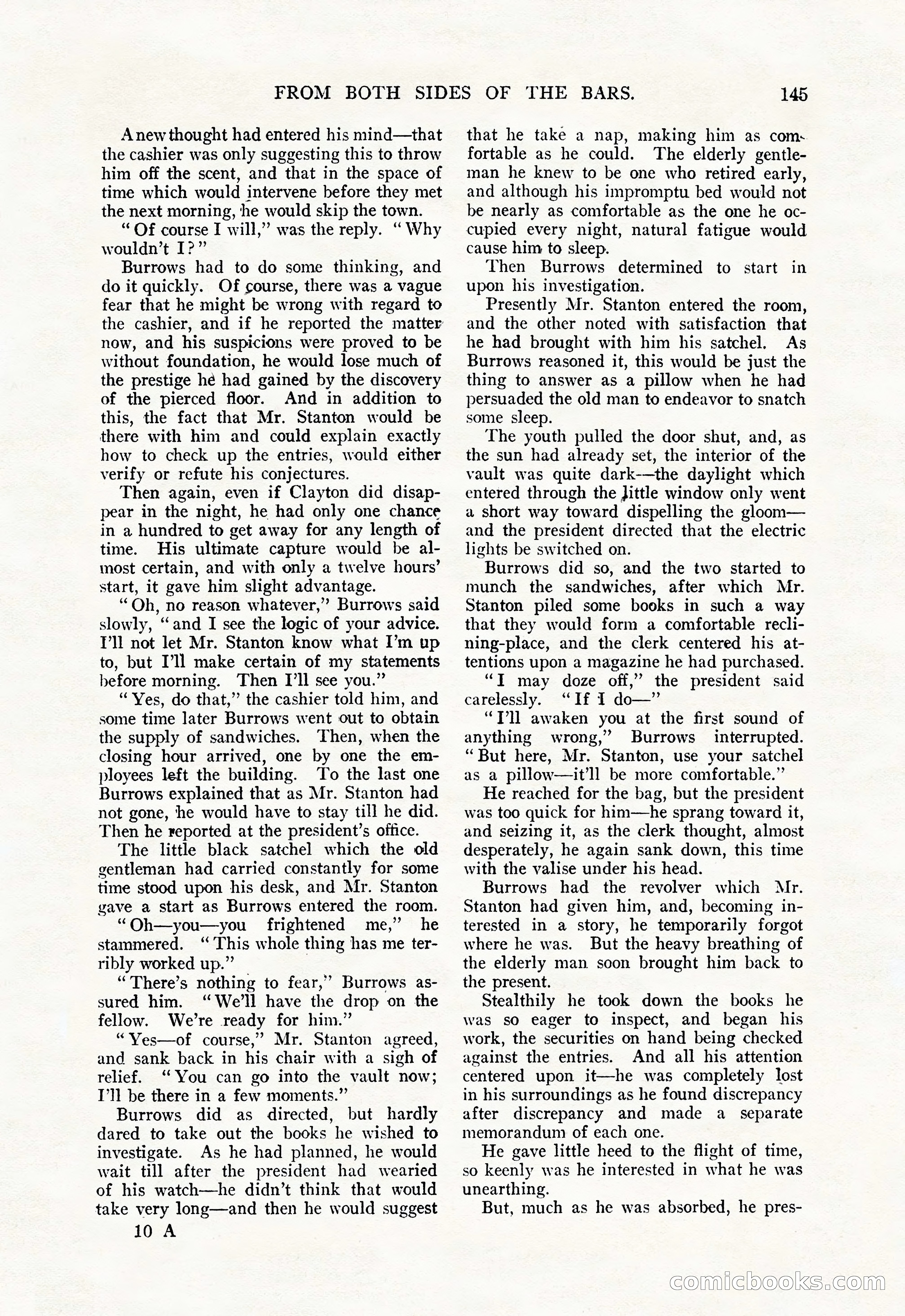
A restored page from Pulp Fiction, 1912. Page through the whole issue in the reader above.
📄 Transcribed text from this page (OCR, searchable)
Machine-transcribed from the original scan — historical spelling and the odd misread are preserved.
FROM BOTH SIDES OF Anew thought had entered his mind—that the cashier was only suggesting this to throw him off the scent, and that in the space of time which would intervene before they met the next morning, the would skip the town. “Of course I will,” was the reply. “ Why wouldn’t I?” Burrows had to do some thinking, and do it quickly. Of course, there was a vague fear that he might be wrong with regard to the cashier, and if he reported the matter now, and his suspicions were proved to be without foundation, he would lose much of the prestige he had gained by the discovery of the pierced floor. And in addition to this, the fact that Mr. Stanton would be there with him and could explain exactly how to check up the entries, would either verify or refute his conjectures. Then again, even if Clayton did disap- pear in the night, he had only one chance in a hundred to get away for any length of time. His ultimate capture would be al- most certain, and with only a twelve hours’ start, it gave him slight advantage. “Oh, no reason whatever,” Burrows said slowly, “and I see the logic of your advice. T’ll not let Mr. Stanton know what I’m up to, but I'll make certain of my statements before morning. Then I’ll see you.” “Yes, do that,” the cashier told him, and some time later Burrows went out to obtain the supply of sandwiches. Then, when the closing hour arrived, one by one the em- ployees left the building. To the last one Burrows explained that as Mr. Stanton had not gone, he would have to stay till he did. Then he reported at the president’s office. The little black satchel which the old gentleman had carried constantly for some time stood upon his desk, and Mr. Stanton gave a start as Burrows entered the room. “Oh—you—you frightened me,’ he stammered. ‘This whole thing has me ter- ribly worked up.” “There’s nothing to fear,” Burrows as- sured him. ‘We'll have the drop on the fellow. We’re ready for him.” “Ves—of course,” Mr. Stanton agreed, and sank back in his chair with a sigh of relief. ‘You can go into the vault now; I'll be there in a few moments.” Burrows did as directed, but hardly dared to take out the books he wished to investigate. As he had planned, he would wait till after the president had wearied of his watch—he didn’t think that would take very long—and then he would suggest 10 A THE BARS. 145 that he take a nap, making him as com. fortable as he could. The elderly gentle- man he knew to be one who retired early, and although his impromptu bed would not be nearly as comfortable as the one he oc- cupied every night, natural fatigue would cause him to sleep. Then Burrows determined to start in upon his investigation. Presently Mr. Stanton entered the room, and the other noted with satisfaction that he had brought with him his satchel. As Burrows reasoned it, this would be just the thing to answer as a pillow when he had persuaded the old man to endeavor to snatch some sleep. The youth pulled the door shut, and, as the sun had already set, the interior of the vault was quite dark-—the daylight which entered through the Jittle window only went a short way toward dispelling the gloom— and the president directed that the electric lights be switched on. Burrows did so, and the two started to munch the sandwiches, after which Mr. Stanton piled some books in such a way that they would form a comfortable recli- ning-place, and the clerk centered his at- tentions upon a magazine he had purchased. “TI may doze off,” the president said carelessly. “If I do—” “Tl awaken you at the first sound of anything wrong,’ Burrows interrupted. “But here, Mr. Stanton, use your satchel as a pillow—it’ll be more comfortable.” He reached for the bag, but the president was too quick for him—he sprang toward it, and seizing it, as the clerk thought, almost desperately, he again sank down, this time with the valise under his head. Burrows had the revolver which Mr. Stanton had given him, and, becoming in- terested in a story, he temporarily forgot where he was. But the heavy breathing of the elderly man soon brought him back to the present. Stealthily he took down the books he was so eager to inspect, and began his work, the securities on hand being checked against the entries. And all his attention centered upon it—he was completely lost in his surroundings as he found discrepancy after discrepancy and made a separate memorandum of each one. He gave little heed to the flight of time, so keenly was he interested in what he was unearthing. But, much as he was absorbed, he pres- Conn clooolk<