
Pulp Fiction, 1912 · page 161 of 238
The Argosy, April 1912 — page 161: what you’re looking at
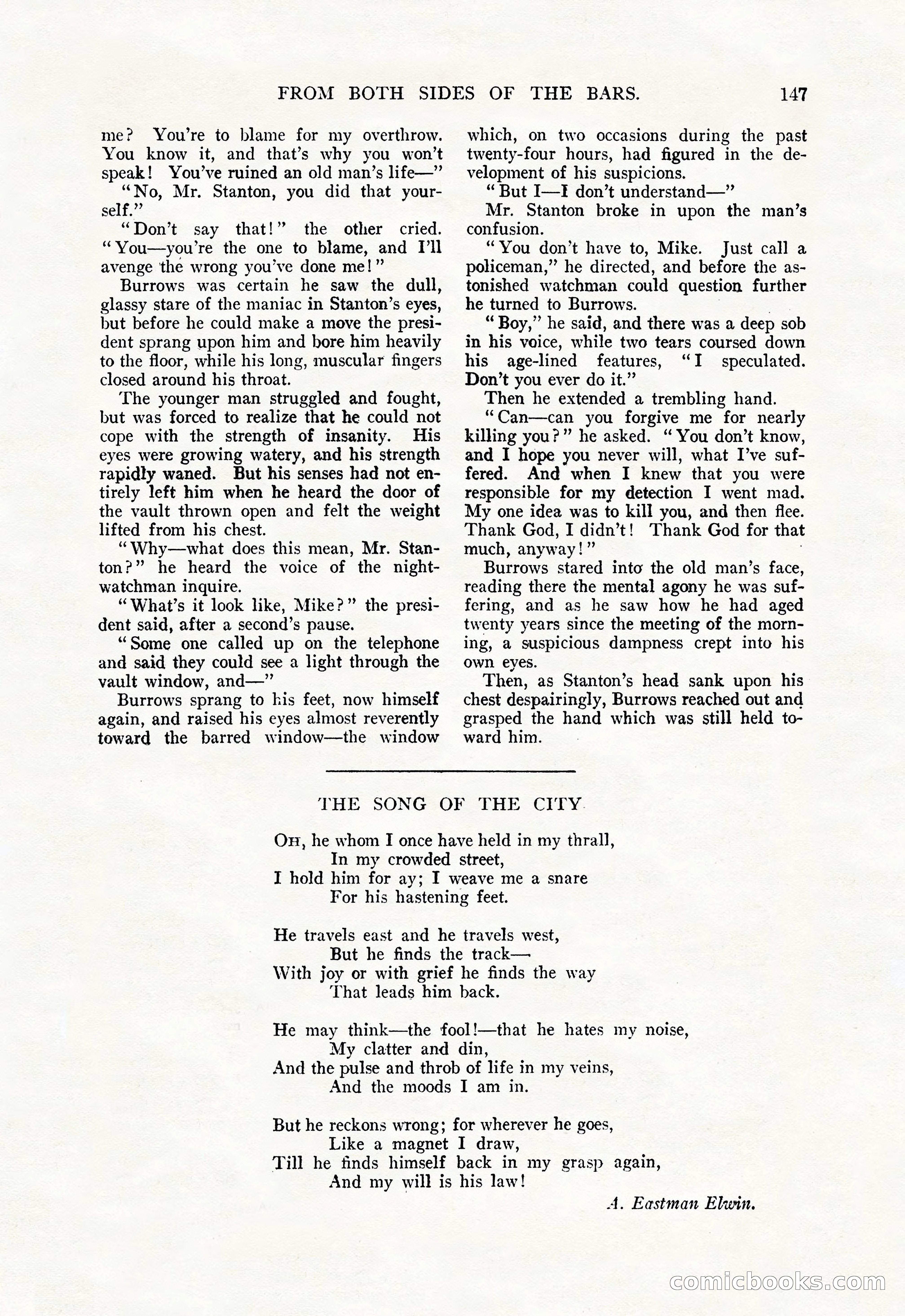
A restored page from Pulp Fiction, 1912. Page through the whole issue in the reader above.
📄 Transcribed text from this page (OCR, searchable)
Machine-transcribed from the original scan — historical spelling and the odd misread are preserved.
FROM BOTH SIDES OF THE BARS. me? You're to blame for my overthrow. You know it, and that’s why you won’t speak! You’ve ruined an old man’s life—” “No, Mr. Stanton, you did that your- self.” “Don’t say that!” the other cried. ‘“You—you’re the one to blame, and Pll avenge the wrong you’ve done me!” Burrows was certain he saw the dull, glassy stare of the maniac in Stanton’s eyes, but before he could make a move the presi- dent sprang upon him and bore him heavily to the floor, while his long, muscular fingers closed around his throat. The younger man struggled and fought, but was forced to realize that he could not cope with the strength of insanity. His eyes were growing watery, and his strength rapidly waned. But his senses had not en- tirely left him when he heard the door of the vault thrown open and felt the weight lifted from his chest. ‘“Why—what does this mean, Mr. Stan- ton?” he heard the voice of the night- watchman inquire. “What’s it look like, Mike?” the presi- dent said, after a second’s pause. “Some one called up on the telephone and said they could see a light through the vault window, and—”’ Burrows sprang to his feet, now himself again, and raised his eyes almost reverently toward the barred window—the window 147 which, on two occasions during the past twenty-four hours, had figured in the de- velopment of his suspicions. “But I—I don’t understand—” Mr. Stanton broke in upon the man’s confusion. “You don’t have to, Mike. Just call a policeman,” he directed, and before the as- tonished watchman could question further he turned to Burrows. | oe “Boy,” he said, and there was a deep sob in his voice, while two tears coursed down his age-lined features, “I speculated. Don’t you ever do it.” Then he extended a trembling hand. ““Can—can you forgive me for nearly killing you?” he asked. “ You don’t know, and I hope you never will, what I’ve suf- fered. And when I knew that you were responsible for my detection I went mad. My one idea was to kill you, and then flee. Thank God, I didn’t! Thank God for that much, anyway!” Burrows stared into the old man’s face, reading there the mental agony he was suf- fering, and as he saw how he had aged twenty years since the meeting of the morn- ing, a suspicious dampness crept into his own eyes. Then, as Stanton’s head sank upon his chest despairingly, Burrows reached out and grasped the hand which was still held to- ward him. SONG OF THE CITY. On, he whom I once have held in my thrall, In my crowded street, I hold him for ay; I weave me a snare For his hastening feet. He travels east and he travels west, But he finds the track— With joy or with grief he finds the way That leads him back. He may think—the fool!—that he hates my noise, My clatter and din, And the pulse and throb of life in my veins, And the moods I am in. But he reckons wrong; for wherever he goes, Like a magnet I draw, Till he finds himself back in my grasp again, And my will is his law! A. Eastman Elwin. (CO NOOLK CO