
Pulp Fiction, 1912 · page 158 of 238
The Argosy, April 1912 — page 158: what you’re looking at
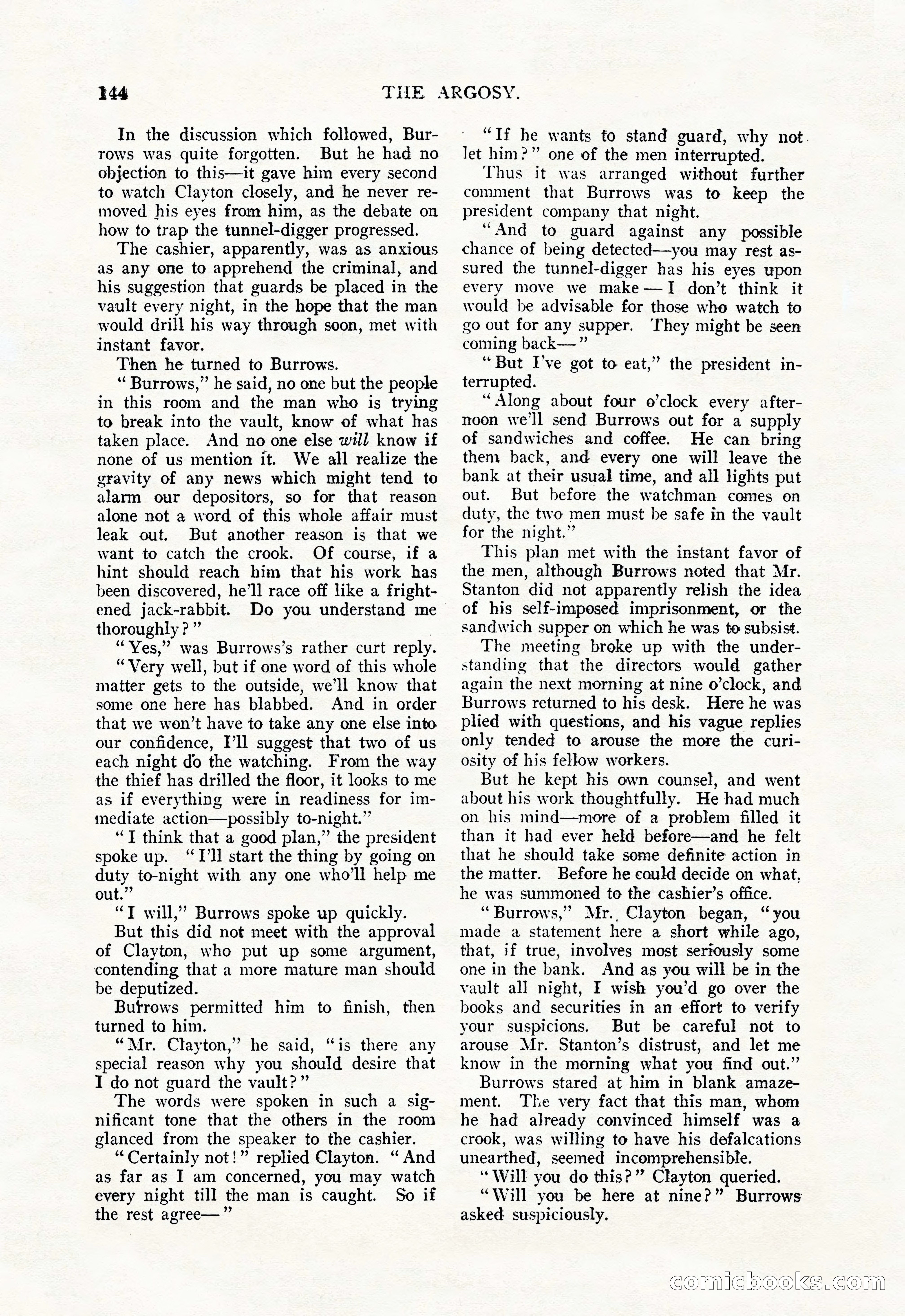
A restored page from Pulp Fiction, 1912. Page through the whole issue in the reader above.
📄 Transcribed text from this page (OCR, searchable)
Machine-transcribed from the original scan — historical spelling and the odd misread are preserved.
144 In the discussion which followed, Bur- rows was quite forgotten. But he had no objection to this—it gave him every second to watch Clayton closely, and he never re- moved his eyes from him, as the debate on how to trap the tunnel-digger progressed. The cashier, apparently, was as anxious as any one to apprehend the criminal, and his suggestion that guards be placed in the vault every night, in the hope that the man would drill his way through soon, met with instant favor. Then he turned to Burrows. ‘“‘ Burrows,” he said, no one but the people in this room and the man who is trying to break into the vault, know of what has taken place. And no one else will know if none of us mention it. We all realize the gravity of any news which might tend to alarm our depositors, so for that reason alone not a word of this whole affair must leak out. But another reason is that we want to catch the crook. Of course, if a hint should reach him that his work has been discovered, he’ll race off like a fright- ened jack-rabbit. Do you understand me thoroughly ? ” “Yes,” was Burrows’s rather curt reply. “Very well, but if one word of this whole matter gets to the outside, we’ll know that some one here has blabbed. And in order that we won’t have to take any one else into our confidence, I’ll suggest that two of us each night do the watching. From the way the thief has drilled the floor, it looks to me as if everything were in readiness for im- mediate action—possibly to-night.”’ ‘“T think that a good plan,” the president spoke up. “I'll start the thing by going on duty to-night with any one who'll help me out.” “T will,” Burrows spoke up quickly. But this did not meet with the approval of Clayton, who put up some argument, contending that a more mature man should be deputized. Butrows permitted him to finish, turned to him. “Mr. Clayton,” he said, “is there any special reason why you should desire that I do not guard the vault?” The words were spoken in such a sig- nificant tone that the others in the room glanced from the speaker to the cashier. “Certainly not!” replied Clayton. “ And as far as I am concerned, you may watch every night till the man is caught. So if the rest agree— ” then THE ARGOSY. “If he wants to stand guard, why not. let him?” one of the men interrupted. Thus it was arranged without further comment that Burrows was to keep the president company that night. “And to guard against any possible chance of being detected—you may rest as- sured the tunnel-digger has his eyes upon every move we make — I don’t think it would be advisable for those whe watch to go out for any supper. They might be seen coming back—” “But I’ve got to eat,” the president in- terrupted. “Along about four o’clock every after- noon we'll send Burrows out for a supply of sandwiches and coffee. He can bring them back, and every one will leave the bank at their usual time, and all lights put out. But before the watchman comes on duty, the two men must be safe in the vault for the night.” This plan met with the instant favor of the men, although Burrows noted that Mr. Stanton did not apparently relish the idea of his self-imposed imprisonment, or the sandwich supper on which he was te subsist. The meeting broke up with the under- standing that “the directors would gather again the next morning at nine o'clock, and Burrows returned to his desk. Here he was plied with questions, and his vague replies only tended to arouse the more the curi- osity of his fellow workers. But he kept his own counsel, and went about his work thoughtfully. He had much on his mind—more of a problem filled it than it had ever held before—and he felt that he should take some definite action in the matter. Before he could decide on what. he was summoned te the cashier’s office. ‘Burrows,’ Mr. Clayton began, “you made a statement here a short while ago, that, if true, involves most sertously some one in the bank. And as you will be in the vault all night, I wish you’d go over the books and securities in an effort to verify your suspicions. But be careful not to arouse Mr. Stanton’s distrust, and let me know in the morning what you find out.” Burrows stared at him in blank amaze- ment. The very fact that this man, whom he had already convinced himself was @ crook, was willing to have his defalcations unearthed, seemed incomprehensible. “Will you do this?” Clayton queried. “Will you be here at nine?” Burrows asked suspiciously. GO JOO) SS