
Pulp Fiction, 1909 · page 106 of 266
The Argosy, Vol. 61, No. 4 — page 106: what you’re looking at
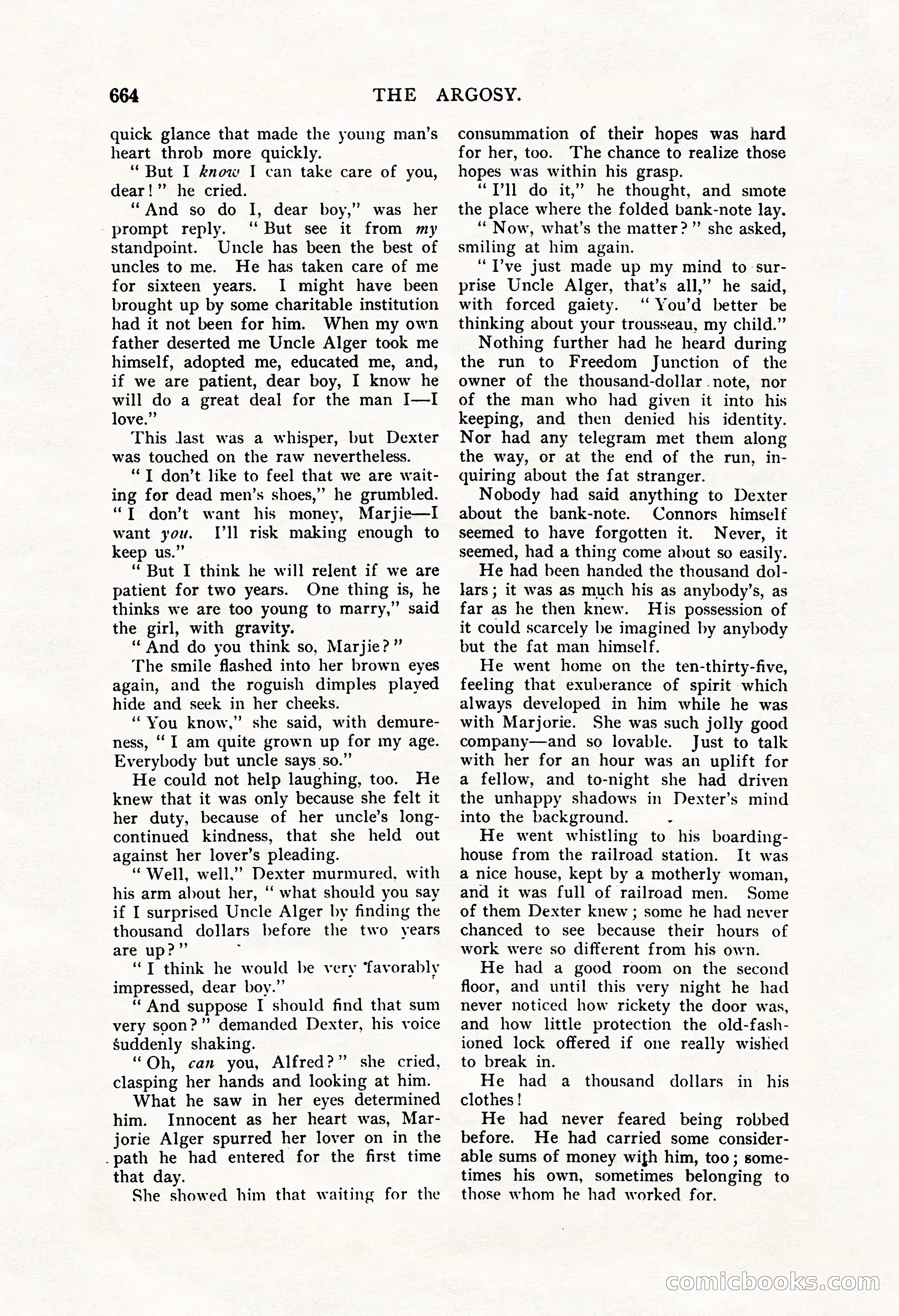
A restored page from Pulp Fiction, 1909. Page through the whole issue in the reader above.
📄 Transcribed text from this page (OCR, searchable)
Machine-transcribed from the original scan — historical spelling and the odd misread are preserved.
664 quick glance that made the young man’s heart throb more quickly. “ But I know I can take care of you, dear!” he cried. ‘And so do I, dear boy,” was her prompt reply. “ But see it from my standpoint. Uncle has been the best of uncles to me. He has taken care of me for sixteen years. I might have been brought up by some charitable institution had it not been for him. When my own father deserted me Uncle Alger took me himself, adopted me, educated me, and, if we are patient, dear boy, I know he will do a great deal for the man I—I love.” This last was a whisper, but Dexter was touched on the raw nevertheless. ‘TI don’t like to feel that we are wait- ing for dead men’s shoes,” he grumbled. “T don’t want his money, Marjie—I want you. I'll risk making enough to keep us.”’ “ But I think he will relent if we are patient for two years. One thing is, he thinks we are too young to marry,” said the girl, with gravity. ‘And do you think so, Marjie?” The smile flashed into her brown eyes again, and the roguish dimples played hide and seek in her cheeks. “You know,” she said, with demure- ness, “I am quite grown up for my age. Everybody but uncle says so.”’ He could not help laughing, too. He knew that it was only because she felt it her duty, because of her uncle’s long- continued kindness, that she held out against her lover’s pleading. ‘Well, well,” Dexter murmured, with his arm about her, ‘“‘ what should you say if I surprised Uncle Alger by finding the thousand dollars before the two years are up?” : “T think he would be very ‘favorably impressed, dear boy.” “And suppose I should find that sum very soon?’’ demanded Dexter, his voice Suddenly shaking. “Oh, can you, Alfred?” she cried, clasping her hands and looking at him. What he saw in her eyes determined him. Innocent as her heart was, Mar- jorie Alger spurred her lover on in the _path he had entered for the first time that day. She showed him that waiting for the THE ARGOSY. consummation of their hopes was hard for her, too. The chance to realize those hopes was within his grasp. “Tl do it,” he thought, and smote the place where the folded bank-note lay. ‘“’ Now, what’s the matter?” she asked, smiling at him again. ‘““Tve just made up my mind to sur- prise Uncle Alger, that’s all,’ he said, with forced gaiety. ‘‘ You’d better be thinking about your trousseau, my child.” Nothing further had he heard during the run to Freedom Junction of the owner of the thousand-dollar note, nor of the man who had given it into his keeping, and then denied his identity. Nor had any telegram met them along the way, or at the end of the run, in- quiring about the fat stranger. Nobody had said anything to Dexter about the bank-note. Connors himself seemed to have forgotten it. Never, it seemed, had a thing come about so easily. He had been handed the thousand dol- lars; it was as much his as anybody’s, as far as he then knew. His possession of it could scarcely be imagined by anybody but the fat man himself. He went home on the ten-thirty-five, feeling that exuberance of spirit which always developed in him while he was with Marjorie. She was such jolly good company—and so lovable. Just to talk with her for an hour was an uplift for a fellow, and to-night she had driven the unhappy shadows in Dexter’s mind into the background. : He went whistling to his boarding- house from the railroad station. It was a nice house, kept by a motherly woman, and it was full of railroad men. Some of them Dexter knew ; some he had never chanced to see because their hours of work were so different from his own. He had a good room on the second floor, and until this very night he had never noticed how rickety the door was, and how little protection the old-fash- ioned lock offered if one really wished to break in. He had a thousand dollars clothes! He had never feared being robbed before. He had carried some consider- able sums of money with him, too; some- times his own, sometimes belonging to those whom he had worked for. in his CO OO