
Pulp Fiction, 1909 · page 105 of 266
The Argosy, Vol. 61, No. 4 — page 105: what you’re looking at
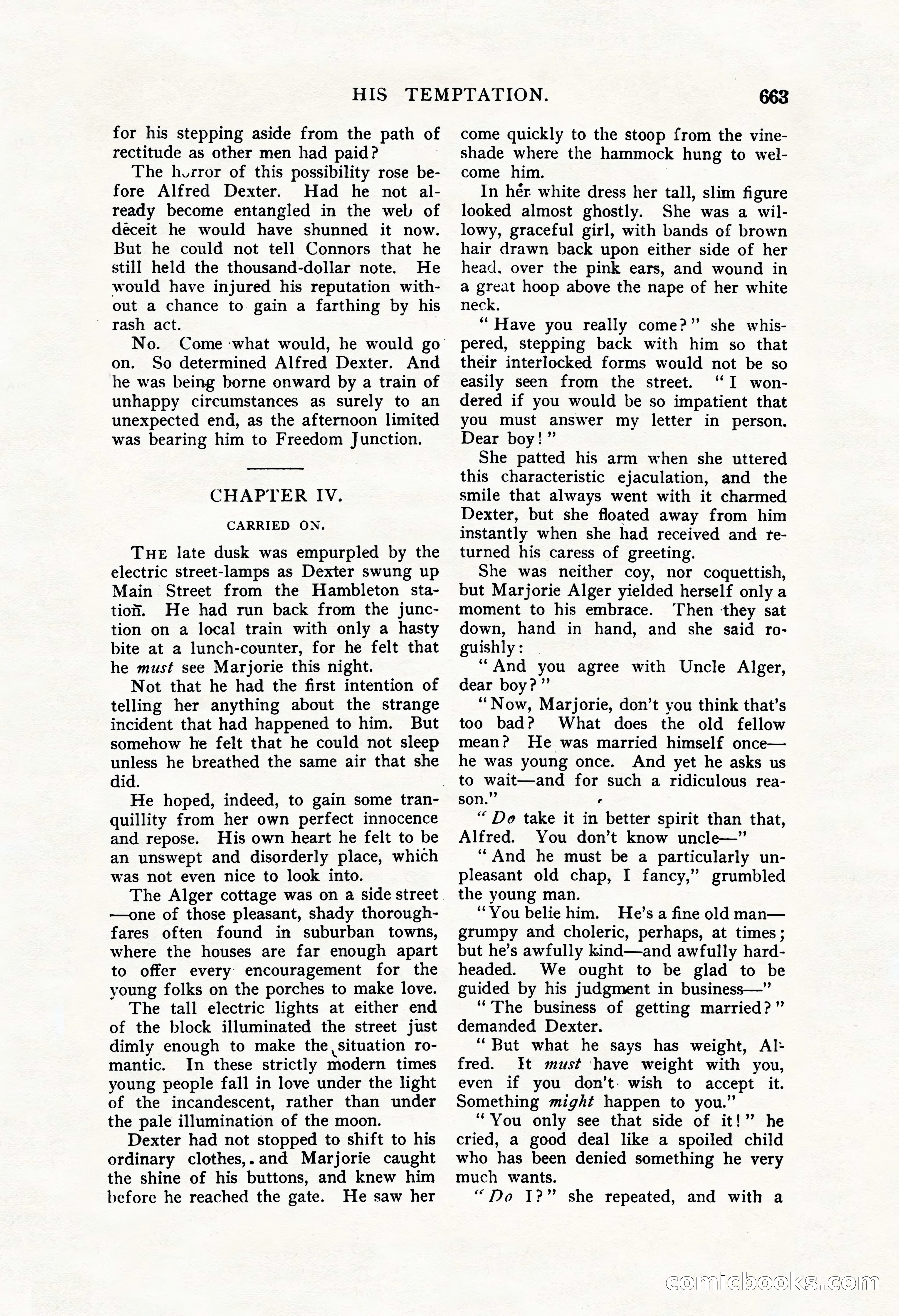
A restored page from Pulp Fiction, 1909. Page through the whole issue in the reader above.
📄 Transcribed text from this page (OCR, searchable)
Machine-transcribed from the original scan — historical spelling and the odd misread are preserved.
HIS TEMPTATION. for his stepping aside from the path of rectitude as other men had paid? The hurror of this possibility rose be- fore Alfred Dexter. Had he not al- ready become entangled in the web of deceit he would have shunned it now. But he could not tell Connors that he still held the thousand-dollar note. He would have injured his reputation with- out a chance to gain a farthing by his ~ rash act. Come ‘what would, he would go No. on. So determined Alfred Dexter. And he was being borne onward by a train of unhappy circumstances as surely to an unexpected end, as the afternoon limited was bearing him to Freedom Junction. CHAPTER IV. CARRIED ON. THE late dusk was empurpled by the electric street-lamps as Dexter swung up Main Street from the Hambleton sta- tion. He had run back from the junc- tion on a local train with only a hasty bite at a lunch-counter, for he felt that he must see Marjorie this night. Not that he had the first intention of telling her anything about the strange incident that had happened to him. But somehow he felt that he could not sleep unless he breathed the same air that she did. He hoped, indeed, to gain some tran- quillity from her own perfect innocence and repose. His own heart he felt to be an unswept and disorderly place, which was not even nice to look into. The Alger cottage was on a side street. —one of those pleasant, shady thorough- fares often found in suburban towns, where the houses are far enough apart to offer every: encouragement for the young folks on the porches to make love. The tall electric lights at either end of the block illuminated the street just dimly enough to make the situation ro- mantic. In these strictly modern times young people fall in love under the light of the incandescent, rather than under the pale illumination of the moon. Dexter had not stopped to shift to his ordinary clothes,.and Marjorie caught the shine of his buttons, and knew him before he reached the gate. He saw her 663 come quickly to the stoop from the vine- shade where the hammock hung to wel- come him. In her white dress her tall, slim figure looked almost ghostly. She was a wil- lowy, graceful girl, with bands of brown hair drawn back upon either side of her head, over the pink ears, and wound in a great hoop above the nape of her white neck. “Have you really come?” she whis- pered, stepping back with him so that their interlocked forms would not be so easily seen from the street. ‘I won- dered if you would be so impatient that you must answer my letter in person. Dear boy!” She patted his arm when she uttered this characteristic ejaculation, and the smile that always went with it charmed Dexter, but she floated away from him instantly when she had received and re- turned his caress of greeting. She was neither coy, nor coquettish, but Marjorie Alger yielded herself only a moment to his embrace. Then they sat down, hand in hand, and she said ro- guishly: | ‘And you agree with Uncle Alger, dear boy?” “Now, Marjorie, don’t you think that’s too bad? What does the old fellow mean? He was married himself once— he was young once. And yet he asks us _ to wait—and for such a ridiculous rea- son.” ¢ “Do take it in better spirit than that, Alfred. You don’t know uncle—” “And he must be a particularly un- pleasant old chap, I fancy,” grumbled the young man. “You belie him. He’s a fine old man— grumpy and choleric, perhaps, at times; but he’s awfully kind—and awfully hard- headed. We ought to be glad to be guided by his judgment in business—”’ ‘The business of getting married?” demanded Dexter. “But what he says has weight, AI: fred. It must have weight with you, even if you don’t- wish to accept it. Something might happen to you.” “You only see that side of it!” he cried, a good deal like a spoiled child who has been denied something he very much wants. “Do 1?” she repeated, and with a Gioo (©