
Pulp Fiction, 1909 · page 107 of 266
The Argosy, Vol. 61, No. 4 — page 107: what you’re looking at
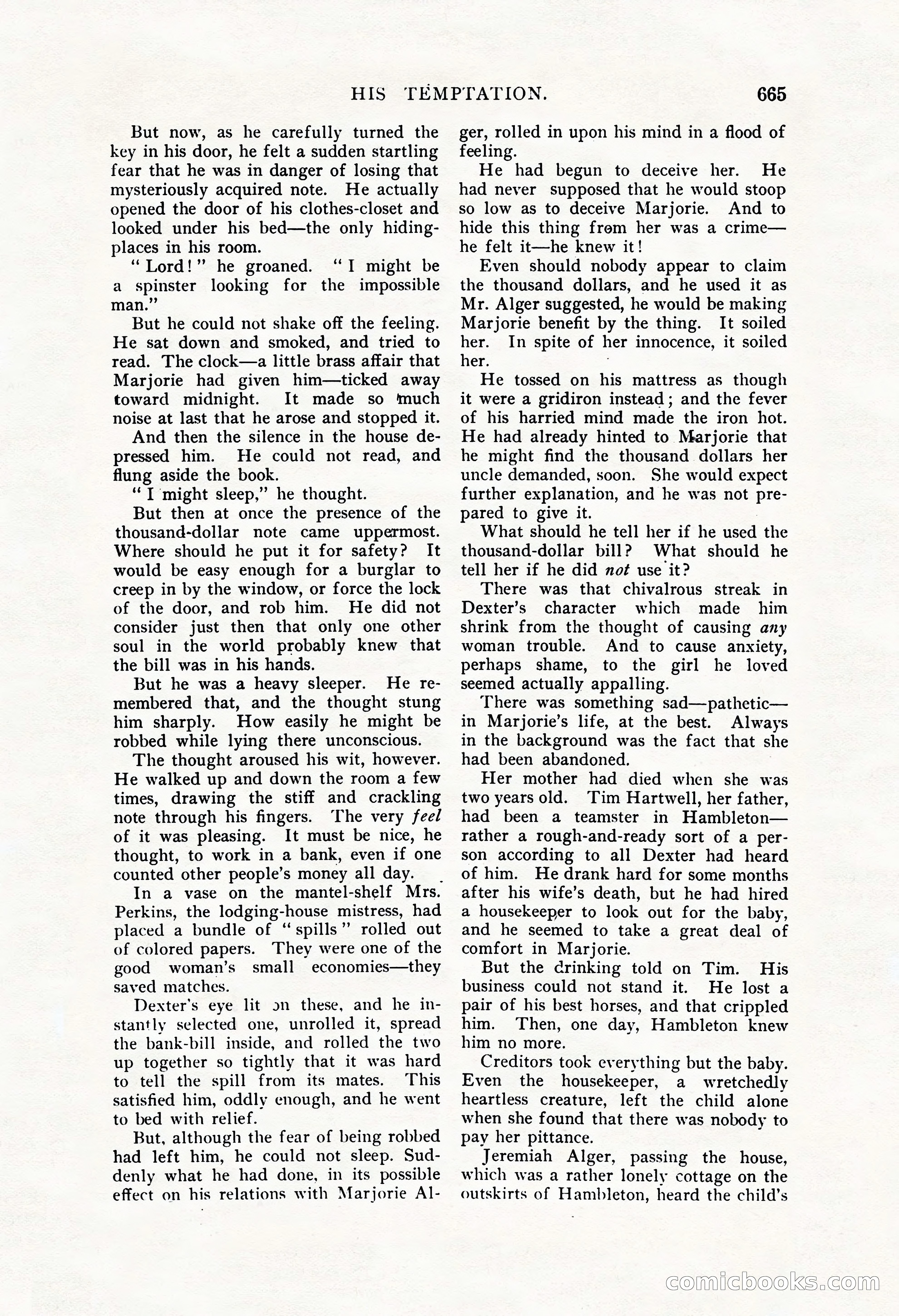
A restored page from Pulp Fiction, 1909. Page through the whole issue in the reader above.
📄 Transcribed text from this page (OCR, searchable)
Machine-transcribed from the original scan — historical spelling and the odd misread are preserved.
HIS TEMPTATION. But now, as he carefully turned the key in his door, he felt a sudden startling fear that he was in danger of losing that mysteriously acquired note. He actually opened the door of his clothes-closet and looked under his bed—the only hiding- places in his room. ‘“Lord!” he groaned. “I might be a spinster looking for the impossible man.” But he could not shake off the feeling. He sat down and smoked, and tried to read. The clock—a little brass affair that Marjorie had given him—ticked away toward midnight. It made so much noise at last that he arose and stopped it. And then the silence in the house de- pressed him. He could not read, and flung aside the book. ‘TI might sleep,” he thought. But then at once the presence of the thousand-dollar note came uppermost. Where should he put it for safety? It would be easy enough for a burglar to creep in by the window, or force the lock of the door, and rob him. He did not consider just then that only one other soul in the world probably knew that the bill was in his hands. But he was a heavy sleeper. He re- membered that, and the thought stung him sharply. How easily he might be robbed while lying there unconscious. The thought aroused his wit, however. He walked up and down the room a few times, drawing the stiff and crackling note through his fingers. The very feel of it was pleasing. It must be nice, he thought, to work in a bank, even if one counted other people’s money all day. In a vase on the mantel-shelf Mrs. Perkins, the lodging-house mistress, had placed a bundle of “spills” rolled out of colored papers. They were one of the good woman’s small economies—they saved matches. Dexter's eye lit on these, and he in- stantly selected one, unrolled it, spread the bank-bill inside, and rolled the two up together so tightly that it was hard to tell the spill from its mates. This satisfied him, oddly enough, and he went to bed with relief. But, although the fear of being robbed had left him, he could not sleep. Sud- denly what he had done, in its possible effect on his relations with Marjorie Al- 665 ger, rolled in upon his mind in a flood of feeling. He had begun to deceive her. He had never supposed that he would stoop so low as to deceive Marjorie. And to hide this thing frem her was a crime— he felt it—he knew it! Even should nobody appear to claim the thousand dollars, and he used it as Mr. Alger suggested, he would be making Marjorie benefit by the thing. It soiled her. In spite of her innocence, it soiled her. He tossed on his mattress as though it were a gridiron instead ; and the fever of his harried mind made the iron hot. He had already hinted to Marjorie that he might find the thousand dollars her uncle demanded, soon. She would expect further explanation, and he was not pre- pared to give it. What should he tell her if he used the thousand-dollar bill? What should he tell her if he did not use it? There was that chivalrous streak in Dexter’s character which made him shrink from the thought of causing any woman trouble. And to cause anxiety, perhaps shame, to the girl he loved seemed actually appalling. There was something sad—pathetic— in Marjorie’s life, at the best. Always in the background was the fact that she had been abandoned. Fler mother had died when she was two years old. Tim Hartwell, her father, had been a teamster in Hambleton— rather a rough-and-ready sort of a per- son according to all Dexter had heard of him. He drank hard for some months after his wife’s death, but he had hired a housekeeper to look out for the baby, and he seemed to take a great deal of comfort in Marjorie. But the crinking told on Tim. His business could not stand it. He lost a pair of his best horses, and that crippled him. Then, one day, Hambleton knew him no more. Creditors took everything but the baby. Even the housekeeper, a wretchedly heartless creature, left the child alone when she found that there was nobody to pay her pittance. Jeremiah Alger, passing the house, which was a rather lonely cottage on the outskirts of Hambleton, heard the child’s EO OO (Cc