
Pulp Fiction, 1909 · page 104 of 266
The Argosy, Vol. 61, No. 4 — page 104: what you’re looking at
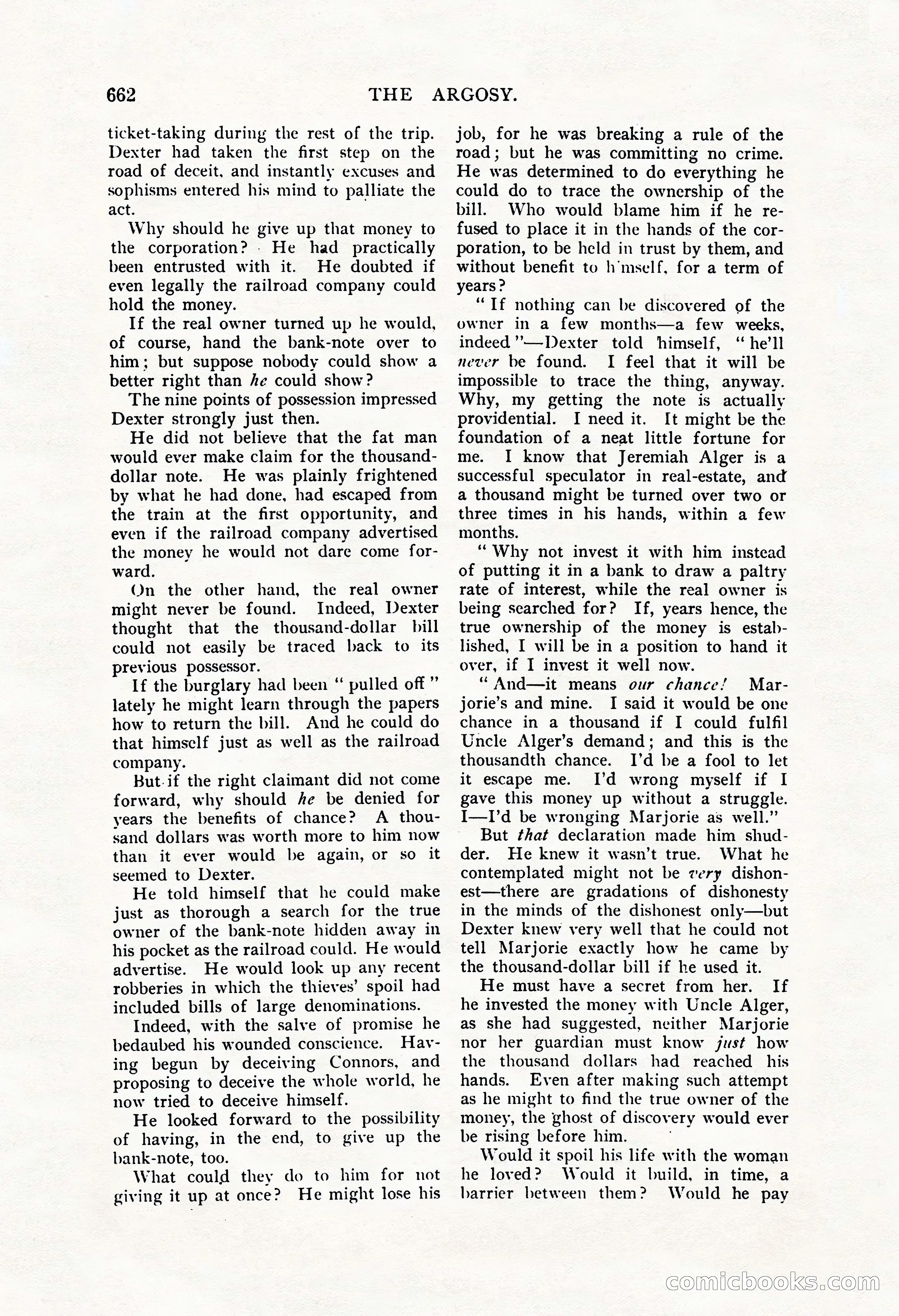
A restored page from Pulp Fiction, 1909. Page through the whole issue in the reader above.
📄 Transcribed text from this page (OCR, searchable)
Machine-transcribed from the original scan — historical spelling and the odd misread are preserved.
662 ticket-taking during the rest of the trip. Dexter had taken the first step on the road of deceit, and instantly excuses and sophisms entered his mind to palliate the act. Why should he give up that money to the corporation? . He had practically been entrusted with it. He doubted if even legally the railroad company could hold the money. If the real owner turned up he would, of course, hand the bank-note over to him; but suppose nobody could show a better right than Ae could show? The nine points of possession impressed Dexter strongly just then. He did not believe that the fat man would ever make claim for the thousand- dollar note. He was plainly frightened by what he had done, had escaped from the train at the first opportunity, and even if the railroad company advertised the money he would not dare come for- ward. Qn the other hand, the real owner might never be found. Indeed, Dexter thought that the thousand-dollar bill could not easily be traced back to its previous possessor. If the burglary had been “ pulled off” lately he might learn through the papers how to return the bill. And he could do that himself just as well as the railroad company. But.if the right claimant did not come forward, why should ke be denied for years the benefits of chance? A _ thou- sand dollars was worth more to him now than it ever would be again, or so it seemed to Dexter. He told himself that he could make just as thorough a search for the true owner of the bank-note hidden away in his pocket as the railroad could. He would advertise. He would look up any recent robberies in which the thieves’ spoil had included bills of large denominations. Indeed, with the salve of promise he bedaubed his wounded conscience. Hav- ing begun by deceiving Connors, and proposing to deceive the whole world, he now tried to deceive himself. He looked forward to the possibility of having, in the end, to give up the bank-note, too. What could they do to him for not giving it up at once? He might lose his THE ARGOSY. job, for he was breaking a rule of the road; but he was committing no crime. He was determined to do everything he could do to trace the ownership of the bill. Who would blame him if he re- fused to place it in the hands of the cor- poration, to be held in trust by them, and without benefit to h'mself, for a term of years? “If nothing can be discovered of the owner in a few months—a few weeks, indeed ’’—Dexter told ‘himself, ‘ he’ll never be found. I feel that it will be impossible to trace the thing, anyway. Why, my getting the note is actually providential. I need it. It might be the foundation of a neat little fortune for me. I know that Jeremiah Alger is a successful speculator in real-estate, and a thousand might be turned over two or three times in his hands, within a few months. “Why not invest it with him instead of putting it in a bank to draw a paltry rate of interest, while the real owner is being searched for? If, years hence, the true ownership of the money is estab- lished, I will be in a position to hand it over, if I invest it well now. “ And—it means our chance! Mar- jorie’s and mine. I said it would be one chance in a thousand if I could fulfil Uncle Alger’s demand; and this is the thousandth chance. I’d be a fool to let it escape me. I’d wrong myself if I gave this money up without a struggle. I—I’d be wronging Marjorie as well.” But ¢hat declaration made him shud- der. He knew it wasn’t true. What he contemplated might not be very dishon- est—there are gradations of dishonesty in the minds of the dishonest only—but Dexter knew very well that he could not tell Marjorie exactly how he came by the thousand-dollar bill if he used it. He must have a secret from her. If he invested the money with Uncle Alger, as she had suggested, neither Marjorie nor her guardian must know just how the thousand dollars had reached his hands. Even after making such attempt as he might to find the true owner of the money, the ghost of discovery would ever be rising before him. Would it spoil his life with the woman he loved? Would it build, in time, a barrier between them? Would he pay JOO (©