
Pulp Fiction, 1928 · page 110 of 152
Argosy All-Story Weekly, April 14, 1928 — page 110: what you’re looking at
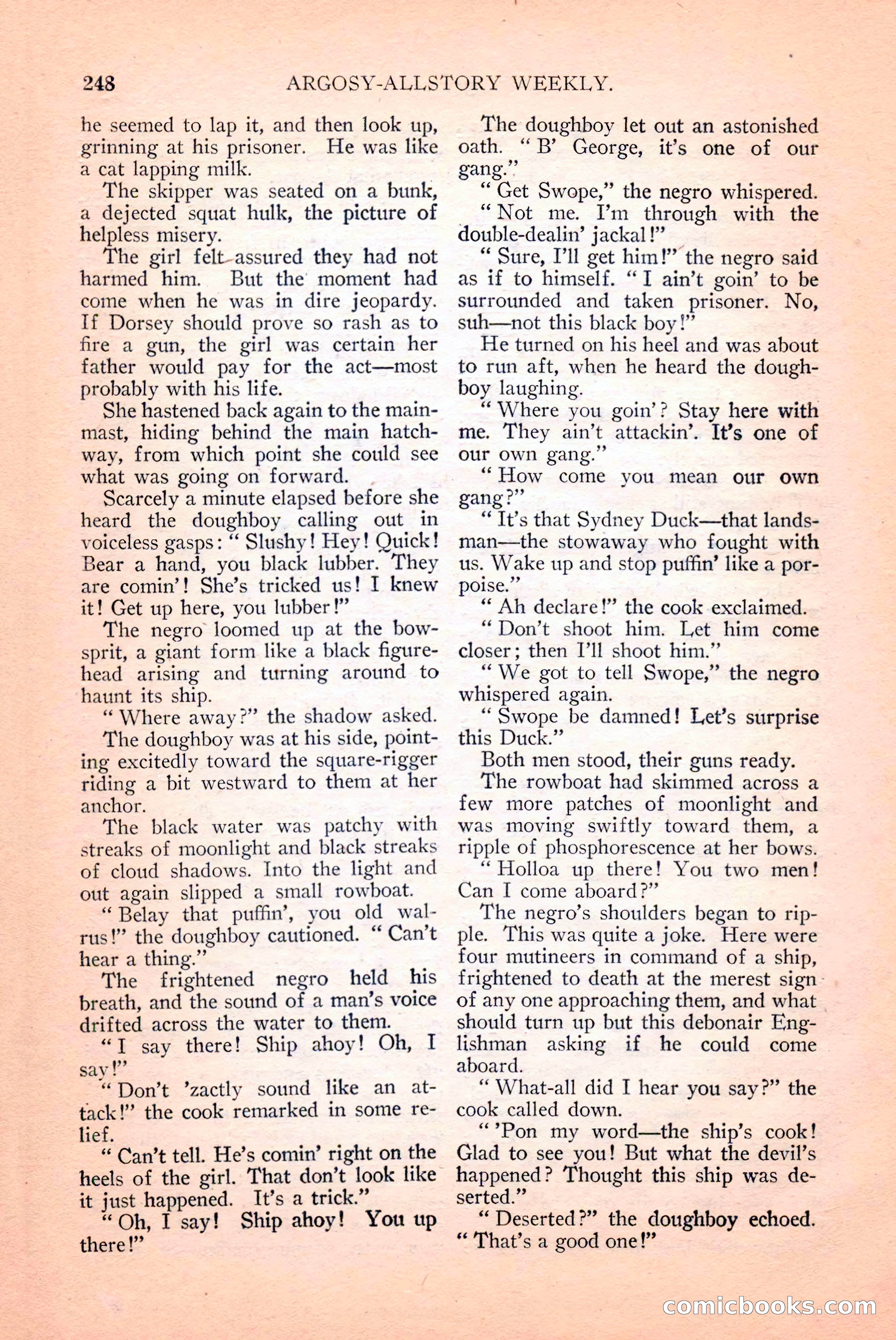
A restored page from Pulp Fiction, 1928. Page through the whole issue in the reader above.
📄 Transcribed text from this page (OCR, searchable)
Machine-transcribed from the original scan — historical spelling and the odd misread are preserved.
248 he seemed to lap it, and then look up, grinning at his prisoner. He was like a cat lapping milk. | The skipper was seated on a bunk, a dejected squat hulk, the picture of helpless misery. The girl felt-assured they had not harmed him. But the moment had come when he was in dire jeopardy. If Dorsey should prove so rash as to fire a gun, the girl was certain her father would pay for the act—most probably with his life. She hastened back again to the main- mast, hiding behind the main hatch- way, from which point she could see what was going on forward. Scarcely a minute elapsed before she heard the doughboy calling out in voiceless gasps: “‘ Slushy! Hey! Quick! Bear a hand, you black lubber. They are comin’! She’s tricked us! I knew it! Get up here, you lubber !” The negro loomed up at the bow- sprit, a giant form like a black figure- head arising and turning around to haunt its ship. “ Where away?” the shadow asked. The doughboy was at his side, point- ing excitedly toward the square-rigger riding a bit westward to them at her anchor. The black water was patchy with streaks of moonlight and black streaks of cloud shadows. Into the light and out again slipped a small rowboat. “Belay that puffin’, you old wal- rus!” the doughboy cautioned. “ Can’t hear a thing.” The frightened negro held his breath, and the sound of a man’s voice drifted across the water to them. “T say there! Ship ahoy! Oh, I say!” “Don’t ’zactly sound like an at- tack!” the cook remarked in some re- lief. “ Can’t tell. He’s comin’ right on the heels of the girl. That don’t look like it just happened. It’s a trick.” “Oh, I say! Ship ahoy! You up there!” ARGOSY-ALLSTORY WEEKLY. The doughboy let out an astonished oath. “B’ George, it’s one of our gang.” “Get Swope,” the negro whispered. “Not me. I’m through with the double-dealin’ jackal !” “Sure, I'll get him!” the negro said as if to himself. “I ain’t goin’ to be surrounded and taken prisoner. No, suh—not this black boy!” He turned on his heel and was about to run aft, when he heard the dough- boy laughing. “Where you goin’? Stay here with me. They ain’t attackin’. It’s one of our own gang.” “How come you mean our own gang?” “ It’s that Sydney Duck—that lands- man—the stowaway who fought with us. Wake up and stop puffin’ like a por- poise.”’ “Ah declare!” the cook exclaimed. “Don’t shoot him. Let him come closer; then I’ll shoot him.” “We got to tell Swope,” the negro whispered again. “Swope be damned! Let’s surprise this Duck.” Both men stood, their guns ready. The rowboat had skimmed across a few more patches of moonlight and was moving swiftly toward them, a ripple of phosphorescence at her bows. “Holloa up there! You two men! Can I come aboard?” The negro’s shoulders began to rip- ple. This was quite a joke. Here were four mutineers in command of a ship, frightened to death at the merest sign > of any one approaching them, and what should turn up but this debonair E'ng- lishman asking if he could come aboard. “ What-all did I hear you say?” the cook called down. “*Pon my word—the ship’s cook! Glad to see you! But what the devil’s happened? Thought this ship was de- serted.” “Deserted?” the doughboy echoed. “ That’s a good one!” (e(0) vOoOK (E@)