
Pulp Fiction, 1928 · page 111 of 152
Argosy All-Story Weekly, April 14, 1928 — page 111: what you’re looking at
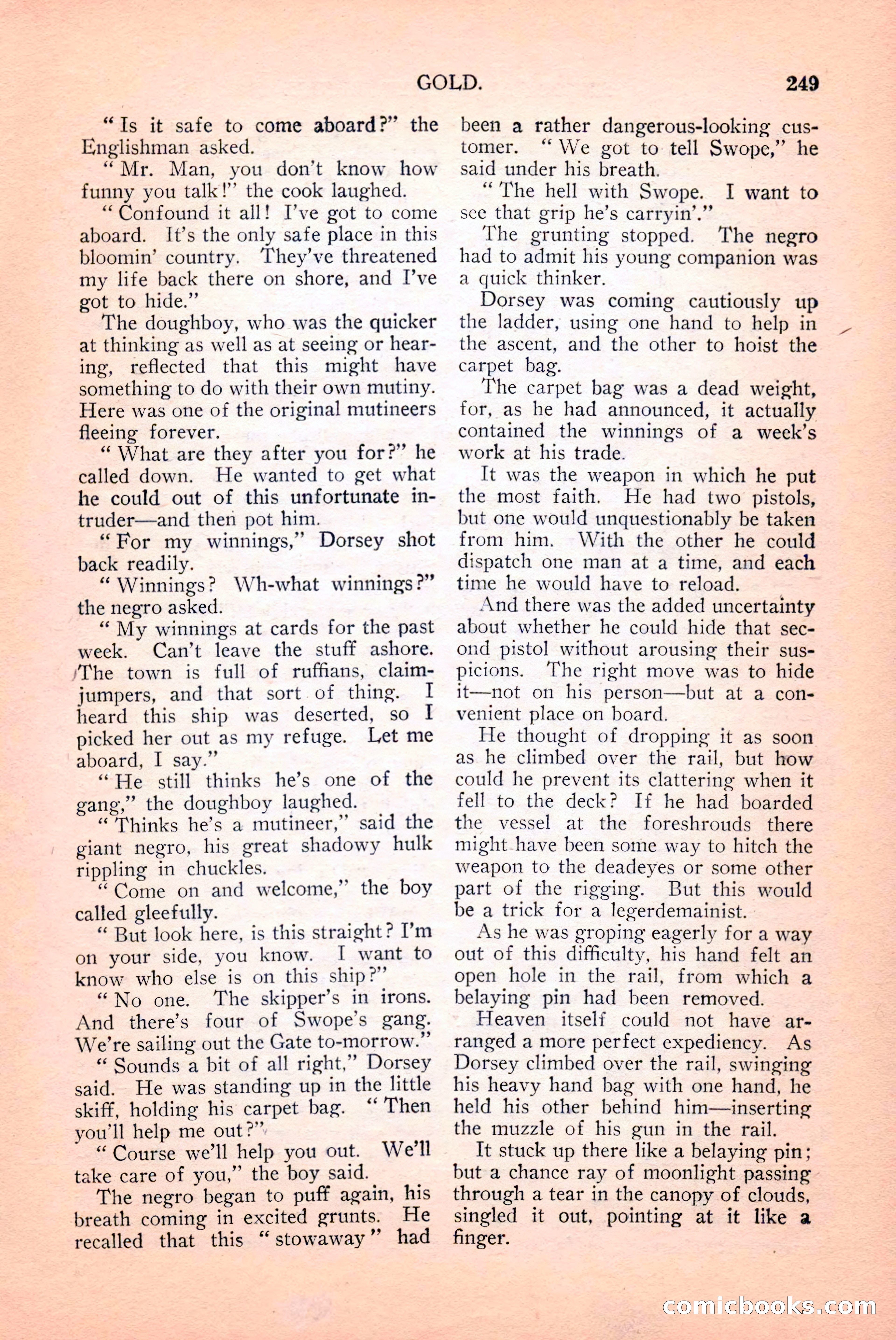
A restored page from Pulp Fiction, 1928. Page through the whole issue in the reader above.
📄 Transcribed text from this page (OCR, searchable)
Machine-transcribed from the original scan — historical spelling and the odd misread are preserved.
GOLD. “Ts it safe to come aboard?” the Englishman asked. “Mr. Man, you don’t know how funny you talk!” the cook laughed. “ Confound it all! I’ve got to come aboard. It’s the only safe place in this bloomin’ country. They’ve threatened my life back there on shore, and I’ve got to hide.” The doughboy, who was the quicker at thinking as well as at seeing or hear- ing, reflected that this might have something to do with their own mutiny. Here was one of the original mutineers fleeing forever. “ What are they after you for?” he called down. He wanted to get what he could out of this unfortunate in- truder—and then pot him. “For my winnings,’ Dorsey shot back readily. “ Winnings? Wh-what winnings?” the negro asked. “ My winnings at cards for the past week. Can’t leave the stuff ashore. ‘The town is full of ruffians, claim- jumpers, and that sort of thing. I heard this ship was deserted, so I picked her out as my refuge. Let me aboard, I say.” “He still thinks he’s one of the gang,” the doughboy laughed. “Thinks he’s a mutineer,” said the giant negro, his great shadowy hulk rippling in chuckles. “Come on and welcome,” the boy called gleefully. “ But look here, is this straight? I’m on your side, you know. I want to know who else is on this ship?” “No one. ‘The skipper’s in irons. And there’s four of Swope’s gang. We're sailing out the Gate to-morrow.” “ Sounds a bit of all right,’ Dorsey said. He was standing up in the little skiff, holding his carpet bag. “ Then you'll help me out?” “Course we'll help you out. We'll take care of you,” the boy said. 1 The negro began to puff again, his breath coming in excited grunts. He recalled that this “stowaway” had 249 been a rather dangerous-looking cus- tomer. ‘We got to tell Swope,” he said under his breath. “The hell with Swope. see that grip he’s carryin’.” The grunting stopped. The negro had to admit his young companion was a quick thinker. Dorsey was coming cautiously up the ladder, using one hand to help in the ascent, and the other to hoist the carpet bag. The carpet bag was a dead weight, for, as he had announced, it actually contained the winnings of a week’s work at his trade. It was the weapon in which he put the most faith. He had two pistols, but one would unquestionably be taken from him. With the other he could dispatch one man at a time, and each time he would have to reload. And there was the added uncertainty about whether he could hide that sec- ond pistol without arousing their sus- picions. The right move was to hide it—not on his person—but at a con- venient place on board. He thought of dropping it as soon as he climbed over the rail, but how could he prevent its clattering when it fell to the deck? If he had boarded the vessel at the foreshrouds there might have been some way to hitch the weapon to the deadeyes or some other part of the rigging. But this would be a trick for a legerdemainist. As he was groping eagerly for a way out of this difficulty, his hand felt an open hole in the rail, from which a belaying pin had been removed. Heaven itself could not have ar- ranged a more perfect expediency. As Dorsey climbed over the rail, swinging his heavy hand bag with one hand, he held his other behind him—inserting the muzzle of his gun in the rail. It stuck up there like a belaying pin; but a chance ray of moonlight passing through a tear in the canopy of clouds, singled it out, pointing at it like a finger. I want to EOPNICLOOOL< (E@)