
Pulp Fiction, 1928 · page 109 of 152
Argosy All-Story Weekly, April 14, 1928 — page 109: what you’re looking at
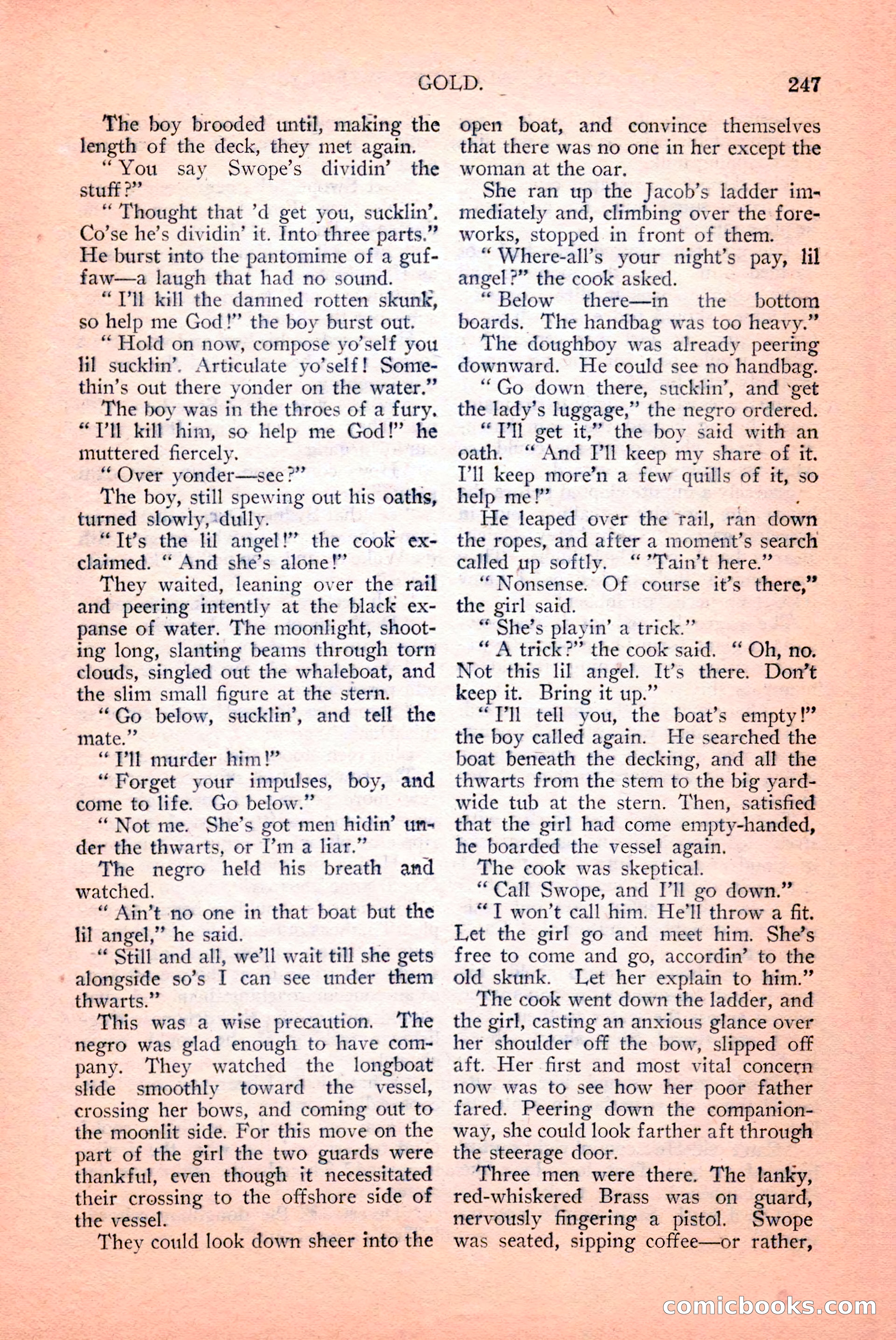
A restored page from Pulp Fiction, 1928. Page through the whole issue in the reader above.
📄 Transcribed text from this page (OCR, searchable)
Machine-transcribed from the original scan — historical spelling and the odd misread are preserved.
GOLD. _ The boy brooded until, making the length of the deck, they met again. “You say Swope’s dividin’ the stuff?” “Thought that ’d get you, sucklin’. Co’se he’s dividin’ it. Into three parts.” He burst into the pantomime of a guf- faw—a laugh that had no sound. “Til kill the dammed rotten skunk, so help me God!” the boy burst out. “Hold on now, compose yo’self you lil sucklin’. Articulate yo’self! Some- thin’s out there yonder on the water.” The boy was in the throes of a fury. “Tl kill him, so help me God!’ he muttered fiercely. “ Over yonder—see ?” The boy, still spewing out his oaths, turned slowly, *dully. “Tt’s the lil angel!” the cook ex- claimed. “ And she’s alone!” They waited, leaning over the rail and peering intently at the black ex- panse of water. The moonlight, shoot- ing long, slanting beams through torn clouds, singled out the whaleboat, and the slim small figure at the stern. ““Go below, sucklin’, and tell the ~ mate.” “Tt murder him “Forget your impulses, boy, and come to life. Go below.” “ Not me. She’s got men hidin’ un- der the thwarts, or I’m a liar.” : The negro held his breath and watched. “ Ain’t no one in that boat but the lil angel,” he said. “ Still and all, we'll wait till she gets ‘ alongside so’s I can see under them thwarts.” This was a wise precaution. The negro was glad enough to have com- pany. They watched the longboat slide smoothly toward the vessel, _ erossing her bows, and coming out to the moonlit side. For this move on the part of the girl the two guards were thankful, even though it necessitated their crossing to the offshore side of the vessel. They could look down sheer into the }?? 247 open boat, and convince themselves that there was no one in her except the woman at the oar. She ran up the Jacob’s ladder im- mediately and, climbing over the fore- works, stopped in front of them. “Where-all’s your night’s pay, lil angel?” the cook asked. “Below there—in the bottom boards. The handbag was too heavy.” The doughboy was already peering downward. He could see no handbag. “Go down there, sucklin’, and ‘get the lady’s luggage,” the negro ordered. “Tl get it,” the boy said with an oath. “ And I'll keep my share of it. Til keep more’n a few quills of it, so help me!” . i He leaped over the tail, ran down the ropes, and after a moment’s search called up softly. “’Tain’t here.” ‘“ Nonsense. Of course it’s there,” the girl said. * She’s playin’ a trick.” “ A trick?” the cook said. “ Oh, no. — Not this lil angel. It’s there. Don’t keep it. Bring it up.” “Tl tell you, the boat’s empty!” the boy called again. He searched the boat beneath the decking, and all the thwarts from the stem to the big yard- wide tub at the stern. Then, satisfied that the girl had come empty-handed, he boarded the vessel again. The cook was skeptical. “Call Swope, and I’ll go down.” - “T won’t call him. He'll throw a fit. Let the girl go and meet him. She’s free to come and go, accordin’ to the old skunk. Let her explain to him.” The cook went down the ladder, and the girl, casting an anxious glance over her shoulder off the bow, slipped off aft. Her first and most vital concern now was to see how her poor father fared. Peering down the companion- way, she could look farther aft through the steerage door. Three men were there. The lanky, red-whiskered Brass was on guard, nervously fingering a pistol. Swope was seated, sipping coffee—or rather, Gomichooks com) |