
Pulp Fiction, 1928 · page 39 of 160
Argosy All-Story Weekly, April 7, 1928 — page 39: what you’re looking at
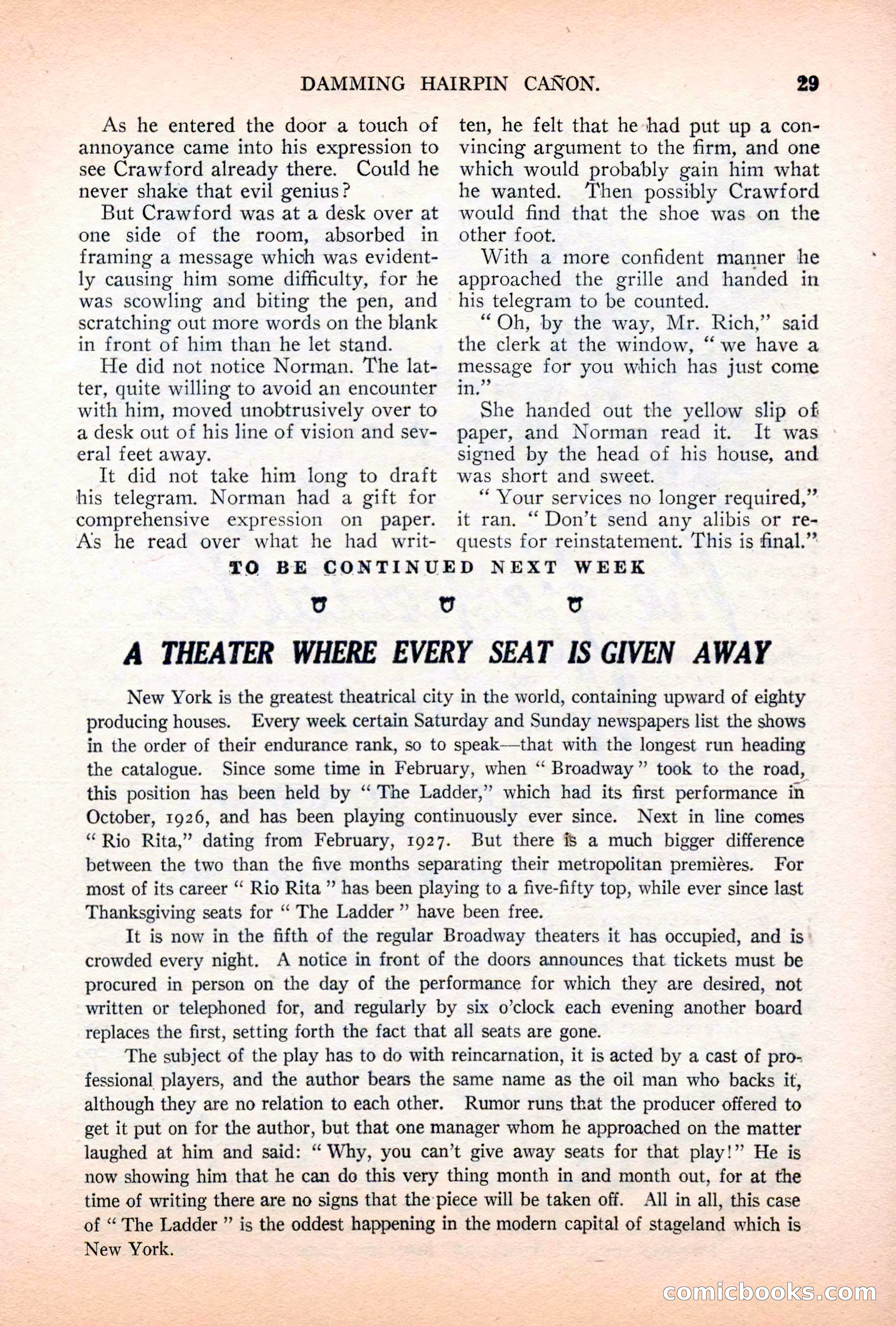
A restored page from Pulp Fiction, 1928. Page through the whole issue in the reader above.
📄 Transcribed text from this page (OCR, searchable)
Machine-transcribed from the original scan — historical spelling and the odd misread are preserved.
DAMMING HAIRPIN CANON. As he entered the door a touch of annoyance came into his expression to see Crawford already there. Could he never shake that evil genius? But Crawford was at a desk over at one side of the room, absorbed in framing a message which was evident- ly causing him some difficulty, for he was scowling and biting the pen, and scratching out more words on the blank in front of him than he let stand. He did not notice Norman. The lat- ter, quite willing to avoid an encounter with him, moved unobtrusively over to a desk out of his line of vision and sev- eral feet away. It did not take him long to draft his telegram. Norman had a gift for comprehensive expression on _ paper. As he read over what he had writ- ten, he felt that he had put up a con- vincing argument to the firm, and one which would probably gain him what he wanted. Then possibly Crawford would find that the shoe was on the other foot. With a more confident manner he approached the grille and handed in his telegram to be counted. “Oh, by the way, Mr. Rich,” said the clerk at the window, ‘‘ we have a message for you which has just come in.” She handed out the yellow slip of paper, and Norman read it. It was signed by the head of his house, and was short and sweet. “Your services no longer required,” it ran. “ Don’t send any alibis or re- quests for reinstatement. This is final.” TO BE CONTINUED NEXT WEEK Le} Lo Le} A THEATER WHERE EVERY SEAT IS GIVEN AWAY New York is the greatest theatrical city in the world, containing upward of eighty producing houses. Every week certain Saturday and Sunday newspapers list the shows in the order of their endurance rank, so to speak—that with the longest run heading the catalogue. Since some time in February, when “ Broadway” took to the road, this position has been held by ‘“‘ The Ladder,’ which had its first performance in October, 1926, and has been playing continuously ever since. “ Rio Rita,” dating from February, 192 between the two than the five months separating their metropolitan premieres. 7° Next in line comes But there iS a much bigger difference For most of its career ‘‘ Rio Rita ” has been playing to a five-fifty top, while ever since last Thanksgiving seats for “ The Ladder” have been free. It is now in the fifth of the regular Broadway theaters it has occupied, and is: crowded every night. A notice in front of the doors announces that tickets must be procured in person on the day of the performance for which they are desired, not written or telephoned for, and regularly by six o’clock each evening another board replaces the first, setting forth the fact that all seats are gone. The subject of the play has to do with reincarnation, it is acted by a cast of pro- fessional players, and the author bears the same name as the oil man who backs it, although they are no relation to each other. get it put on for the author, but that one manager whom he approached on the matter laughed at him and said: “ Why, you can’t give away seats for that play!” He is now showing him that he can do this very thing month in and month out, for at the time of writing there are no signs that the piece will be taken off. All in all, this case of “ The Ladder ” is the oddest happening in the modern capital of stageland which is New York. Rumor runs that the producer offered to EOPMICLOOO© (E@)