
Pulp Fiction, 1928 · page 38 of 160
Argosy All-Story Weekly, April 7, 1928 — page 38: what you’re looking at
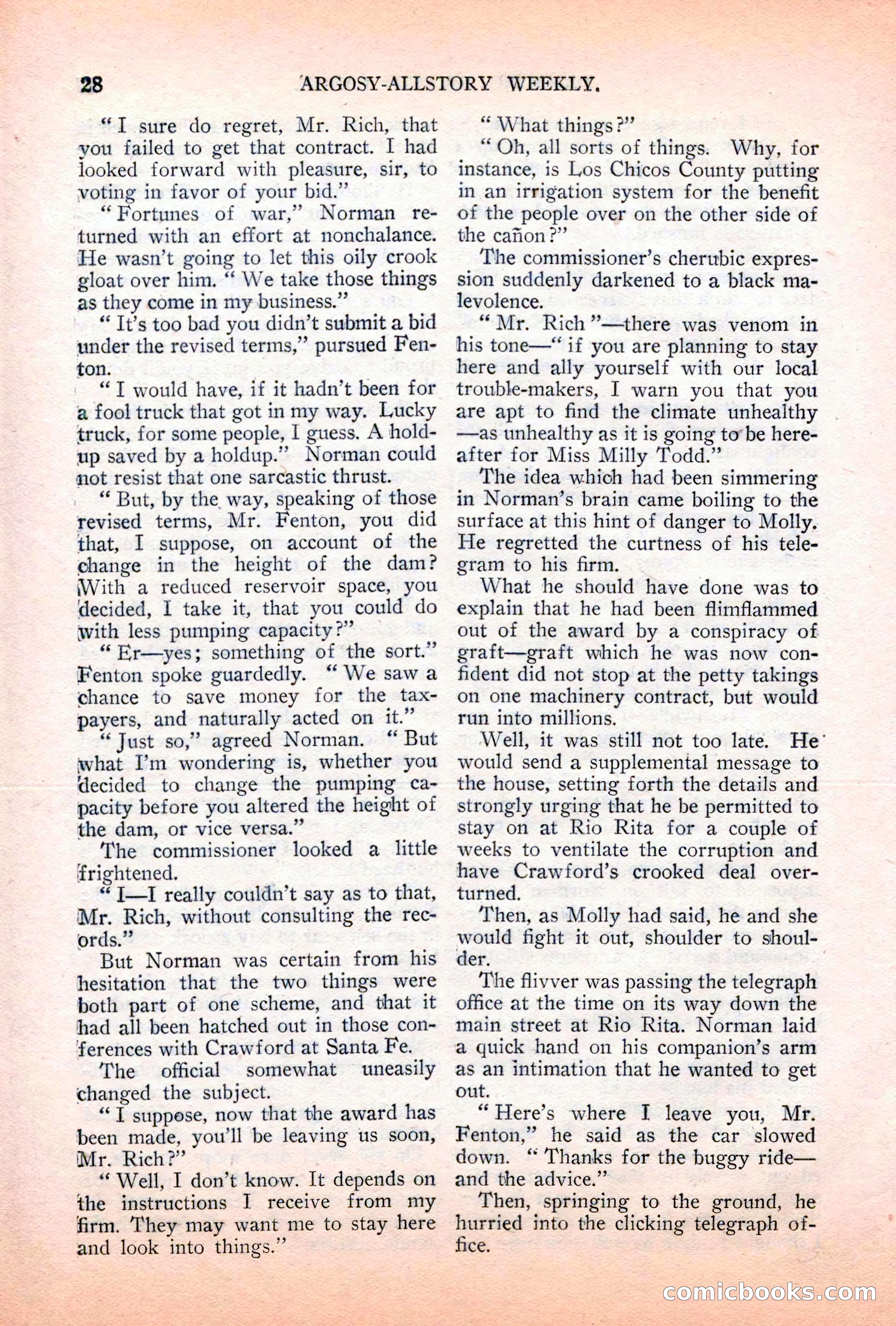
A restored page from Pulp Fiction, 1928. Page through the whole issue in the reader above.
📄 Transcribed text from this page (OCR, searchable)
Machine-transcribed from the original scan — historical spelling and the odd misread are preserved.
28 “TI sure do regret, Mr. Rich, that you failed to get that contract. | had looked forward with pleasure, sir, to voting in favor of your bid.” ‘Fortunes of war,’ Norman re- turned with an effort at nonchalance. He wasn’t going to let this oily crook gloat over him. ‘ We take those things as they come in my business.” “It’s too bad you didn’t submit a bid under the revised terms,” pursued Fen- ton. “T would have, if it hadn’t been for a fool truck that got in my way. Lucky truck, for some people, I guess. A hold- up saved by a holdup.”’ Norman could not resist that one sarcastic thrust. “ But, by the way, speaking of those revised terms, Mr. Fenton, you did that, I suppose, on account of the change in the height of the dam? With a reduced reservoir space, you decided, I take it, that you could do with less pumping capacity?” “ Er—yes; something of the sort.” Fenton spoke guardedly. “We saw a chance to save money for the tax- payers, and naturally acted on it.” “Just so,” agreed Norman. “ But what I’m wondering is, whether you decided to change the pumping ca- pacity before you altered the height of the dam, or vice versa.” The commissioner looked a little frightened. “ T—I really couldn’t say as to that, Mr. Rich, without consulting the rec- ords.” But Norman was certain from his hesitation that the two things were both part of one scheme, and that it had all been hatched out in those con- ferences with Crawford at Santa Fe. The official somewhat uneasily changed the subject. “T suppose, now that the award has been made, you'll be leaving us soon, Mr. Rich?’ “ Well, I don’t know. It depends on the instructions I receive from my firm. They may want me to stay here and look into things.” ARGOSY-ALLSTORY WEEKLY. “What things?” “Oh, all sorts of things. Why, for instance, is Los Chicos County putting in an irrigation system for the benefit of the people over on the other side of the cafion?” The commissioner’s cherubic expres- sion suddenly darkened to a black ma- levolence. “Mr. Rich ”—there was venom in his tone—“ if you are planning to stay here and ally yourself with our local trouble-makers, I warn you that you are apt to find the climate unhealthy —as unhealthy as it is going tobe here- after for Miss Milly Todd.” The idea which had been simmering in Norman’s brain came boiling to the surface at this hint of danger to Molly. He regretted the curtness of his tele- gram to his firm. What he should have done was to explain that he had been flimflammed out of the award by a conspiracy of graft—graft which he was now con- fident did not stop at the petty takings on one machinery contract, but would run into millions. Well, it was still not too late. would send a supplemental message to the house, setting forth the details and strongly urging that he be permitted to stay on at Rio Rita for a couple of weeks to ventilate the corruption and have Crawford’s crooked deal over- turned. Then, as Molly had said, he and she Mee fight it out, shoulder to shoul- er. The flivver was passing the telegraph office at the time on its way down the main street at Rio Rita. Norman laid a quick hand on his companion’s arm as an intimation that he wanted to get out. “Here’s where I leave you, Mr. Fenton,” he said as the car slowed down. “ Thanks for the buggy ride— and the advice.” Then, springing to the ground, he fice. (€(0) DOOKS mG He’ hurried into the clicking telegraph of- (EC)