
Pulp Fiction, 1922 · page 34 of 176
Argosy All-Story Weekly — page 34: what you’re looking at
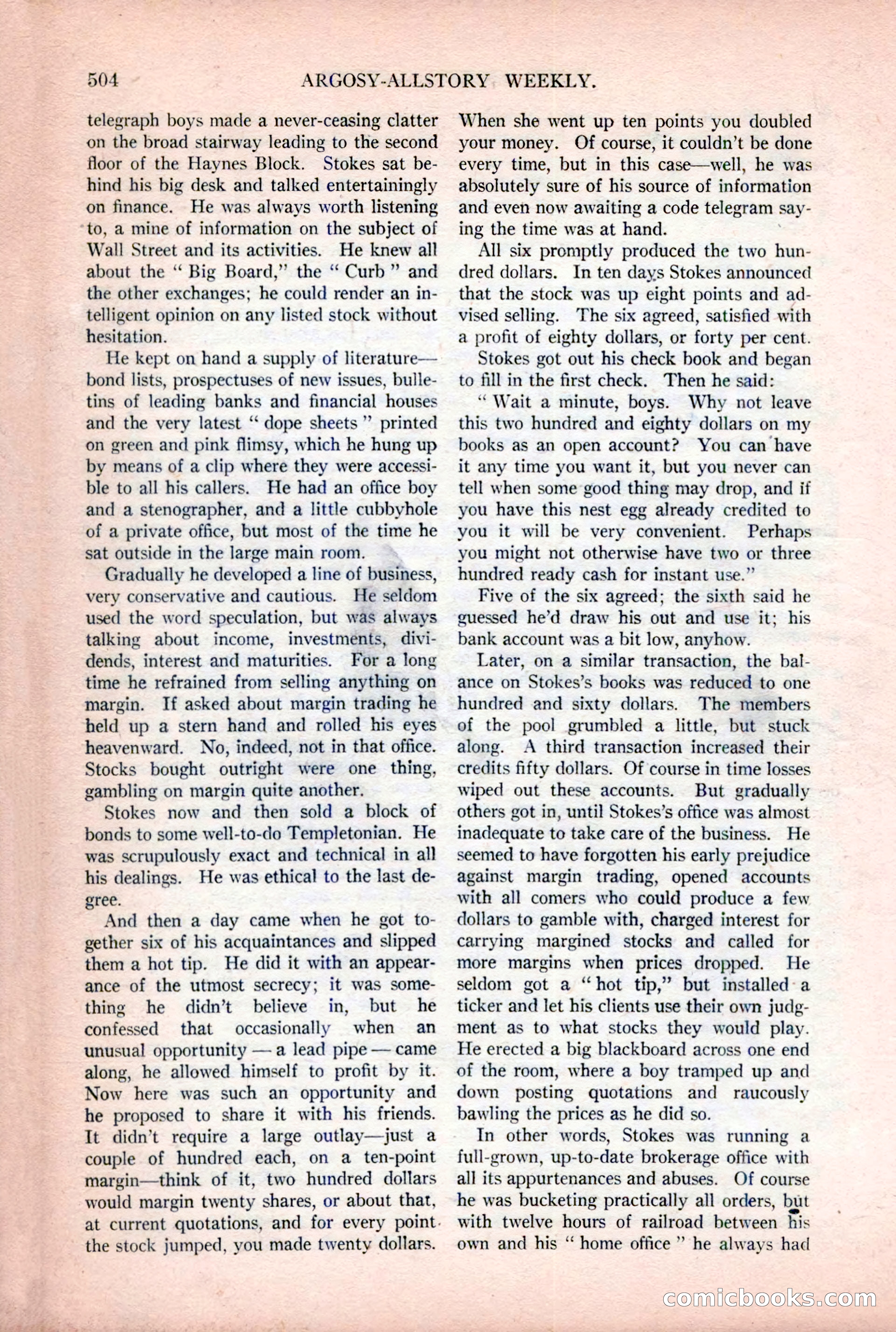
A restored page from Pulp Fiction, 1922. Page through the whole issue in the reader above.
📄 Transcribed text from this page (OCR, searchable)
Machine-transcribed from the original scan — historical spelling and the odd misread are preserved.
504 telegraph boys made a never-ceasing clatter on the broad stairway leading to the second floor of the Haynes Block. Stokes sat be- hind his big desk and talked entertainingly on finance. He was always worth listening to, a mine of information on the subject of Wall Street and its activities. He knew all about the “ Big Board,” the “ Curb ” and the other exchanges; he could render an in- telligent opinion on any listed stock without hesitation. He kept on hand a supply of literature— bond lists, prospectuses of new issues, bulle- tins of leading banks and financial houses and the very latest ‘“ dope sheets ”’ printed on green and pink flimsy, which he hung up by means of a clip where they were accessi- ble to all his callers. He had an office boy and a stenographer, and a little cubbyhole of a private office, but most of the time he sat outside in the large main room. Gradually he developed a line of business, very conservative and cautious. He seldom used the word speculation, but was always talking about income, investments, divi- dends, interest and maturities. For a long time he refrained from selling anything on margin. If asked about margin trading he held up a stern hand and rolled his eyes heavenward. No, indeed, not in that office. Stocks bought outright were one thing, gambling on margin quite another. Stokes now and then sold a block of bonds to some well-to-do Templetonian. He was scrupulously exact and technical in all his dealings. He was ethical to the last de- gree. And then a day came when he got to- gether six of his acquaintances and slipped them a hot tip. He did it with an appear- ance of the utmost secrecy; it was some- thing he didn’t believe in, but he confessed that occasionally when an unusual opportunity — a lead pipe — came along, he allowed himself to profit by it. Now here was such an opportunity and he proposed to share it with his friends. It didn’t require a large outlay—just a couple of hundred each, on a ten-point margin—think of it, two hundred dollars would margin twenty shares, or about that, at current quotations, and for every point. the stock jumped, you made twenty dollars. ARGOSY-ALLSTORY WEEKLY. When she went up ten points you doubled your money. Of course, it couldn’t be done every time, but in this case—well, he was absolutely sure of his source of information and even now awaiting a code telegram say- ing the time was at hand. All six promptly produced the two hun- dred dollars. In ten days Stokes announced that the stock was up eight points and ad- vised selling. The six agreed, satisfied with a profit of eighty dollars, or forty per cent. Stokes got out his check book and began to fill in the first check. Then he said: ‘Wait a minute, boys. Why not leave this two hundred and eighty dollars on my books as an open account? You can have it any time you want it, but you never can tell when some good thing may drop, and if you have this nest egg already credited to you it will be very convenient. Perhaps you might not otherwise have two or three hundred ready cash for instant use.” Five of the six agreed; the sixth said he guessed he’d draw his out and use it; his bank account was a bit low, anyhow. Later, on a similar transaction, the bal- ance on Stokes’s books was reduced to one hundred and sixty dollars. The members of the pool grumbled a little, but stuck along. <A third transaction increased their credits fifty dollars. Of course in time losses wiped out these accounts. But gradually others got in, until Stokes’s office was almost inadequate to take care of the business. He seemed to have forgotten his early prejudice against margin trading, opened accounts with all comers who could produce a few dollars to gamble with, charged interest for carrying margined stocks and called for more margins when prices dropped. He seldom got a “hot tip,” but installed: a ticker and let his clients use their own judg- ment as to what stocks they would play. He erected a big blackboard across one end of the room, where a boy tramped up and down posting quotations and _ raucously bawling the prices as he did so. In other words, Stokes was running a full-grown, up-to-date brokerage office with all its appurtenances and abuses. Of course he was bucketing practically all orders, but with twelve hours of railroad between his own and his “ home office” he always had Gomichbooksreom