
Pulp Fiction, 1922 · page 33 of 176
Argosy All-Story Weekly — page 33: what you’re looking at
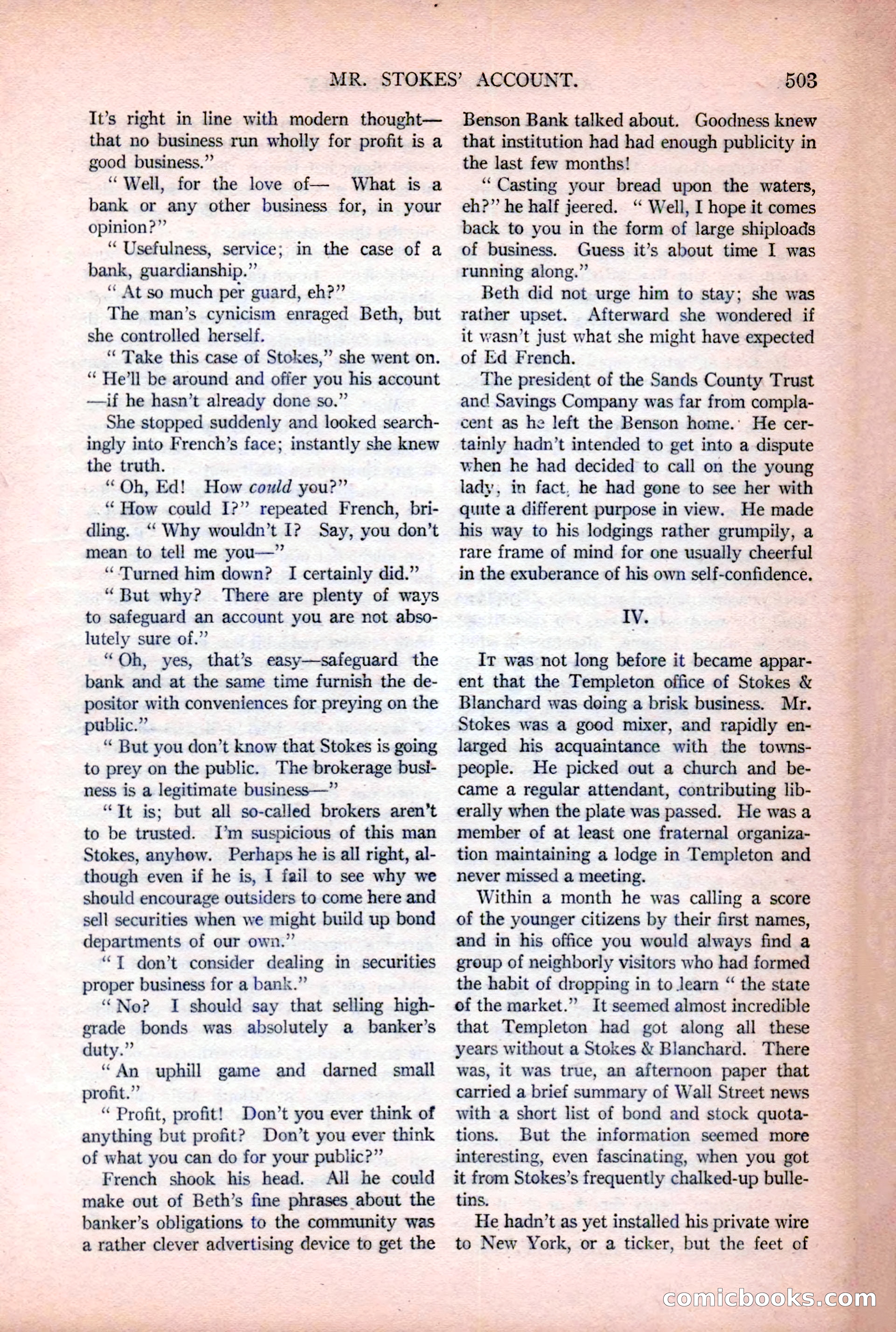
A restored page from Pulp Fiction, 1922. Page through the whole issue in the reader above.
📄 Transcribed text from this page (OCR, searchable)
Machine-transcribed from the original scan — historical spelling and the odd misread are preserved.
MR. STOKES’ ACCOUNT. It’s right in line with modern thought— that no business run wholly for profit is a good business.” “Well, for the love of— What is a bank or any other business for, in your opinion?” ‘““ Usefulness, service; in the case of a bank, guardianship.” ‘At so much per guard, eh?” The man’s cynicism enraged Beth, but she controlled herself. “ Take this case of Stokes,” she went on. “ He'll be around and offer you his account —if he hasn’t already done so.” She stopped suddenly and looked search- ingly into French’s face; instantly she knew the truth. “Oh, Ed! How could you?” “ How could I?” repeated French, bri- dling. “‘ Why wouldn’t 1? Say, you don’t mean to tell me you—” “Turned him down? I certainly did.” “ But why? There are plenty of ways to safeguard an account you are not abso- lutely sure of.” “Oh, yes, that’s easy—safeguard the bank and at the same time furnish the de- positor with conveniences for preying on the public.” “ But you don’t know that Stokes is going to prey on the public. The brokerage busi- ness is a legitimate business—” “Tt is; but all so-called brokers aren’t to be trusted. I’m suspicious of this man Stokes, anyhow. Perhaps he is all right, al- though even if he is, I fail to see why we should encourage outsiders to come here and sell securities when we might build up bond departments of our own.” “Tf don’t consider dealing in securities proper business for a bank.” ‘No? I should say that selling high- grade bonds was absolutely a banker’s duty.” “An uphill game and darned small profit.” “ Profit, profit!) Don’t you ever think of anything but profit? Don’t you ever think of what you can do for your public?”’ French shook his head. All he could make out of Beth’s fine phrases about the banker’s obligations to the community was a rather clever advertising device to get the Benson Bank talked about. Goodness knew that institution had had enough publicity in the last few months! “Casting your bread upon the waters, eh?” he half jeered. ‘“ Well, I hope it comes back to you in the form of large shiploads of business. Guess it’s about time I was running along.” Beth did not urge him to stay; she was rather upset. Afterward she wondered if it wasn’t just what she might have expected of Ed French. The president of the Sands County Trust and Savings Company was far from compla- cent as he left the Benson home.’ He cer- tainly hadn’t intended to get into a dispute when he had decided to call on the young lady, in fact, he had gone to see her with quite a different purpose in view. He made his way to his lodgings rather grumpily, a rare frame of mind for one usually cheerful in the exuberance of his own self-confidence. IV. It was not long before it became appar- ent that the Templeton office of Stokes & Blanchard was doing a brisk business. Mr. Stokes was a good mixer, and rapidly en- larged his acquaintance with the towns- people. He picked out a church and be- came a regular attendant, contributing lib- erally when the plate was passed. He was a member of at least one fraternal organiza- tion maintaining a lodge in Templeton and never missed a meeting. Within a month he was calling a score of the younger citizens by their first names, and in his office you would always find a group of neighborly visitors who had formed the habit of dropping in to learn “ the state of the market.” It seemed almost incredible that Templeton had got along all these years without a Stokes & Blanchard. There was, it was true, an afternoon paper that carried a brief summary of Wall Street news with a short list of bond and stock quota- tions. But the information seemed more interesting, even fascinating, when you got it from Stokes’s frequently chalked-up bulle- tins. He hadn’t as yet installed his private wire to New York, or a ticker, but the feet of Comicbooks.com —— a 5 ' ee - ; itn % a % oo ee : é 4 - a = , 7 + dy uti} am RD wth ere Fin ~— ~ > > a