
Pulp Fiction, 1922 · page 35 of 176
Argosy All-Story Weekly — page 35: what you’re looking at
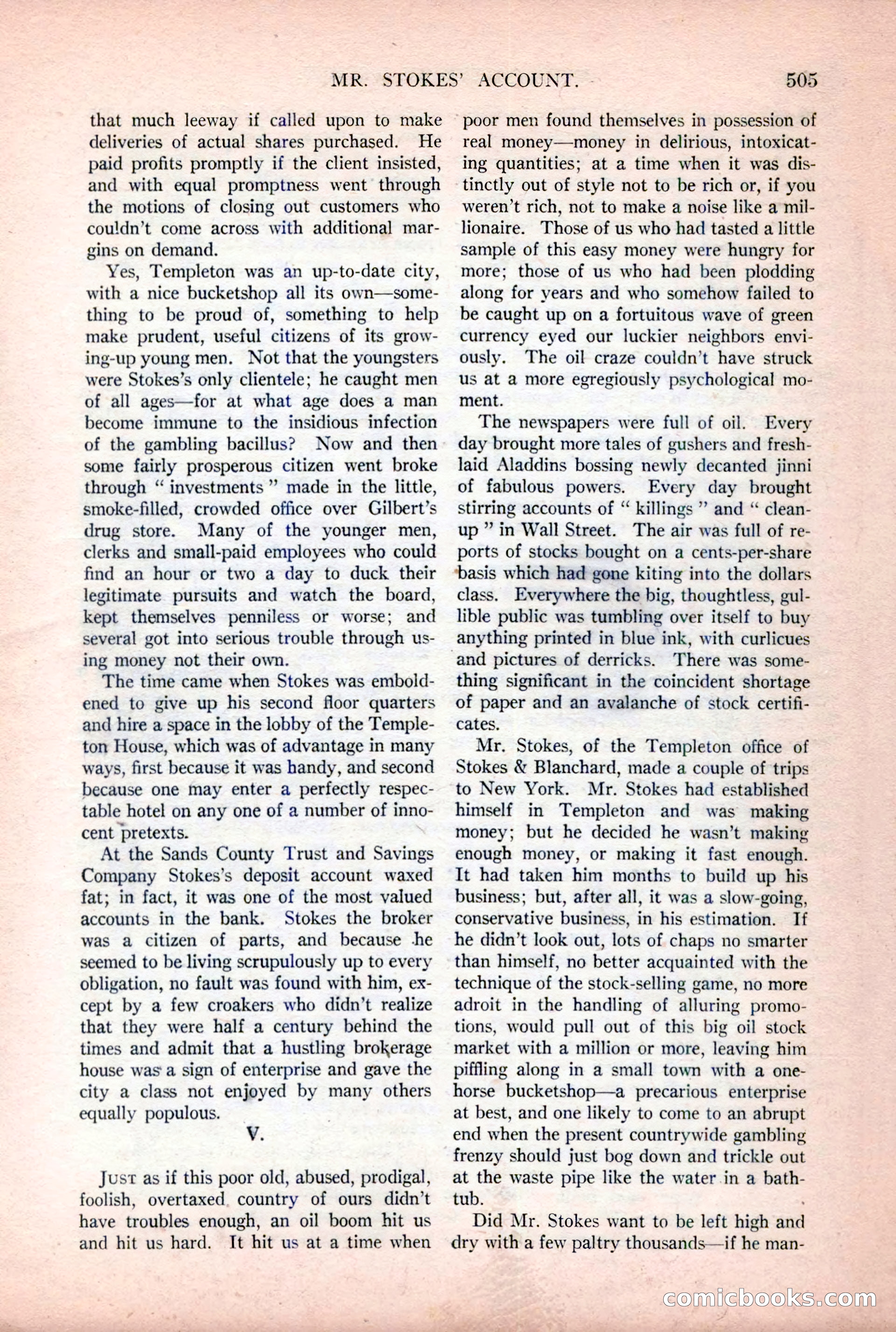
A restored page from Pulp Fiction, 1922. Page through the whole issue in the reader above.
📄 Transcribed text from this page (OCR, searchable)
Machine-transcribed from the original scan — historical spelling and the odd misread are preserved.
a MR. STOKES’ ACCOUNT. - 505 that much leeway if called upon to make deliveries of actual shares purchased. He paid profits promptly if the client insisted, and with equal promptness went through the motions of closing out customers who couldn’t come across with additional mar- gins on demand. Yes, Templeton was an up-to-date city, with a nice bucketshop all its own—some- thing to be proud of, something to help make prudent, useful citizens of its grow- ing-up young men. Not that the youngsters were Stokes’s only clientele; he caught men of all ages—for at what age does a man become immune to the insidious infection of the gambling bacillus? Now and then some fairly prosperous citizen went broke through “ investments ” made in the little, smoke-filled, crowded office over Gilbert’s drug store. Many of the younger men, clerks and small-paid employees who could find an hour or two a day to duck their legitimate pursuits and watch the board, kept themselves penniless or worse; and several got into serious trouble through us- ing money not their own. The time came when Stokes was embold- ened to give up his second floor quarters and hire a space in the lobby of the Temple- ton House, which was of advantage in many ways, first because it was handy, and second because one may enter a perfectly respec- table hotel on any one of a number of inno- cent pretexts. At the Sands County Trust and Savings Company Stokes’s deposit account waxed fat; in fact, it was one of the most valued accounts in the bank. Stokes the broker was a citizen of parts, and because he seemed to be living scrupulously up to every obligation, no fault was found with him, ex- cept by a few croakers who didn’t realize that they were half a century behind the times and admit that a hustling brokerage house was a sign of enterprise and gave the city a class not enjoyed by many others equally populous. Just as if this poor old, abused, prodigal, foolish, overtaxed. country of ours didn’t have troubles enough, an oil boom hit us and hit us hard. It hit us at a time when and pictures of derricks. poor men found themselves in possession of real money—money in delirious, intoxicat- ing quantities; at a time when it was dis- tinctly out of style not to be rich or, if you weren’t rich, not to make a noise like a mil- lionaire. Those of us who had tasted a little sample of this easy money were hungry for more; those of us who had been plodding along for years and who somehow failed to be caught up on a fortuitous wave of green currency eyed our luckier neighbors envi- ously. The oil craze couldn’t have struck us at a more egregiously psychological mo- ment. The newspapers were full of oil. Every day brought more tales of gushers and fresh- laid Aladdins bossing newly decanted jinni of fabulous powers. Every day brought stirring accounts of “ killings ” and “ clean- up ” in Wall Street. The air was full of re- ports of stocks bought on a cents-per-share ‘basis which had gone kiting into the dollars class. Everywhere the big, thoughtless, gul- lible public was tumbling over itself to buy anything printed in blue ink, with curlicues There was some- thing significant in the coincident shortage of paper and an avalanche of stock certifi- cates. Mr. Stokes, of the Templeton office of Stokes & Blanchard, made a couple of trips to New York. Mr. Stokes had established himself in Templeton and was making money; but he decided he wasn’t making enough money, or making it fast enough. It had taken him months to build up his business; but, after all, it was a slow-going, conservative business, in his estimation. If he didn’t look out, lots of chaps no smarter than himself, no better acquainted with the technique of the stock-selling game, no more adroit in the handling of alluring promo- tions, would pull out of this big oil stock market with a million or more, leaving him piffling along in a small town with a one- horse bucketshop—a precarious enterprise at best, and one likely to come to an abrupt end when the present countrywide gambling frenzy should just bog down and trickle out at the waste pipe like the water in a bath- tub. : Did Mr. Stokes want to be left high and dry with a few paltry thousands—if he man- COM GCOOOK<Sa Ol — eee.