
Pulp Fiction, 1920 · page 114 of 160
The Argosy, March 27, 1920 — page 114: what you’re looking at
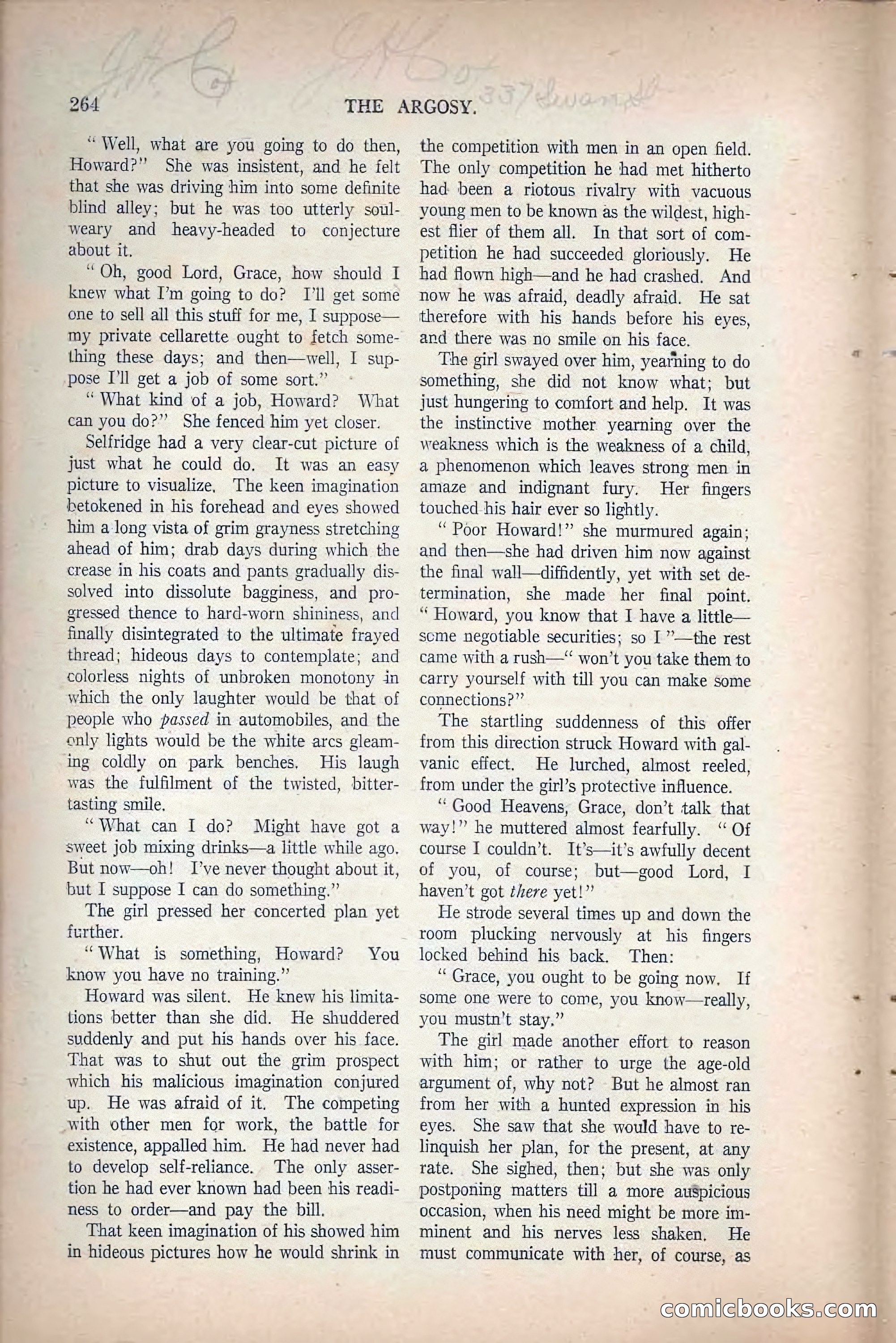
A restored page from Pulp Fiction, 1920. Page through the whole issue in the reader above.
📄 Transcribed text from this page (OCR, searchable)
Machine-transcribed from the original scan — historical spelling and the odd misread are preserved.
264 “Well, what are you going to do then, Howard?’ She was insistent, and he felt that she was driving him into some definite blind alley; but he was too utterly soul- weary and heavy-headed to conjecture about it. “Oh, good Lord, Grace, how should I knew what I’m going to do? I'll get some one to sell all this stuff for me, I suppose— my private cellarette ought to fetch some- thing these days; and then—well, I sup- pose I’ll get a job of some sort.” “ What kind of a job, Howard? What can you do?” She fenced him yet closer. Selfridge had a very clear-cut picture of just what he could do. It was an easy picture to visualize, The keen imagination betokened in his forehead and eyes showed him a long vista of grim grayness stretching ahead of him; drab days during which the crease in his coats and pants gradually dis- solved into dissolute bagginess, and pro- gressed thence to hard-worn shininess, and finally disintegrated to the ultimate frayed thread; hideous days to contemplate; and colorless nights of unbroken monotony in which the only laughter would be that of people who passed in automobiles, and the only lights would be the white arcs gleam- ing coldly on park benches, His laugh was the fulfilment of the twisted, bitter- tasting smile, “What can I do? Might have got a sweet job mixing drinks—a little while ago. But now—oh! I’ve never thought about it, but I suppose I can do something.” The girl pressed her concerted plan yet further. ‘““What is something, Howard? know you have no training.”’ Howard was silent. He knew his limita- tions better than she did. He shuddered suddenly and put his hands over his face. That was to shut out the grim prospect which his malicious imagination conjured up. He was afraid of it. The competing with other men for work, the battle for existence, appalled him. He had never had to develop self-reliance. The only asser- tion he had ever known had been his readi- ness to order—and pay the bill. That keen imagination of his showed him in hideous pictures how he would shrink in You THE ARGOSY. the competition with men in an open field. The only competition he had met hitherto had been a riotous rivalry with vacuous young men to be known as the wildest, high- est flier of them all. In that sort of com- petition he had succeeded gloriously. He had flown high—and he had crashed. And now he was afraid, deadly afraid. He sat therefore with his hands before his eyes, and there was no smile on his face. The girl swayed over him, yearning to do something, she did not know what; but just hungering to comfort and help. It was the instinctive mother yearning over the weakness which is the weakness of a child, a phenomenon which leaves strong men in amaze and indignant fury. Her fingers touched his hair ever so lightly. “ Poor Howard!” she murmured again; and then—she had driven him now against the final wall—diffidently, yet with set de- termination, she made her final point. ‘Howard, you know that I have a little— scme negotiable securities; so I ”’—the rest came with a rush—* won’t you take them to carry yourself with till you can make some connections?” The startling suddenness of this offer from this direction struck Howard with gal- vanic effect. He lurched, almost reeled, from under the girl’s protective influence. “Good Heavens, Grace, don’t talk that way!” he muttered almost fearfully. “ Of course I couldn’t. It’s—it’s awfully decent of you, of course; but—good Lord, I haven’t got there yet!” He strode several times up and down the room plucking nervously at his fingers locked behind his back. Then: “Grace, you ought to be going now. If some one were to come, you know—really, you mustn’t stay,” The girl made another effort to reason with him; or rather to urge the age-old argument of, why not? But he almost ran from her with a hunted expression in his eyes. She saw that she would have to re- linquish her plan, for the present, at any rate. She sighed, then; but she was only postponing matters till a more auSpicious occasion, when his need might be more im- minent and his nerves less shaken, He must communicate with her, of course, as ComnmiclooolkS.COmn