
Pulp Fiction, 1920 · page 113 of 160
The Argosy, March 27, 1920 — page 113: what you’re looking at
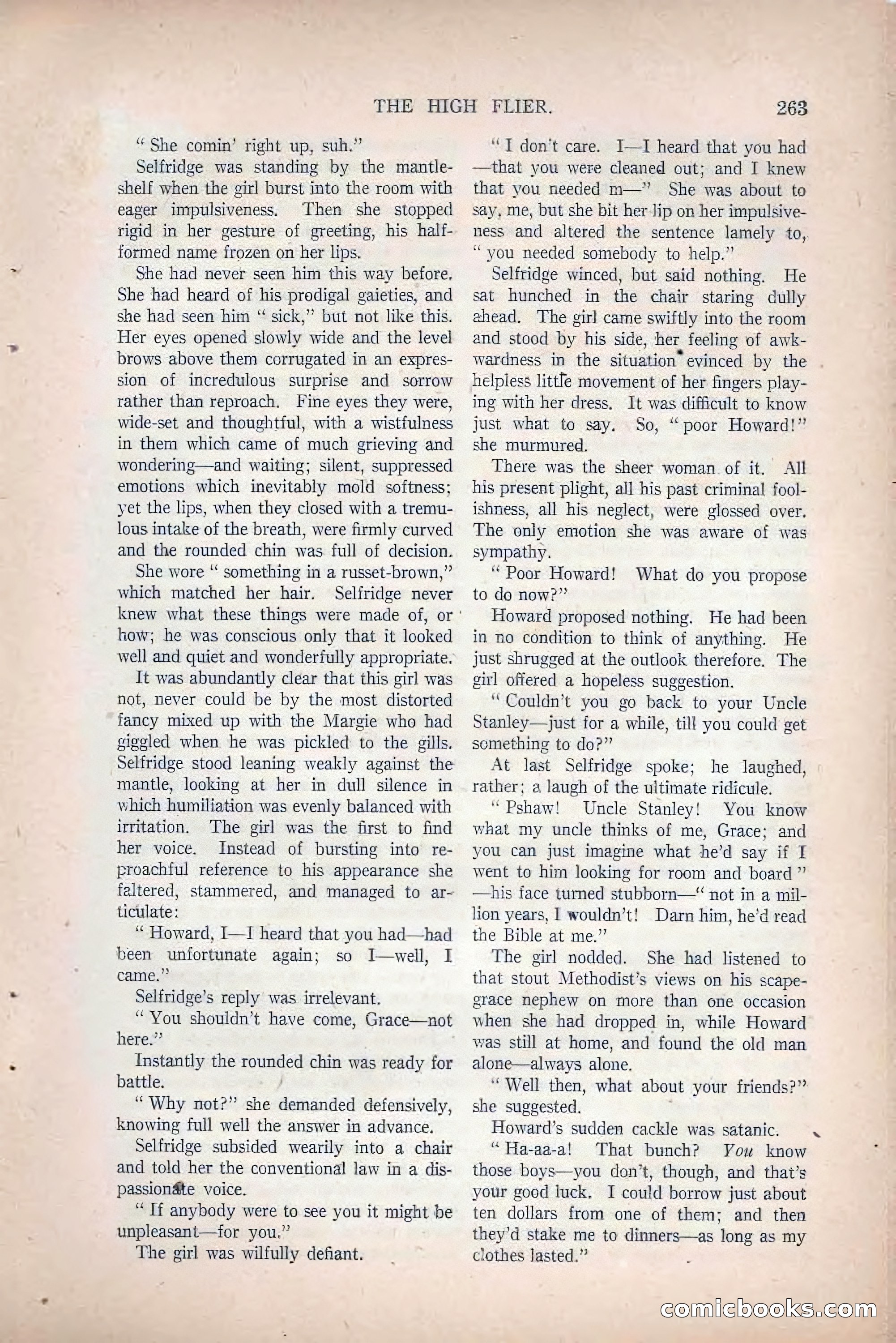
A restored page from Pulp Fiction, 1920. Page through the whole issue in the reader above.
📄 Transcribed text from this page (OCR, searchable)
Machine-transcribed from the original scan — historical spelling and the odd misread are preserved.
THE HIGH FLIER. “ She comin’ right up, suh.” Selfridge was standmg by the mantle- shelf when the girl burst into the room with eager imptlsiveness. Then she stopped rigid in her gesture of greeting, his half- formed name frozen on her lips, She had never seen him this way before, She had heard of his predigal gaieties, and she had seen him “ sick,” but not like this. Her eyes opened slowly wide and the level brows above them corrugated in an expres- sion of incredulous surprise and sorrow rather than reproach. Fine eyes they were, wide-set and thoughtful, with a wistfulness in them which came of much grieving and wondering—and waiting; silent, suppressed emotions which inevitably mold softness; yet the lips, when they closed with a tremu- lous intake of the breath, were firmly curved and the rounded chin was full of decision. She wore ‘‘ something in a russet-brown,” which matched her hair. Selfridge never knew what these things were made of, or ' ow; he was conscious only that it looked well and quiet and wonderfully appropriate. It was abundantly clear that this girl was not, never could be by the most distorted fancy mixed up with the Margie who had giggled when he was pickled to the gills. Selfridge stood leaning weakly against the mantle, looking at her in dull silence in which humiliation was evenly balanced with irritation. The girl was the first to find her voice. Instead of bursting into re- proachful reference to his appearance she faltered, stammered, and managed to ar- ticulate: “ Howard, I—I heard that you had—had been unfortunate again; so I—well, I came.” Selfridge’s reply was irrelevant. “You shouldn’t have come, Grace—not here.” Instantly the rounded chin was ready for battle. “Why not?” she demanded defensively, knowing full well the answer in advance, Selfridge subsided wearily into a chair and told her the conventional law in a dis- passionate voice. “If anybody were to see you it might be unpleasant—for you.” The girl was wilfully defiant. 263 “T don’t care. I—I heard that you had —that you were cleaned out; and I knew that you needed m—” She was about to say, me, but she bit her lip on her impulsive- ness and altered the sentence lamely to,. “you needed somebody to help.” Selfridge winced, but said nothing. He sat hunched in the chair staring dully ahead. The girl came swiftly into the room and stood by his side, her feeling of awk- wardness in the situation” evinced by the helpless little movement of her fingers play- ing with her dress. It was difficult to know just what to say. So, “poor Howard!” she murmured. There was the sheer woman of it. All his present plight, all his past criminal fool- ishness, all his neglect, were glossed over, The only emotion she was aware of was sympathy. “Poor Howard! to do now?” Howard proposed nothing. He had been in no condition to think of anything. He just shrugged at the outlook therefore. The girl offered a hopeless suggestion. ‘Couldn’t you go back to your Uncle Stanley—just for a while, till you could get something to do?” At last Selfridge spoke; he laughed, rather; a laugh of the ultimate ridicule. “Pshaw! Uncle Stanley! You know what my uncle thinks of me, Grace; and you can just imagine what he’d say if I went to him looking for room and board ” —his face turned stubborn— not in a mil- lion years, 1 wouldn’t! Darn him, he'd read the Bible at me.” The girl nodded. She had listened to that stout Methodist’s views on his scape- grace nephew on more than one occasion when she had dropped in, while Howard was still at home, and found the old man alone—always alone, ‘Well then, what about your friends?” she suggested. Howard’s sudden cackle was satanic. “Ha-aa-a! That bunch? You know those boys—you don’t, though, and that’s your good luck. I could borrow just about ten dollars from one of them; and then they'd stake me to dinners—as long as my clothes lasted.” What do you propose cComicbookssacom