
Pulp Fiction, 1920 · page 115 of 160
The Argosy, March 27, 1920 — page 115: what you’re looking at
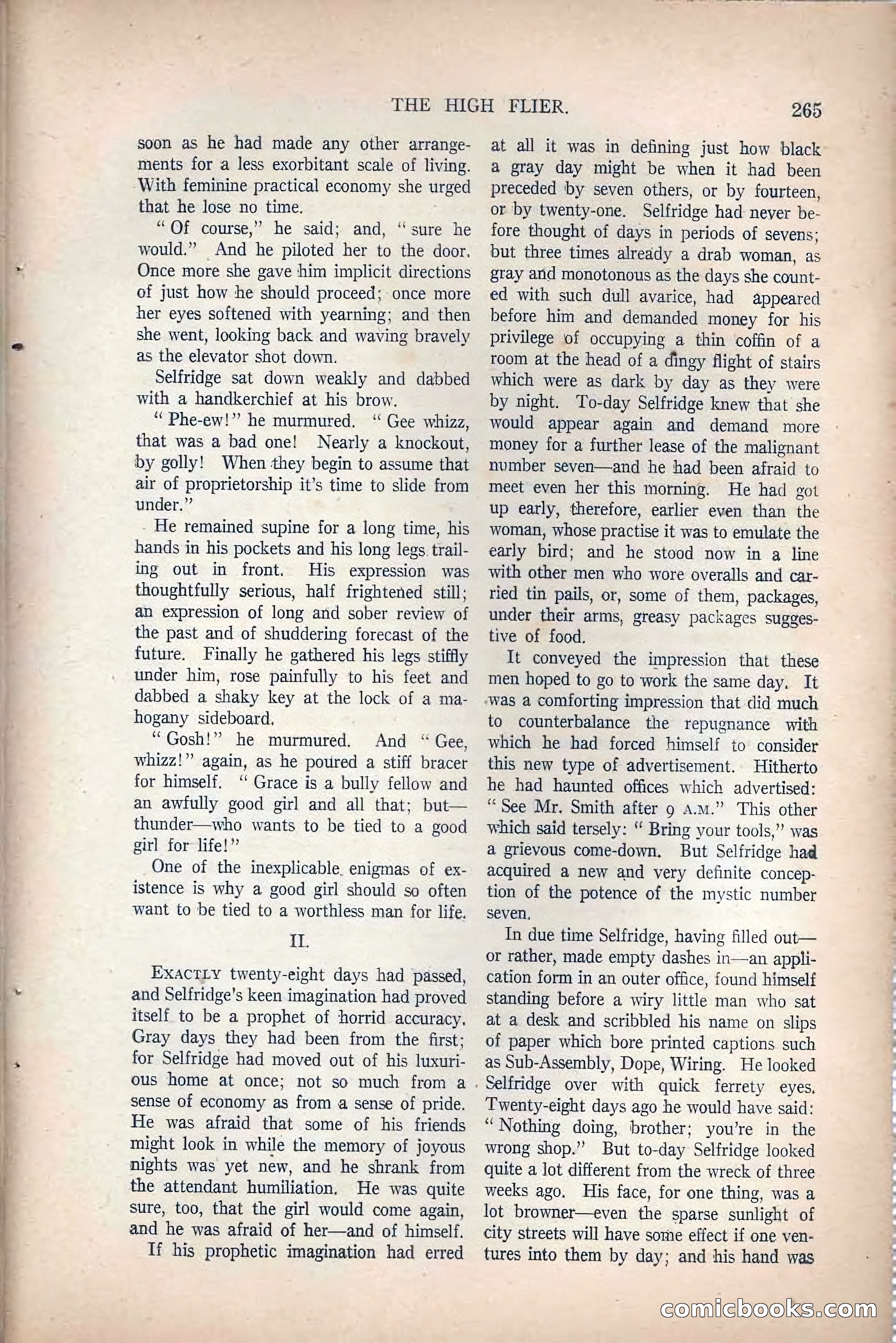
A restored page from Pulp Fiction, 1920. Page through the whole issue in the reader above.
📄 Transcribed text from this page (OCR, searchable)
Machine-transcribed from the original scan — historical spelling and the odd misread are preserved.
THE HIGH FLIER. 265 soon as he had made any other arrange- ments for a less exorbitant scale of living. With feminine practical economy she urged that he lose no time. “Of course,” he said; and, ‘sure he would.” And he piloted her to the door, Once more she gave him implicit directions of just how he should proceed; once more her eyes softened with yearning; and then she went, looking back and waving bravely as the elevator shot down. Selfridge sat down weakly and dabbed with a handkerchief at his brow. “Phe-ew!” he murmured. “ Gee whizz, that was a bad one! Nearly a knockout, by golly! When they begin to assume that air of proprietorship it’s time to slide from under.” He remained supine for a long time, his hands in his pockets and his long legs. trail- ing out in front. His expression was thoughtfully serious, half frightened still; an expression of long and sober review of the past and of shuddering forecast of the future. Finally he gathered his legs stiffly under him, rose painfully to his feet and dabbed a shaky key at the lock of a ma- hogany sideboard, “Gosh!” he murmured, And “ Gee, whizz!” again, as he poured a stiff bracer for himself. “ Grace is a bully fellow and an awfully good girl and all that; but— thunder—who wants to be tied to a good girl for life!” One of the inexplicable enigmas of ex- istence is why a good girl should so often want to be tied to a worthless man for life. IL, ExactLy twenty-eight days had passed, and Selfridge’s keen imagination had proved itself to be a prophet of ‘horrid accuracy, Gray days they had been from the first: for Selfridge had moved out of his luxuri- ous home at once; not so much from a. sense of economy as from a sense of pride. He was afraid that some of his friends might look in while the memory of joyous nights was yet new, and he shrank from the attendant humiliation. He was quite sure, too, that the girl would come again, and he was afraid of her—and of himself. If his prophetic imagination had erred at all it was in defining just how black a gray day might be when it had been preceded by seven others, or by fourteen, or by twenty-one. Selfridge had never be- fore thought of days in periods of sevens: but three times alreddy a drab woman, as gray and monotonous as the days she count- ed with such dull avarice, had appeared before him and demanded money for his privilege of occupying a thin coffin of a room at the head of a dingy flight of stairs which were as dark by day as they were by night. To-day Selfridge knew that she would appear again and demand more money for a further lease of the malignant number seven—and he had been afraid to meet even her this morning. He had got up early, therefore, earlier even than the woman, whose practise it was to emulate the early bird; and he stood now in a line with other men who wore overalls and car- ried tin pails, or, some of them, packages, under their arms, greasy packages sugges- tive of food. It conveyed the impression that these men hoped to go to work the same day. It ‘was a comforting impression that did much to counterbalance the repugnance with — which he had forced himself to consider this new type of advertisement. Hitherto he had haunted offices which advertised: “See Mr. Smith after 9 Aw.” This other which said tersely: “ Bring your tools,” was a grievous come-down. But Selfridge had acquired a new and very definite concep- tion of the potence of the mystic number seven, In due time Selfridge, having filled out— or rather, made empty dashes in—an appli- cation form in an outer office, found himself standing before a wiry little man who sat at a desk and scribbled his name on slips of paper which bore printed captions such as Sub-Assembly, Dope, Wiring. He looked Selfridge over with quick ferrety eyes, Twenty-eight days ago he would have said: “Nothing doing, brother; you’re in the wrong shop.” But to-day Selfridge looked quite a lot different from the wreck of three weeks ago. His face, for one thing, was a lot browner—even the sparse sunlight of city streets will have some effect if one ven- tures into them by day; and his hand was comicbooksscom