
Pulp Fiction, 1928 · page 54 of 99
Amazing Stories — page 54: what you’re looking at
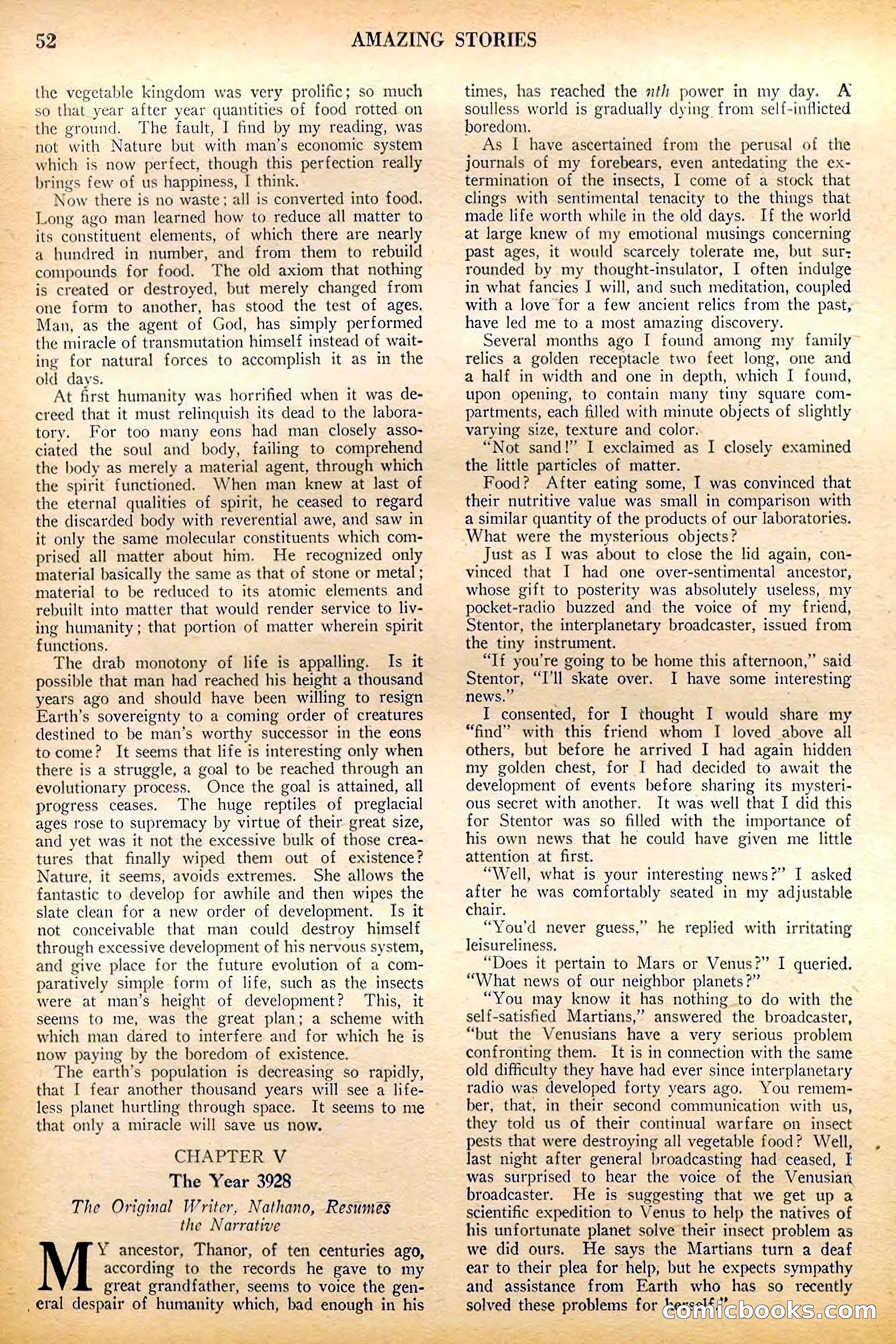
A restored page from Pulp Fiction, 1928. Page through the whole issue in the reader above.
📄 Transcribed text from this page (OCR, searchable)
Machine-transcribed from the original scan — historical spelling and the odd misread are preserved.
aS oo ~ o2 the vegetable kingdom was very prolific; so much so that year after year quantities of food rotted on the ground. The fault, I find by my reading, was not with Nature but with man’s economic system which is now perfect, though this perfection really brings few of us happiness, I think. Now there is no waste; all is converted into food. Long ago man learned how to reduce all matter to its constituent elements, of which there are nearly a hundred in number, and from them to rebuild compounds for food. The old axiom that nothing is created or destroyed, but merely changed from one form to another, has stood the test of ages. Man, as the agent of God, has simply performed the miracle of transmutation himself instead of wait- ing for natural forces to accomplish it as in the old days. At first humanity was horrified when it was de- creed that it must relinquish its dead to the labora- tory. For too many eons had man closely asso- ciated the soul and body, failing to comprehend the body as merely a material agent, through which the spirit functioned. When man knew at last of the eternal qualities of spirit, he ceased to regard the discarded body with reverential awe, and saw in it only the same molecular constituents which com- prised all matter about him. He recognized only material basically the same as that of stone or metal ; material to be reduced to its atomic elements and rebuilt into matter that would render service to liv- ing humanity; that portion of matter wherein spirit functions. The drab monotony of life is appalling. Is it possible that man had reached his height a thousand years ago and should have been willing to resign Earth’s sovereignty to a coming order of creatures destined to be man’s worthy successor in the eons to come? It seems that life is interesting only when there is a struggle, a goal to be reached through an evolutionary process. Once the goal is attained, all progress ceases. The huge reptiles of preglacial ages rose to supremacy by virtue of their great size, and yet was it not the excessive bulk of those crea- tures that finally wiped them out of existence? Nature, it seems, avoids extremes. She allows the fantastic to develop for awhile and then wipes the slate clean for a new order of development. Is it not conceivable that man could destroy himself through excessive development of his nervous system, and give place for the future evolution of a com- paratively simple form of life, such as the insects were at man’s height of development? This, it seems to me, was the great plan; a scheme with which man dared to interfere and for which he is now paying by the boredom of existence. The earth’s population is decreasing so rapidly, that I fear another thousand years will see a life- less planet hurtling through space. It seems to me that only a miracle will save us now. CHAPTER V The Year 3928 The Original Writer, Nathano, Resumes the Narrative Y ancestor, Thanor, of ten centuries ago, according to the records he gave to my -@& great grandfather, seems to voice the gen- _ eral despair of humanity which, bad enough in his a AMAZING STORIES times, has reached the nf power in my day, A soulless world is gradually dying from self-inflicted boredom. As | have ascertained from the perusal of the journals of my forebears, even antedating the ex- termination of the insects, I come of a stock that clings with sentimental tenacity to the things that made life worth while in the old days. If the world at large knew of my emotional musings concerning past ages, it would scarcely tolerate me, but sur: rounded by my thought-insulator, I often indulge in what fancies I will, and such meditation, coupled with a love for a few ancient relics from the past, have led me to a most amazing discovery. Several months ago I found among my family telics a golden receptacle two feet long, one and a half in width and one in depth, which I found, upon opening, to contain many tiny square com- partments, each filled with minute objects of slightly varying size, texture and color. “Not sand!” I exclaimed as I closely examined the little particles of matter. Food? After eating some, I was convinced that their nutritive value was small in comparison with a similar quantity of the products of our laboratories. What were the mysterious objects? Just as I was about to close the lid again, con- vinced that I had one over-sentimental ancestor, whose gift to posterity was absolutely useless, my pocket-radio buzzed and the voice of my friend, Stentor, the interplanetary broadcaster, issued from the tiny instrument. “If you're going to be home this afternoon,” said Stentor, “I'll skate over. I have some interesting news.” | I consented, for I thought I would share my “find” with this friend whom I loved above all others, but before he arrived I had again hidden my golden chest, for I had decided to await the development of events before sharing its mysteri- ous secret with another. It was well that I did this for Stentor was so filled with the importance of his own news that he could have given me little attention at first. “Well, what is your interesting news?” I asked after he was comfortably seated in my adjustable chair. “You'd never guess,” he replied with irritating leisureliness. “Does it pertain to Mars or Venus?” I queried. “What news of our neighbor planets?” “You may know it has nothing to do with the self-satisfied Martians,’ answered the broadcaster, “but the Venusians have a very serious problem confronting them. It is in connection with the same old difficulty they have had ever since interplanetary radio was developed forty years ago, You remem- ber, that, in their second communication with us, they told us of their continual warfare on insect pests that were destroying all vegetable food? Well, last night after general broadcasting had ceased, I was surprised to hear the voice of the Venusian broadcaster. He is suggesting that we get up a scientific expedition to Venus to help the natives of his unfortunate planet solve their insect problem as we did ours. He says the Martians turn a deaf ear to their plea for help, but he expects sympathy and assistance from Earth who has so recently . *~ ; “" : J = Toa tig: a . eo ae ‘ i Oe a . se Se solved these problems for ‘eess24ht(elbyoyo)| KS. Colin) =: one ae