
Pulp Fiction, 1928 · page 53 of 99
Amazing Stories — page 53: what you’re looking at
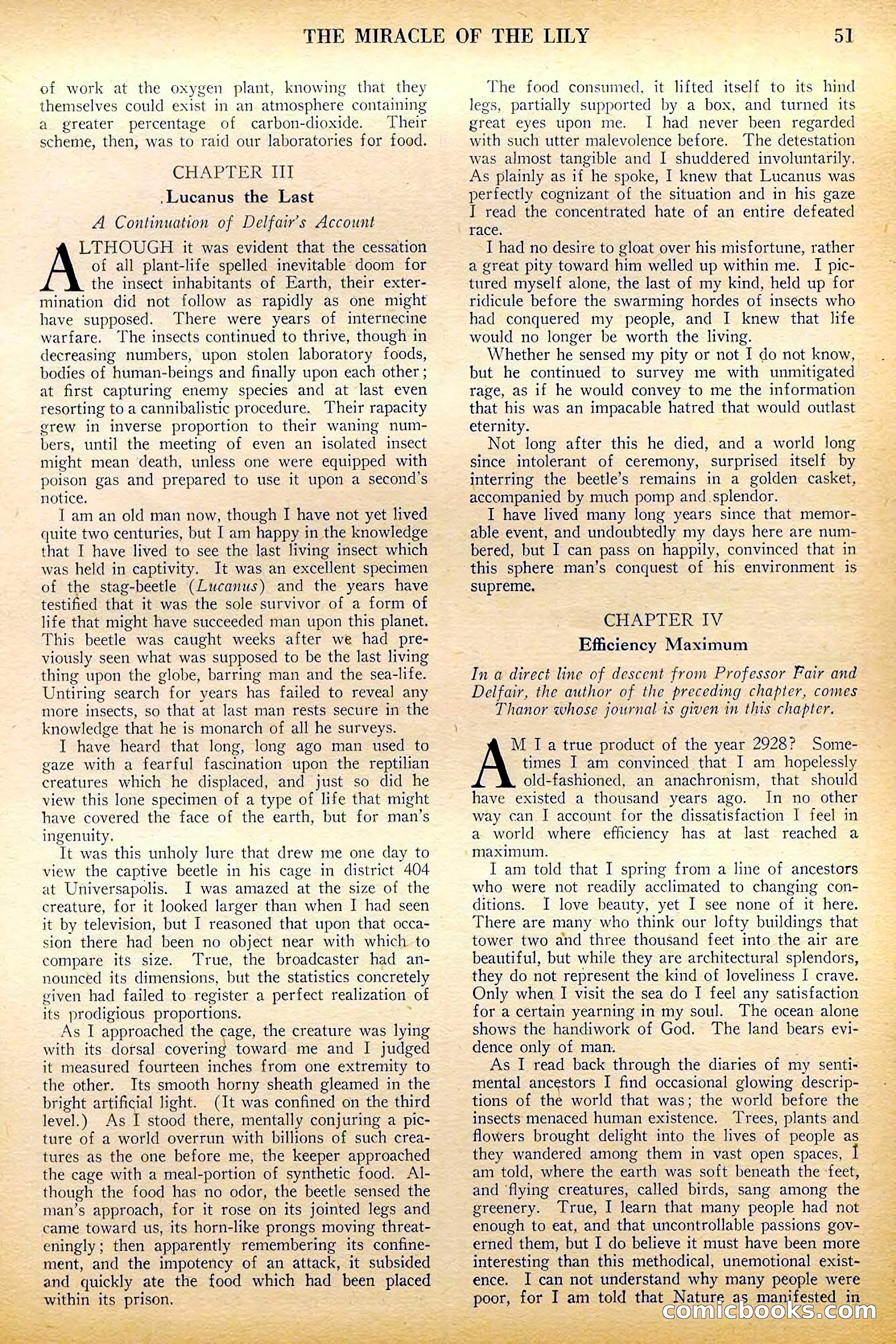
A restored page from Pulp Fiction, 1928. Page through the whole issue in the reader above.
📄 Transcribed text from this page (OCR, searchable)
Machine-transcribed from the original scan — historical spelling and the odd misread are preserved.
THE MIRACLE OF THE LILY ol of work at the oxygen plant, knowing that they themselves could exist in an atmosphere containing a greater percentage of carbon-dioxide. Their scheme, then, was to raid our laboratories for food. CHAPTER IIT .Lucanus the Last A Continuation of Delfawr’s Account LTHOUGH it was evident that the cessation A of all plant-life spelled inevitable doom for the insect inhabitants of Earth, their exter- mination did not follow as rapidly as one might have supposed. There were years of internecine warfare. The insects continued to thrive, though in decreasing numbers, upon stolen laboratory foods, bodies of human-beings and finally upon each other ; at first capturing enemy species and at last even resorting to a cannibalistic procedure. Their rapacity erew in inverse proportion to their waning num- bers, until the meeting of even an isolated insect might mean death, unless one were equipped with poison gas and prepared to use it upon a second’s notice. 1 am an old man now, though I have not yet lived quite two centuries, but I am happy in the knowledge that I have lived to see the last living insect which was held in captivity. It was an excellent specimen of the stag-beetle (Lucanus) and the years have testified that it was the sole survivor of a form of life that might have succeeded man upon this planet. This beetle was caught weeks after we had pre- viously seen what was supposed to be the last living thing upon the globe, barring man and the sea- -life. Untiring search for years has failed to reveal any more insects, so that at last man rests secure in the knowledge that he is monarch of all he surveys. I have heard that long, long ago man used to gaze with a fearful fascination upon the reptilian creatures which he displaced, and just so did he view this lone specimen of a type of life that might have covered the face of the earth, but for man’s ingenuity. It was this unholy lure that drew me one day to view the captive beetle in his cage in district 404 at Universapolis. I was amazed at the size of the creature, for it looked larger than when I had seen it by television, but I reasoned that upon that occa- sion there had been no object near with which to compare its size. True, the broadcaster had an- nounced its dimensions, but the statistics concretely given had failed to register a perfect realization of its prodigious proportions. As I approached the cage, the creature was lying with its dorsal covering toward me and I judged it measured fourteen inches from one extremity to the other. Its smooth horny sheath gleamed in the bright artificial light. (It was confined on the third level.) As I stood there, mentally conjuring a pic- ture of a world overrun with billions of such crea- tures as the one before me, the keeper approached the cage with a meal-portion of synthetic food. Al- though the food has no odor, the beetle sensed the man’s approach, for it rose on its jointed legs and came toward us, its horn-like prongs moving threat- eningly; then apparently remembering its “confine- ment, and the impotency of an attack, it subsided and quickly ate the food which had been pues within its prison. ine Sate ps Si Pn Sierras bees ce: The food consumed, it lifted itself to its hind legs, partially supported by a box, and turned its great eyes upon me. I had never been regarded with such utter malevolence before. The detestation was almost tangible and I shuddered involuntarily. As plainly as if he spoke, I knew that Lucanus was perfectly cognizant of the situation and in his gaze I read the concentrated hate of an entire defeated race. I had no desire to gloat over his misfortune, rather a great pity toward him welled up within me. I pic- tured myself alone, the last of my kind, held up for ridicule before the swarming hordes of insects who had conquered my people, and I knew that life would no longer be worth the living. Whether he sensed my pity or not I do not know, but he continued to survey me with unmitigated rage, as if he would convey to me the information that his was an impacable hatred that would outlast eternity. Not long after this he died, and a world long since intolerant of ceremony, surprised itself by interring the beetle’s remains in a golden casket, accompanied by much pomp and splendor. I have lived many long years since that memor- able event, and undoubtedly my days here are num- bered, but I can pass on happily, convinced that in this sphere man’s conquest of his environment is supreme. CHAPTER IV Efficiency Maximum In a direct line of descent from Professor Fair and Delfair, the author of the preceding chapter, comes Thanor whose journal is given in this chapter. M [ a true product of the year 2928? Some- A times I am convinced that I am hopelessly old-fashioned, an anachronism, that should have existed a thousand years ago. In no other way can I account for the dissatisfaction I feel in a world where efficiency has at last reached a maximum. I am told that I spring from a line of ancestors who were not readily acclimated to changing con- ditions. I love beauty, yet I see none of it here. There are many who think our lofty buildings that tower two and three thousand feet into the air are beautiful, but while they are architectural splendors, they do not represent the kind of loveliness I crave. Only when I visit the sea do I feel any satisfaction for a certain yearning in my soul. The ocean alone shows the handiwork of God. The land bears evi- dence only of man. As I read back through the diaries of my senti- mental ancestors I find occasional glowing descrip- tions of the world that was; the world before the insects menaced human existence. Trees, plants and flowers brought delight into the lives of people as they wandered among them in vast open spaces, am told, where the earth was soft beneath the feet, and ‘flying creatures, called birds, sang among the greenery. True, I learn that many people had not enough to eat, and that uncontrollable passions gov- erned them, but I do believe it must have been more — interesting ‘than this methodical, unemotional exist- ence. I can not understand why many people were poor, or Iam tel that ‘omicbooks.c it GOMIEE boo “a