
Pulp Fiction, 1928 · page 55 of 99
Amazing Stories — page 55: what you’re looking at
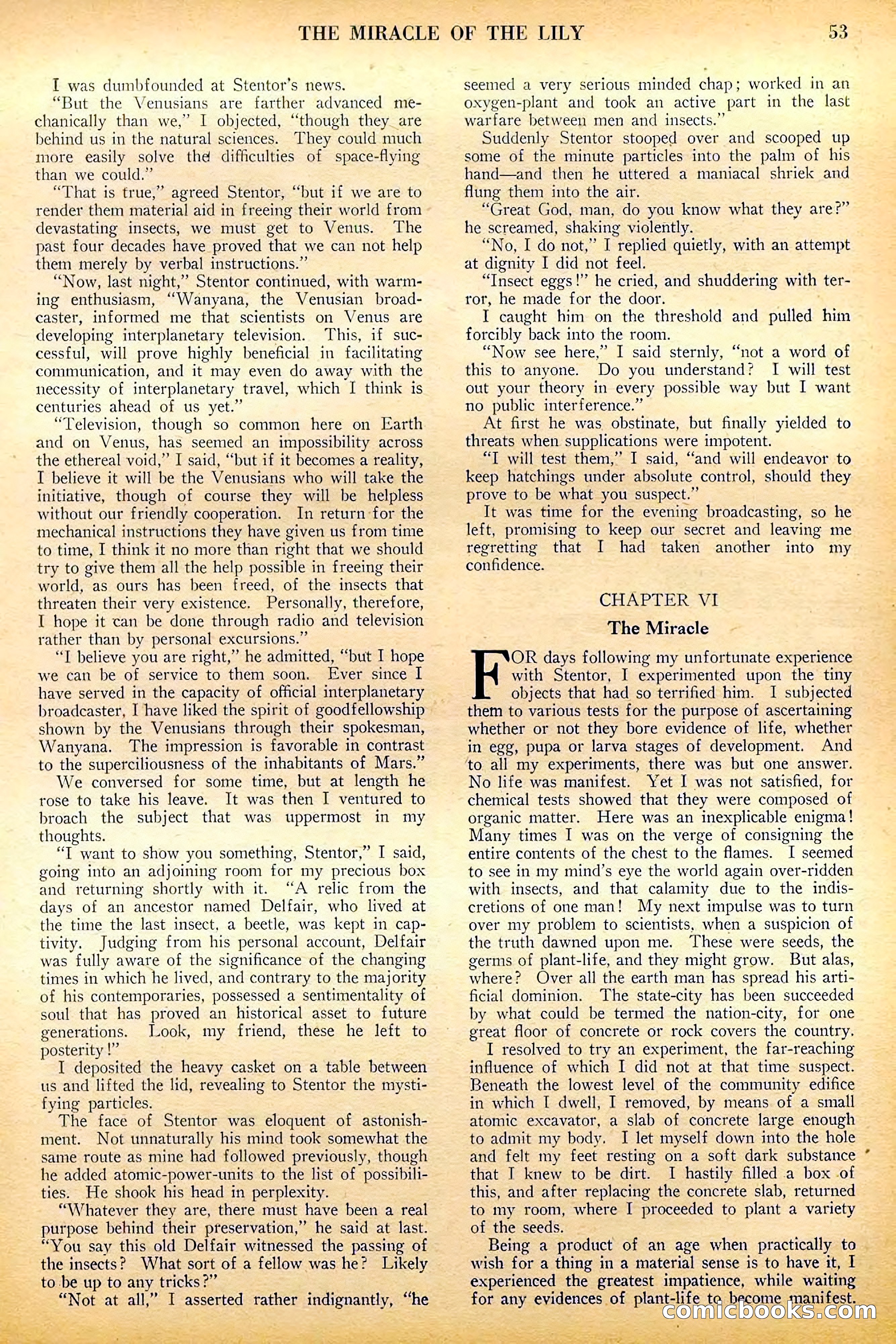
A restored page from Pulp Fiction, 1928. Page through the whole issue in the reader above.
📄 Transcribed text from this page (OCR, searchable)
Machine-transcribed from the original scan — historical spelling and the odd misread are preserved.
THE MIRACLE OF THE LILY 53 I was dumbfounded at Stentor’s news. “But the Venusians are farther advanced me- chanically than we,” I objected, “though they are behind us in the natural sciences. They could much more easily solve the difficulties of space-flying than we could.” “That is true,” agreed Stentor, “but if we are to render them material aid in freeing their world from devastating insects, we must get to Venus. The past four decades have proved that we can not help them merely by verbal instructions.” “Now, last night,’ Stentor continued, with warm- ing enthusiasm, ‘““Wanyana, the Venusian broad- caster, informed me that scientists on Venus are developing interplanetary television. This, if suc- cessful, will prove highly beneficial in facilitating communication, and it may even do away with the necessity of interplanetary travel, which I think is centuries ahead of us yet.” “Television, though so common here on Earth and on Venus, has seemed an impossibility across the ethereal void,” I said, “but if it becomes a reality, I believe it will be the Venusians who will take the initiative, though of course they will be helpless without our friendly cooperation. In return for the mechanical instructions they have given us from time to time, I think it no more than right that we should try to give them all the help possible in freeing their world, as ours has been freed, of the insects that threaten their very existence. Personally, therefore, I hope it can be done through radio and television rather than by personal excursions.” “T believe you are right,” he admitted, “but I hope we can be of service to them soon. Ever since I have served in the capacity of official interplanetary broadcaster, I have liked the spirit of goodfellowship shown by the Venusians through their spokesman, Wanyana. The impression is favorable in contrast to the superciliousness of the inhabitants of Mars.” We conversed for some time, but at length he rose to take his leave. It was then I ventured to broach the subject that was uppermost in my thoughts. “T want to show you something, Stentor,” I said, going into an adjoining room for my precious box and returning shortly with it. “A relic from the days of an ancestor named Delfair, who lived at the time the last insect, a beetle, was kept in cap- tivity. Judging from his personal account, Delfair was fully aware of the significance of the changing times in which he lived, and contrary to the majority of his contemporaries, possessed a sentimentality of soul that has proved an historical asset to future generations. Look, my friend, these he left to posterity !” I deposited the heavy casket on a table between us and lifted the lid, revealing to Stentor the mysti- fying particles. The face of Stentor was eloquent of astonish- ment. Not unnaturally his mind took somewhat the same route as mine had followed previously, though he added atomic-power-units to the list of possibili- ties. He shook his head in perplexity. “Whatever they are, there must have been a real purpose behind their preservation,” he said at last. “You say this old Delfair witnessed the passing of the insects? What sort of a fellow was he? Likely to be up to any tricks?” ; “Not at all,” I asserted rather indignantly, “he seemed a very serious minded chap; worked in an oxygen-plant and took an active part in the last warfare between men and insects.” Suddenly Stentor stooped over and scooped up some of the minute particles into the palm of his hand—and then he uttered a maniacal shriek and flung them into the air. “Great God, man, do you know what they are?” he screamed, shaking violently. “No, I do not,” I replied quietly, with an attempt at dignity I did not feel. “Insect eggs!” he cried, and shuddering with ter- ror, he made for the door. I caught him on the threshold and pulled him forcibly back into the room. “Now see here,’ I said sternly, “not a word of this to anyone. Do you understand? I will test out your theory in every possible way but I want no public interference.” At first he was obstinate, but finally yielded to threats when supplications were impotent. “T will test them,” I said, “and will endeavor to keep hatchings under absolute control, should they prove to be what you suspect.” It was time for the evening broadcasting, so he left, promising to keep our secret and leaving me regretting that I had taken another into my confidence. CHAPTER VI The Miracle OR days following my unfortunate experience with Stentor, I experimented upon the tiny objects that had so terrified him. I subjected them to various tests for the purpose of ascertaining whether or not they bore evidence of life, whether in egg, pupa or larva stages of development. And ‘to all my experiments, there was but one answer. No life was manifest. Yet I was not satisfied, for chemical tests showed that they were composed of organic matter. Here was an inexplicable enigma! Many times I was on the verge of consigning the entire contents of the chest to the flames. I seemed to see in my mind’s eye the world again over-ridden with insects, and that calamity due to the indis- cretions of one man! My next impulse was to turn over my problem to scientists, when a suspicion of the truth dawned upon me. These were seeds, the germs of plant-life, and they might grow. But alas, where? Over all the earth man has spread his arti- ficial dominion. The state-city has been succeeded by what could be termed the nation-city, for one great floor of concrete or rock covers the country. I resolved to try an experiment, the far-reaching influence of which I did not at that time suspect. Beneath the lowest level of the community edifice in which I dwell, I removed, by means of a small atomic excavator, a slab of concrete large enough to admit my body. I let myself down into the hole and felt my feet resting on a soft dark substance that I knew to be dirt. I hastily filled a box of this, and after replacing the concrete slab, returned to my room, where I proceeded to plant a variety of the seeds. Being a product of an age when practically to — wish for a thing in a material sense is to have it, I _ experienced the greatest impatience, while waiting for any evidences of plant-life te, become manifest y SComichook roe, AS