
Pulp Fiction, 1928 · page 23 of 99
Amazing Stories — page 23: what you’re looking at
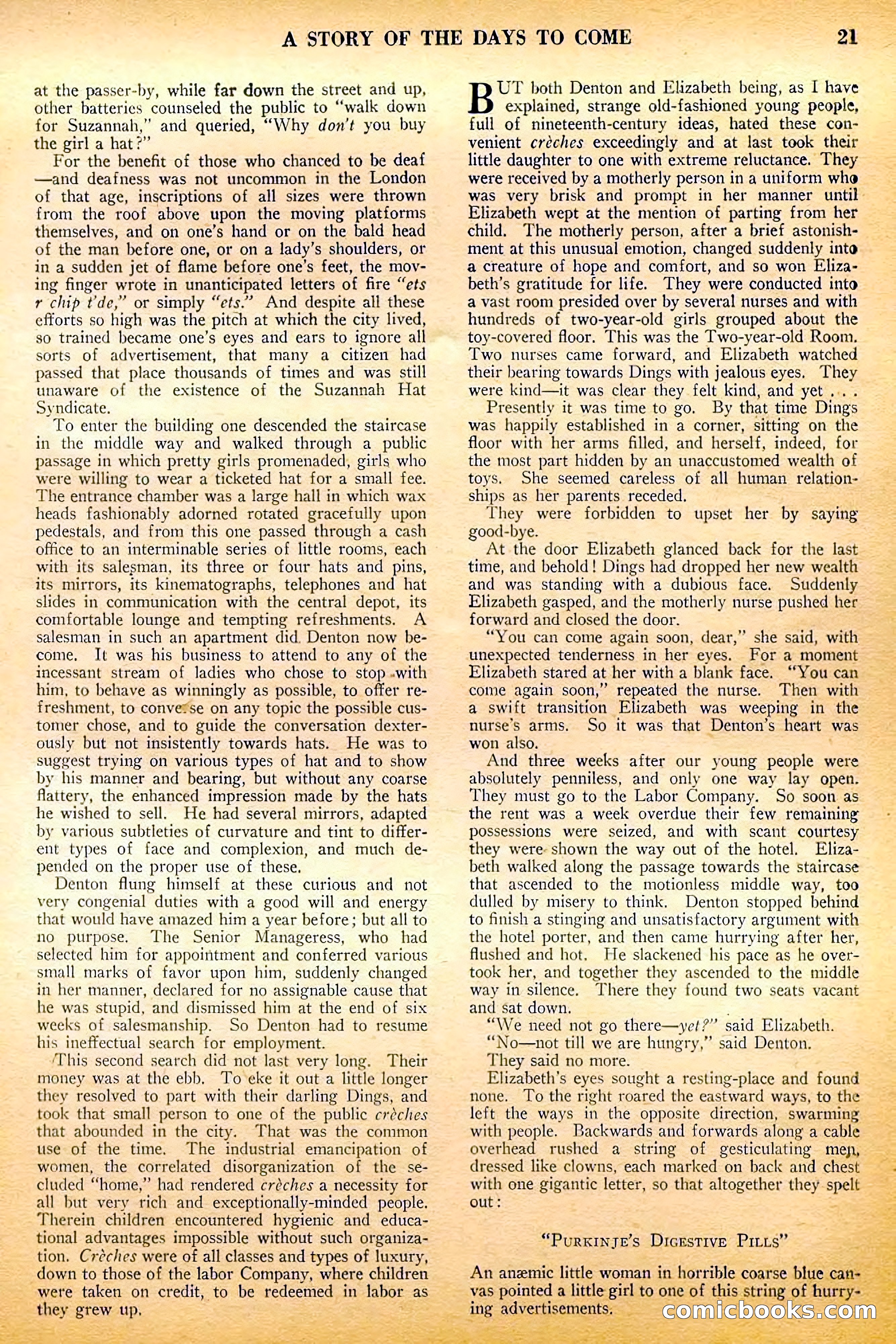
A restored page from Pulp Fiction, 1928. Page through the whole issue in the reader above.
📄 Transcribed text from this page (OCR, searchable)
Machine-transcribed from the original scan — historical spelling and the odd misread are preserved.
ae - 4s a A STORY OF THE DAYS TO COME = | 21 at the passer-by, while far down the street and up, other batterics counseled the public to “walk down for Suzannah,” and queried, “Why don’t you buy the girl a hat: 2 For the benefit of those who chanced to be deaf —and deafness was not uncommon in the London of that age, inscriptions of all sizes were thrown from the roof above upon the moving platforms themselves, and on one’s hand or on the bald head of the man before one, or on a lady’s shoulders, or in a sudden jet of flame before one’s feet, the mov- ing finger wrote in unanticipated letters of fire “ets r chip tde,” or simply “ets.’ And despite all these efforts so high was the pitch at which the city lived, so trained became one’s eyes and ears to ignore all sorts of advertisement, that many a citizen had passed that place thousands of times and was still unaware of the existence of the Suzannah Hat Syndicate. To enter the building one descended the staircase in the middle way and walked through a public passage in which pretty girls promenaded, girls who were willing to wear a ticketed hat for a small fee. The entrance chamber was a large hall in which wax heads fashionably adorned rotated gracefully upon pedestals, and from this one passed through a cash office to an interminable series of little rooms, each with its salesman, its three or four hats and pins, its mirrors, its kinematographs, telephones and hat slides in communication with the central depot, its comfortable lounge and tempting refreshments. A salesman in such an apartment did. Denton now be- come. It was his business to attend to any of the incessant stream of ladies who chose to stop .with him, to behave as winningly as possible, to offer re- freshment, to converse on any topic the possible cus- tomer chose, and to guide the conversation dexter- ously but not insistently towards hats. He was to suggest trying on various types of hat and to show by his manner and bearing, but without any coarse flattery, the enhanced impression made by the hats he wished to sell. He had several mirrors, adapted by various subtleties of curvature and tint to differ- ent types of face and complexion, and much de- pended on the proper use of these, Denton flung himself at these curious and not very congenial duties with a good will and energy that would have amazed him a year before; but all to no purpose. The Senior Manageress, who had selected him for appointment and conferred various small marks of favor upon him, suddenly changed in her manner, declared for no assignable cause that he was stupid, and dismissed him at the end of six weeks of salesmanship. So Denton had to resume his ineffectual search for employment. ‘This second search did not last very long. Their money was at the ebb. To eke it out a little longer they resolved to part with their darling Dings, and took that small person to one of the public créches that abounded in the city. That was the common use of the time. The industrial emancipation of women, the correlated disorganization of the se- cluded “home, ” had rendered créches a necessity for all but very rich and exceptionally-minded people. Therein children encountered hygienic and educa- tional advantages impossible without such organiza- tion. Créches were of all classes and types of luxury, down to those of the labor Company, where children were taken on credit, to be redeemed in LO as Seay. =Brew. ae. ST hee Se fF — Ld te = ~~. — ~~. | fe. — dines UT both Denton and Elizabeth being, as I have B explained, strange old-fashioned young people, full of nineteenth-century ideas, hated these con- venient créches exceedingly and at last took their little daughter to one with extreme reluctance. They were received by a motherly person in a uniform who was very brisk and prompt in her manner until Elizabeth wept at the mention of parting from her child. The motherly person, after a brief astonish- ment at this unusual emotion, changed suddenly into a creature of hope and comfort, and so won Eliza- beth’s gratitude for life. They were conducted into a vast room presided over by several nurses and with hundreds of two-year-old girls grouped about the toy-covered floor. This was the Two-year-old Room. Two nurses came forward, and Elizabeth watched their bearing towards Dings with jealous eyes, They were kind—it was clear they felt kind, and yet . Presently it was time to go. By that time Dings was happily established in a corner, sitting on the floor with her arms filled, and herself, indeed, for the most part hidden by an unaccustomed wealth of toys. She seemed careless of all human relation- ships as her parents receded, They were forbidden to upset her by saying good-bye. At the door Elizabeth glanced back for the last time, and behold! Dings had dropped her new wealth and was standing with a dubious face. Suddenly Elizabeth gasped, and the motherly nurse pushed her forward and closed the door. “You can come again soon, dear, unexpected tenderness in her eyes. For a moment Elizabeth stared at her with a blank face. come again soon,” repeated the nurse. Then with a swift transition Elizabeth was weeping in the nurse’s arms. won also. And three weeks after our young people were absolutely penniless, and only one way lay open. They must go to the Labor Company. So soon as the rent was a week overdue their few remaining possessions were seized, and with scant courtesy they were- shown the way out of the hotel. Eliza- beth walked along the passage towards the staircase that ascended to the motionless middle way, too dulled by misery to think. Denton stopped behind to finish a stinging and unsatisfactory argument with the hotel porter, and then came hurrying after her, flushed and hot. He slackened his pace as he over- took her, and together they ascended to the middle way in silence. There they found two seats vacant and sat down. “We need not go there—yel?” said Elizabeth. “No—not till we are hungry,” said Denton. They said no more. Elizabeth's eyes sought a resting-place and found none. To the right roared the eastward ways, to the left the ways in the opposite direction, swarming with people. Backwards and forwards along a cable overhead rushed a string of gesticulating mep, — dressed like clowns, each marked on back and chest — with one gigantic letter, so that altogether they. spelt out: S “PurKINJE’s Dicestive Pits” An anemic little woman in horrible coarse bh le vas pointed | a little girl this. ” she said, with — “Youcane So it was that Denton’s heart was —