
Pulp Fiction, 1928 · page 24 of 99
Amazing Stories — page 24: what you’re looking at
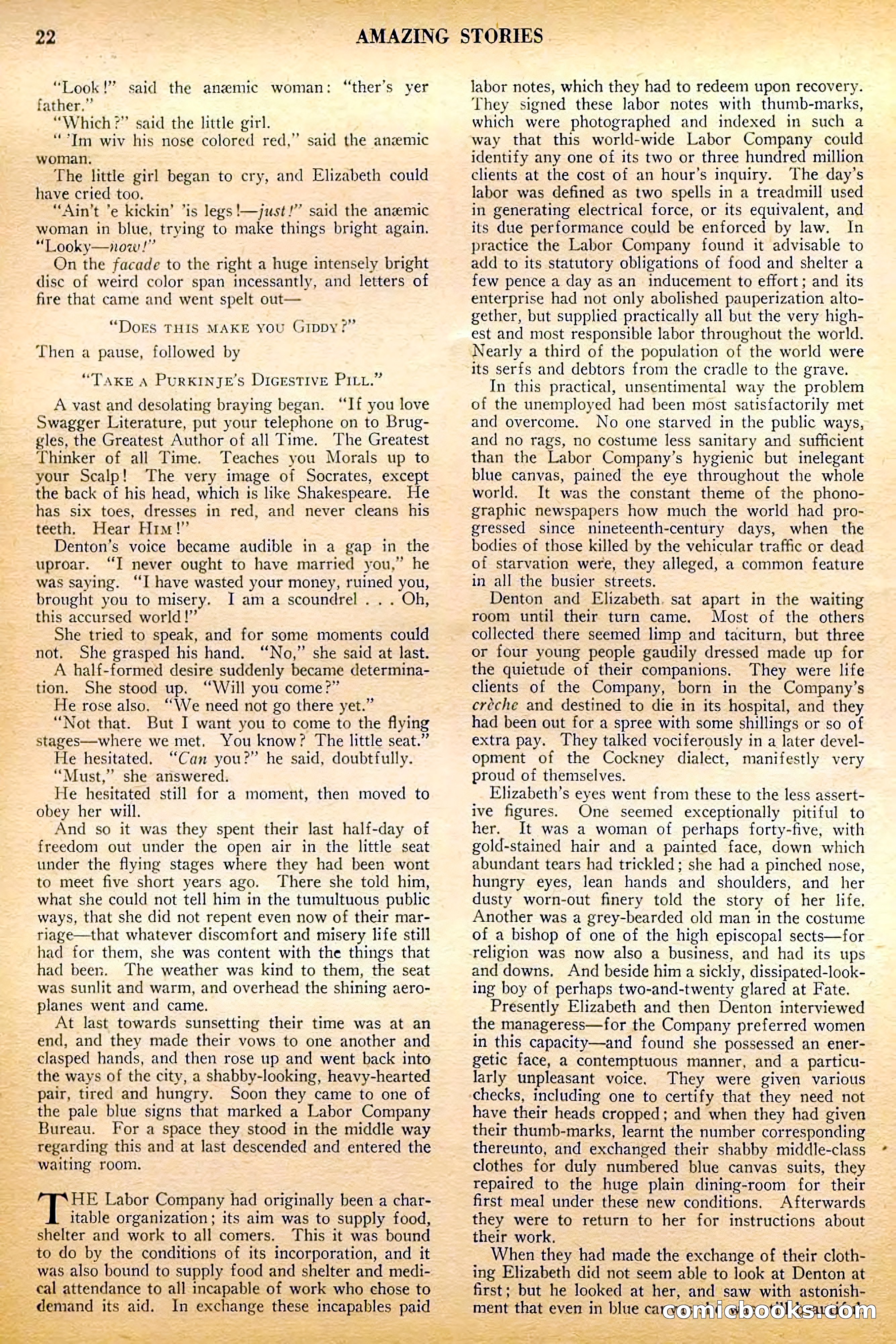
A restored page from Pulp Fiction, 1928. Page through the whole issue in the reader above.
📄 Transcribed text from this page (OCR, searchable)
Machine-transcribed from the original scan — historical spelling and the odd misread are preserved.
— a eer a ee ot < e - er 22 AMAZING STORIES “Look!”’ said the anemic woman: “ther’s yer father.” “Which ?” said the little girl. ‘Im wiv his nose colored red,” said the anemic woman, The little girl began to cry, and Elizabeth could have cried too. “Ain't "e kickin’ ‘is legs !—just!’”’ said the anemic woman in blue, trying to make things bright again. “Looky—now!” On the facade to the right a huge intensely bright disc of weird color span incessantly, and letters of fire that came and went spelt out— “Dorks THIS MAKE you Gippy?” Then a pause, followed by “Take A Purkinje’s Dicestive Pitt.” A vast and desolating braying began. “If you love Swagger Literature, put your telephone on to Brug- «les, the Greatest Author of all Time. The Greatest Thinker of all Time. Teaches you Morals up to your Scalp! The very image of Socrates, except the back of his head, which is like Shakespeare. He has six toes, dresses in red, and never cleans his teeth. Hear Him!” Denton’s voice became audible in a gap in the uproar. “I never ought to have married you,” he was saying. “I have wasted your money, ruined you, brought you to misery. I am a scoundrel . . . Oh, this accursed world!” She tried to speak, and for some moments could not. She grasped his hand. “No,” she said at last. A half-formed desire suddenly became determina- tion. She stood up. “Will you come?” He rose also, ‘We need not go there yet.” “Not that. But I want you to come to the flying stages—where we met. You know? The little seat.” He hesitated. “Can you?” he said, doubtfully. “Must,” she answered. He hesitated still for a moment, then moved to obey her will. And so it was they spent their last half-day of freedom out under the open air in the little seat under the flying stages where they had been wont to meet five short years ago. There she told him, what she could not tell him in the tumultuous public ways, that she did not repent even now of their mar- tiage—that whatever discomfort and misery life still had for them, she was content with the things that had beer. The weather was kind to them, the seat was sunlit and warm, and overhead the shining aero- planes went and came. At last towards sunsetting their time was at an end, and they made their vows to one another and clasped hands, and then rose up and went back into the ways of the city, a shabby-looking, heavy-hearted pair, tired and hungry. Soon they came to one of the pale blue signs that marked a Labor Company Bureau. For a space they stood in the middle way regarding this and at last descended and entered the waiting room. HE Labor Company had originally been a char- itable organization; its aim was to supply food, shelter and work to all comers. This it was bound to do by the conditions of its incorporation, and it was also bound to supply food and shelter and medi- _¢al attendance to all incapable of work who chose to _ demand its aid. In exchange these incapables paid labor notes, which they had to redeem upon recovery. They signed these labor notes with thumb-marks, which were photographed and indexed in such a way that this world-wide Labor Company could identify any one of its two or three hundred million clients at the cost of an hour’s inquiry. The day’s labor was defined as two spells in a treadmill used in generating electrical force, or its equivalent, and its due performance could be enforced by law. In practice the Labor Company found it advisable to add to its statutory obligations of food and shelter a few pence a day as an inducement to effort; and its enterprise had not only abolished pauperization alto- gether, but supplied practically all but the very high- est and most responsible labor throughout the world. Nearly a third of the population of the world were its serfs and debtors from the cradle to the grave. In this practical, unsentimental way the problem of the unemployed had been most satisfactorily met and overcome. No one starved in the public ways, and no rags, no costume less sanitary and sufficient than the Labor Company’s hygienic but inelegant blue canvas, pained the eye throughout the whole world. It was the constant theme of the phono- graphic newspapers how much the world had pro- gressed since nineteenth-century days, when the bodies of those killed by the vehicular traffic or dead of starvation were, they alleged, a common feature in all the busier streets. Denton and Elizabeth. sat apart in the waiting room until their turn came. Most of the others collected there seemed limp and taciturn, but three or four young people gaudily dressed made up for the quietude of their companions. They were life clients of the Company, born in the Company’s créche and destined to die in its hospital, and they had been out for a spree with some shillings or so of extra pay. They talked vociferously in a later devel- opment of the Cockney dialect, manifestly very proud of themselves. Elizabeth’s eyes went from these to the less assert- ive figures. One seemed exceptionally pitiful to her. It was a woman of perhaps forty-five, with gold-stained hair and a painted face, down which abundant tears had trickled; she had a pinched nose, hungry eyes, lean hands and shoulders, and her dusty worn-out finery told the story of her life, Another was a grey-bearded old man in the costume of a bishop of one of the high episcopal sects—for religion was now also a business, and had its ups and downs. And beside him a sickly, dissipated-look- ing boy of perhaps two-and-twenty glared at Fate. Presently Elizabeth and then Denton interviewed the manageress—for the Company preferred women in this capacity—and found she possessed an ener- getic face, a contemptuous manner, and a particu- larly unpleasant voice. They were given various checks, including one to certify that they need not have their heads cropped; and when they had given their thumb-marks, learnt the number corresponding thereunto, and exchanged their shabby middle-class clothes for duly numbered blue canvas suits, they repaired to the huge plain dining-room for their first meal under these new conditions. Afterwards they were to return to her for instructions about their work. When they had made the exchange of their cloth- ing Elizabeth did not seem able to look at Denton at — first; but he looked at her, and saw with astonish-— ment that even in blue cararayaay@ sXofol ead) ee i a et eh et it et ai OI peg Ft Nt gee eee a Mls SN 5 na am NRE 0 be mete oe re