
Pulp Fiction, 1928 · page 22 of 99
Amazing Stories — page 22: what you’re looking at
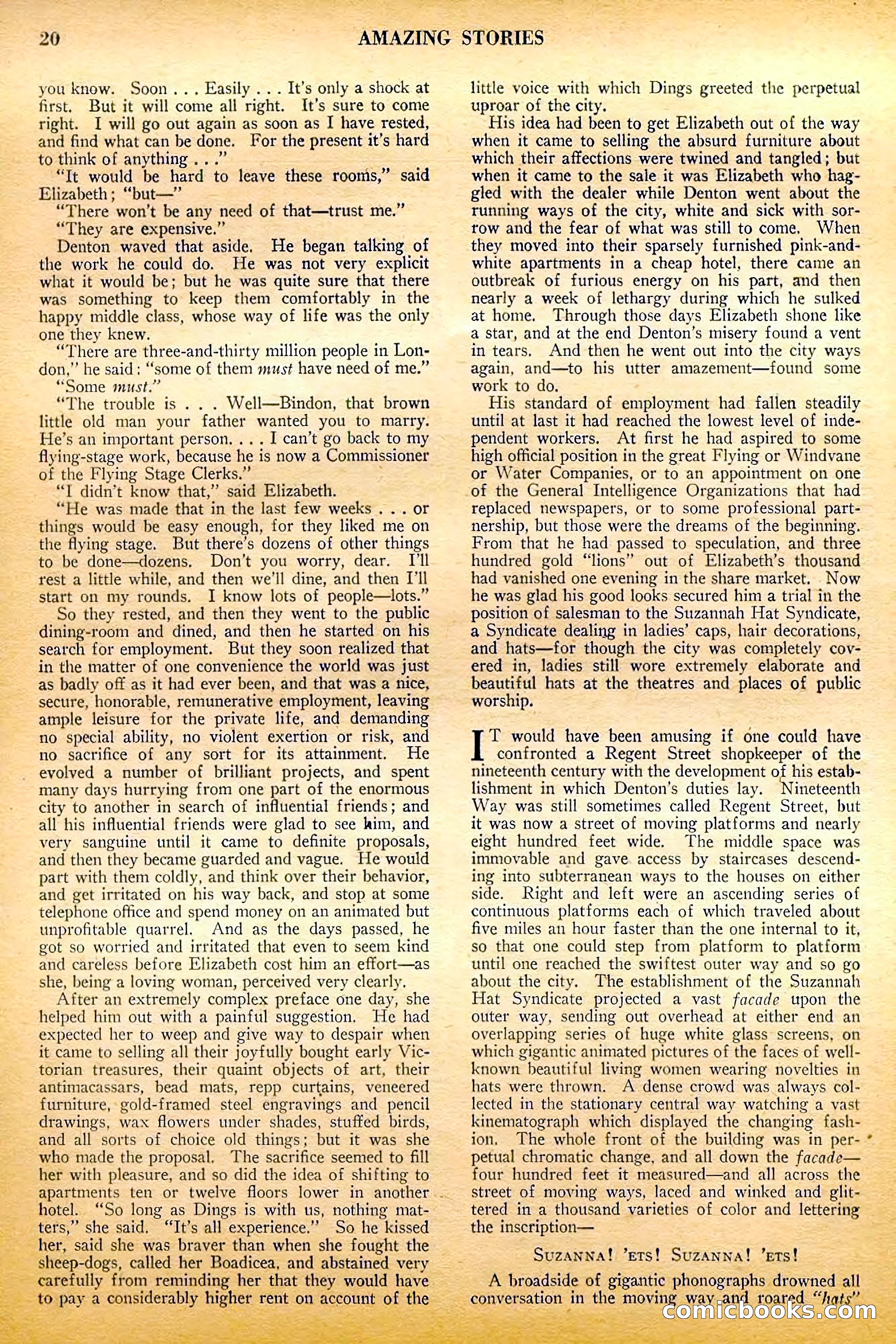
A restored page from Pulp Fiction, 1928. Page through the whole issue in the reader above.
📄 Transcribed text from this page (OCR, searchable)
Machine-transcribed from the original scan — historical spelling and the odd misread are preserved.
20 AMAZING STORIES you know. Soon... Easily ... It’s only a shock at first. But it will come all right. It’s sure to come right. I will go out again as soon as I have rested, and find what can be done. For the present it’s hard to think of anything... font would be hard to leave these roomis,” said Elizabeth; “but— “There won't be any need of that—trust me.” “They are expensive.” Denton waved that aside. He began talking of the work he could do. He was not very explicit what it would be; but he was quite sure that there was something to keep them comfortably in the happy middle class, whose way of life was the only one they knew. “There are three- and-thirty million people in Lon- don,” he said; “some of them must have need of me.’ “Some must.” “The trouble is . . . Well—Bindon, that brown little old man your father wanted you to marry. He’s an important person. ... I can’t go back to my flying-stage work, because he i is now a Commissioner of the Flying Stage Clerks.” “T didn’t know that,” said Elizabeth. “He was made that in the last few weeks... or things would be easy enough, for they liked me on the flying stage. But there’s dozens of other things to be done—dozens, Don’t you worry, dear. I'll rest a little while, and then we'll dine, and then Dil start on my rounds. I know lots of people—lots.” So they rested, and then they went to the public _ dining-room and dined, and then he started on his ns.) ie a i ~who made the proposal. her with pleasure, and so did the idea of shifting to _ apartments ten or twelve floors lower in another . 5 hotel. eters; her, said she was braver than when she fought the — ep-dogs, called her Boadicea, east abstained very _ search for employment. But they soon realized that in the matter of one convenience the world was just as badly off as it had ever been, and that was a nice, secure, honorable, remunerative employment, leaving ample leisure for the private life, and demanding no special ability, no violent exertion or risk, and no sacrifice of any sort for its attainment. He evolved a number of brilliant projects, and spent many days hurrying from one part of the enormous city to another in search of influential friends; and all his influential friends were glad to see him, and very sanguine until it came to definite proposals, and then they became guarded and vague. He would part with them coldly, and think over their behavior, and get irritated on his way back, and stop at some telephone office and spend money on an animated but unprofitable quarrel. And as the days passed, he got so worried and irritated that even to seem kind and careless before Elizabeth cost him an effort—as she, being a loving woman, perceived very clearly. Aiter an extremely complex preface one day, she helped him out with a painful suggestion. He had expected her to weep and give way to despair when it came to selling all their joyfully bought early Vic- torian treasures, their quaint objects of art, their antimacassars, bead mats, repp curtains, veneered furniture, gold- framed steel engravings and pencil drawings, wax flowers under shades, stuffed birds, and all sorts of choice old things; but it was she The sacrifice seemed to fill “So long as Dings is with us, nothing mat- she said, “It’s all experience.” So he kissed et es in. a *e” - he - oe ee | ‘@. Vi little voice with which Dings greeted the perpetual uproar of the city. His idea had been to get Elizabeth out of the way when it came to selling the absurd furniture about which their affections were twined and tangled; but when it came to the sale it was Elizabeth who hag- gled with the dealer while Denton went about the running ways of the city, white and sick with sor- row and the fear of what was still to come. When they moved into their sparsely furnished pink-and- white apartments in a cheap hotel, there came an outbreak of furious energy on his part, and then nearly a week of lethargy during which he sulked at home. Through those days Elizabeth shone like a star, and at the end Denton’s misery found a vent in tears. And then he went out into the city ways again, and—to his utter amazement—found some work to do. His standard of employment had fallen steadily until at last it had reached the lowest level of inde- pendent workers. At first he had aspired to some high official position in the great Flying or Windvane or Water Companies, or to an appointment on one of the General Intelligence Organizations that had replaced newspapers, or to some professional part- nership, but those were the dreams of the beginning. From that he had passed to speculation, and three hundred gold “lions” out of Elizabeth’s thousand had vanished one evening in the share market. Now he was glad his good looks secured him a trial in the position of salesman to the Suzannah Hat Syndicate, a Syndicate dealing in ladies’ caps, hair decorations, and hats—for though the city was completely cov- ered in, ladies still wore extremely elaborate and beautiful hats at the theatres and places of public worship. jie would have been amusing if one could have confronted a Regent Street shopkeeper of the nineteenth century with the development of his estab- lishment in which Denton’s duties lay. Nineteenth Way was still sometimes called Regent Street, but it was now a street of moving platforms and nearly eight hundred feet wide. The middle space was immovable and gave. access by staircases descend- ing into subterranean ways to the houses on either side. Right and left were an ascending series of continuous platforms each of which traveled about five miles an hour faster than the one internal to it, so that one could step from platform to platform until one reached the swiftest outer way and so go about the city. The establishment of the Suzannah Hat Syndicate projected a vast facade upon the outer way, sending out overhead at either end an overlapping series of huge white glass screens, on which gigantic animated pictures of the faces of well- known beautiful living women wearing novelties in hats were thrown. A dense crowd was always col- lected in the stationary central way watching a vast kinematograph which displayed the changing fash- ion. The whole front of the building was in per- * petual chromatic change, and all down the facade— four hundred feet it measured—and all across the street of moving ways, laced and winked and glit- tered in a thousand varieties of color and lettering the inscription— Suzanna! ‘ets! Suzanna! 'ets! < Aes broadside of gigantic phonogmpande owned all ec way ee j 4