
Pulp Fiction, 1928 · page 21 of 99
Amazing Stories — page 21: what you’re looking at
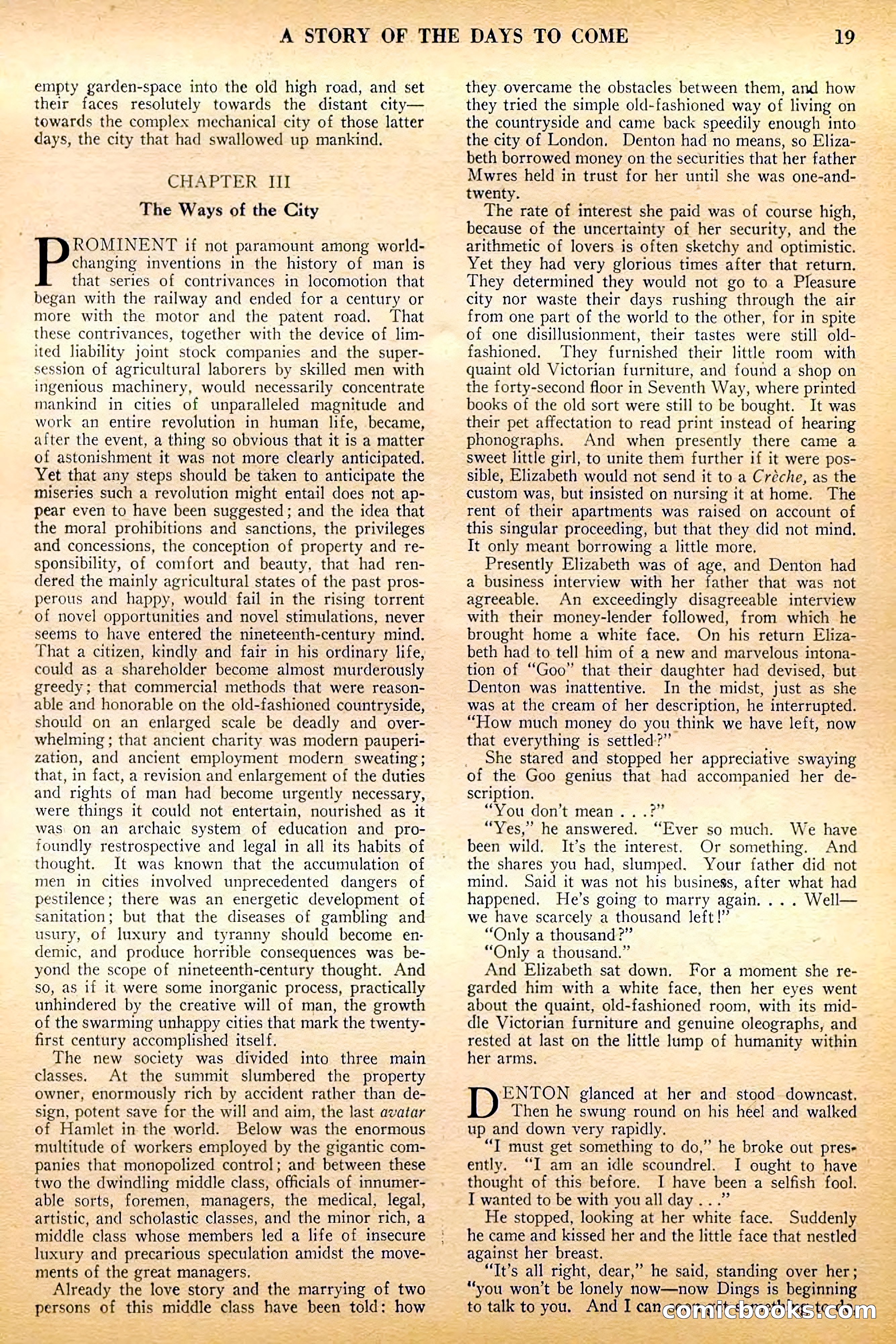
A restored page from Pulp Fiction, 1928. Page through the whole issue in the reader above.
📄 Transcribed text from this page (OCR, searchable)
Machine-transcribed from the original scan — historical spelling and the odd misread are preserved.
A STORY OF THE DAYS TO COME 19 empty garden-space into the old high road, and set their faces resolutely towards the distant city— towards the complex mechanical city of those latter days, the city that had swallowed up mankind. CHAPTER III The Ways of the City ROMINENT if not paramount among world- changing inventions in the history of man is that series of contrivances in locomotion that began with the railway and ended for a century or more with the motor and the patent road. That these contrivances, together with the device of lim- ited liability joint stock companies and the super- session of agricultural laborers by skilled men with ingenious machinery, would necessarily concentrate mankind in cities of unparalleled magnitude and work an entire revolution in human life, became, after the event, a thing so obvious that it is a matter of astonishment it was not more clearly anticipated. Yet that any steps should be taken to anticipate the miseries such a revolution might entail does not ap- pear even to have been suggested; and the idea that the moral prohibitions and sanctions, the privileges and concessions, the conception of property and re- sponsibility, of comfort and beauty, that had ren- dered the mainly agricultural states ‘of the past pros- perous and happy, would fail in the rising torrent ’ of novel opportunities and novel stimulations, never seems to have entered the nineteenth-century mind, That a citizen, kindly and fair in his ordinary life, could as a shareholder become almost murderously greedy; that commercial methods that were reason- able and honorable on the old-fashioned countryside, should on an enlarged scale be deadly and over- whelming ; that ancient charity was modern pauperi- zation, and ancient employment modern sweating; that, in fact, a revision and enlargement of the duties and rights of man had become urgently necessary, were things it could not entertain, nourished as it was on an archaic system of education and pro- foundly restrospective and legal in all its habits of thought. It was known that the accumulation of men in cities involved unprecedented dangers of pestilence; there was an energetic development of sanitation; but that the diseases of gambling and usury, of luxury and tyranny should become en- demic, and produce horrible consequences was be- yond the scope of nineteenth-century thought. And so, as if it were some inorganic process, practically unhindered by the creative will of man, the growth of the swarming unhappy cities that mark the twenty- first century accomplished itself. The new society was divided into three main classes. At the summit slumbered the property owner, enormously rich by accident rather than de- sign, potent save for the will and aim, the last avatar of Hamlet in the world. Below was the enormous multitude of workers employed by the gigantic com- panies that monopolized control; and between these two the dwindling middle class, officials of innumer- able sorts, foremen, managers, the medical, legal, artistic, and scholastic classes, and the minor rich, a middle class whose members led a life of insecure luxury and precarious speculation amidst the move- ments of the great managers. Already the love story and the marrying of two persons of this middle class have been told: how ad =F - en > o> Mii _ —" oa SON ae ae a <0) talk to nO And I -comicbooks.co oe ae yo they overcame the obstacles between them, and how they tried the simple old-fashioned way of living on the countryside and came back speedily enough into the city of London. Denton had no means, so Eliza- beth borrowed money on the securities that her father Mwres held in trust for her until she was one-and- twenty. The rate of interest she paid was of course high, because of the uncertainty of her security, and the arithmetic of lovers is often sketchy and optimistic. Yet they had very glorious times after that return. They determined they would not go to a Pleasure city nor waste their days rushing through the air from one part of the world to the other, for in spite of one disillusionment, their tastes were still old- fashioned. They furnished their little room with quaint old Victorian furniture, and found a shop on the forty-second floor in Seventh Way, where printed books of the old sort were still to be bought. It was their pet affectation to read print instead of hearing phonographs. And when presently there came a sweet little girl, to unite them further if it were pos- sible, Elizabeth would not send it to a Créche, as the custom was, but insisted on nursing it at home. The rent of their apartments was raised on account of this singular proceeding, but that they did not mind, It only meant borrowing a little more, Presently Elizabeth was of age, and Denton had a business interview with her father that was not agreeable. An exceedingly disagreeable interview with their money-lender followed, from which he brought home a white face. On his return Eliza- beth had to tell him of a new and marvelous intona- tion of “Goo” that their daughter had devised, but Denton was inattentive. In the midst, just as she was at the cream of her description, he interrupted. “How much money do you think we have left, now that everything is settled?” She stared and stopped her appreciative swaying of the Goo genius that had accompanied her de- scription. “You don’t mean ...?” “Yes,” he answered. “Ever so much. We have been wild. It’s the interest. Or something. And the shares you had, slumped. Your father did not mind. Said it was not his business, after what had happened, He’s going to marry again. .. . Well— we have scarcely a thousand left!’ “Only a thousand?” “Only a thousand.” And Elizabeth sat down. For a moment she re- garded him with a white face, then her eyes went about the quaint, old-fashioned room, with its mid- dle Victorian furniture and genuine oleographs, and rested at last on the little lump of humanity within her arms. ‘-ENTON glanced at her and stood downcast. Then he swung round on his heel and walked up and down very rapidly. “T must get something to do,” ently. “I am an idle scoundrel. I ought to have thought of this before. I have been a selfish fool. I wanted to be with you all day...” He stopped, looking at her white face. Suddenly he came and kissed her and the little face that nestled against her breast. “It’s all right, dear,” he said, standing over her; — “you won't be lonely now—now Dings is beginning _ he broke out prese a