
Pulp Fiction, 1927 · page 48 of 107
Amazing Stories, August 1927 — page 48: what you’re looking at
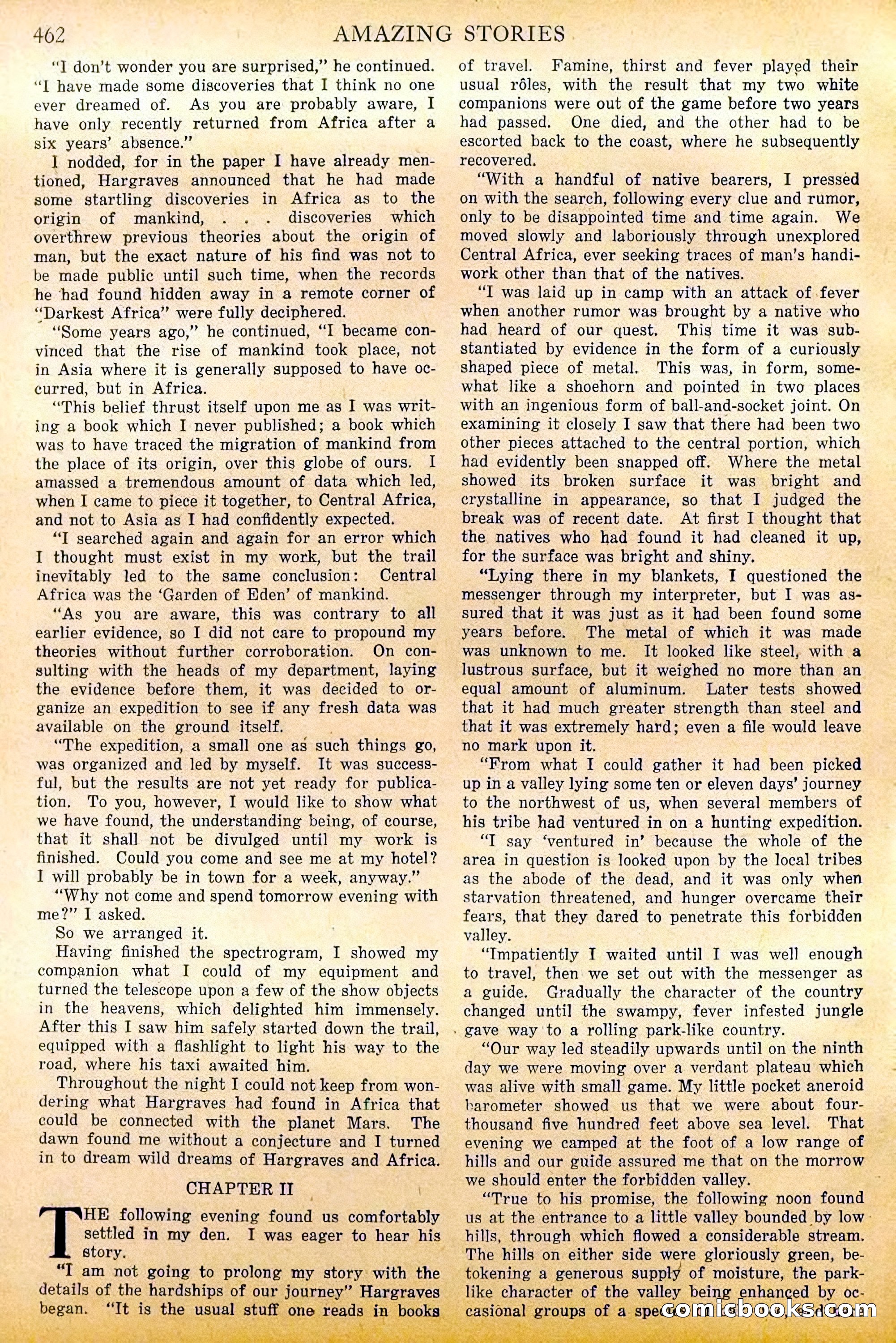
A restored page from Pulp Fiction, 1927. Page through the whole issue in the reader above.
📄 Transcribed text from this page (OCR, searchable)
Machine-transcribed from the original scan — historical spelling and the odd misread are preserved.
462 “7 don’t wonder you are surprised,” he continued. “T have made some discoveries that I think no one ever dreamed of. As you are probably aware, I have only recently returned from Africa after a six years’ absence.” J nodded, for in the paper I have already men- tioned, Hargraves announced that he had made some startling discoveries in Africa as to the origin of mankind, . . discoveries which overthrew previous theories about the origin of man, but the exact nature of his find was not to be made public until such time, when the records he ‘had found hidden away in a remote corner of “Darkest Africa” were fully deciphered. “Some years ago,” he continued, “I became con- vinced that the rise of mankind took place, not in Asia where it is generally supposed to have oc- curred, but in Africa. “This belief thrust itself upon me as I was writ- ing a book which I never published; a book which was to have traced the migration of mankind from the place of its origin, over this globe of ours, I amassed a tremendous amount of data which led, when I came to piece it together, to Central Africa, and not to Asia as I had confidently expected. “T searched again and again for an error which I thought must exist in my work, but the trail inevitably led to the same conclusion: Central Africa was the ‘Garden of Eden’ of mankind. “As you are aware, this was contrary to all earlier evidence, so I did not care to propound my theories without further corroboration. On con- sulting with the heads of my department, laying the evidence before them, it was decided to or- ganize an expedition to see if any fresh data was available on the ground itself. : “The expedition, a small one as such things go, was organized and led by myself. It was success- ful, but the results are not yet ready for publica- tion. To you, however, I would like to show what we have found, the understanding being, of course, that it shall not be divulged until my work is finished. Could you come and see me at my hotel? I will probably be in town for a week, anyway.” “Why not come and spend tomorrow evening with me?’ I asked. So we arranged it. Having finished the spectrogram, I showed my companion what I could of my equipment and turned the telescope upon a few of the show objects in the heavens, which delighted him immensely. After this I saw him safely started down the trail, equipped with a flashlight to light his way to the road, where his taxi awaited him. Throughout the night I could not keep from won- dering what Hargraves had found in Africa that could be connected with the planet Mars. The dawn found me without a conjecture and I turned in to dream wild dreams of Hargraves and Africa. CHAPTER II | \ HE following evening found us comfortably settled in my den. story. “I am not going to prolong my story with the I was eager to hear his AMAZING STORIES of travel. Famine, thirst and fever played their usual réles, with the result that my two white companions were out of the game before two years had passed. One died, and the other had to be escorted back to the coast, where he subsequently recovered. “With a handful of native bearers, I pressed on with the search, following every clue and rumor, only to be disappointed time and time again. We moved slowly and laboriously through unexplored Central Africa, ever seeking traces of man’s handi- work other than that of the natives. “T was laid up in camp with an attack of fever when another rumor was brought by a native who had heard of our quest. This time it was sub- stantiated by evidence in the form of a curiously shaped piece of metal. This was, in form, some- what like a shoehorn and pointed in two places with an ingenious form of ball-and-socket joint. On examining it closely I saw that there had been two other pieces attached to the central portion, which had evidently been snapped off. Where the metal showed its broken surface it was bright and crystalline in appearance, so that I judged the break was of recent date. At first I thought that the natives who had found it had cleaned it up, for the surface was bright and shiny. “Lying there in my blankets, I questioned the messenger through my interpreter, but I was as- sured that it was just as it had been found some years before. The metal of which it was made was unknown to me. It looked like steel, with a lustrous surface, but it weighed no more than an equal amount of aluminum. Later tests showed that it had much greater strength than steel and that it was extremely hard; even a file would leave no mark upon it. “From what I could gather it had been picked up in a valley lying some ten or eleven days’ journey to the northwest of us, when several members of his tribe had ventured in on a hunting expedition. “T say ‘ventured in’ because the whole of the area in question is looked upon by the local tribes as the abode of the dead, and it was only when starvation threatened, and hunger overcame their fears, that they dared to penetrate this forbidden valley. “Tmpatiently I waited until I was well enough to travel, then we set out with the messenger as a guide. Gradually the character of the country changed until the swampy, fever infested jungle . gave way to a rolling park-like country. “Our way led steadily upwards until on the ninth day we were moving over a verdant plateau which was alive with small game. My little pocket aneroid harometer showed us that we were about four- thousand five hundred feet above sea level. That evening we camped at the foot of a low range of hills and our guide assured me that on the morrow we should enter the forbidden valley. “True to his promise, the following noon found us at the entrance to a little valley bounded by low - hills, through which flowed a considerable stream. ‘The hills on either side were gloriously green, be- _tokening a Bencrous supp of moisture, the Ege