
Pulp Fiction, 1927 · page 47 of 107
Amazing Stories, August 1927 — page 47: what you’re looking at
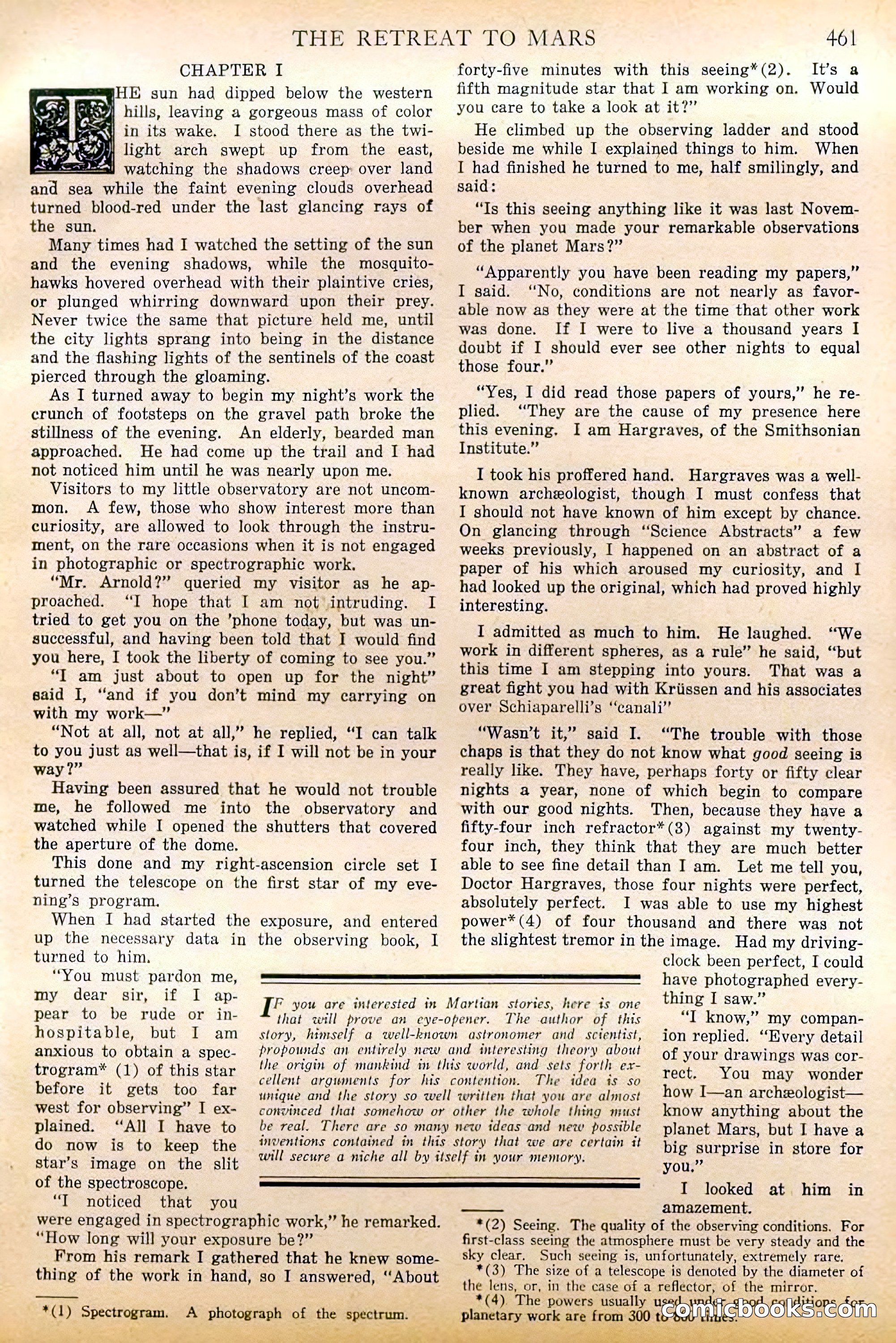
A restored page from Pulp Fiction, 1927. Page through the whole issue in the reader above.
📄 Transcribed text from this page (OCR, searchable)
Machine-transcribed from the original scan — historical spelling and the odd misread are preserved.
THE RETREAT TO MARS CHAPTER I fHE sun had dipped below the western Sse hills, leaving a gorgeous mass of color ac oA in its wake. I stood there as the twi- sty) light arch swept up from the east, pease} watching the shadows creep: over land and sea while the faint evening clouds overhead turned blood-red under the last glancing rays of the sun. Many times had I watched the setting of the sun and the evening shadows, while the mosquito- hawks hovered overhead with their plaintive cries, or plunged whirring downward upon their prey. Never twice the same that picture held me, until the city lights sprang into being in the distance and the flashing lights of the sentinels of the coast pierced through the gloaming. As I turned away to begin my night’s work the crunch of footsteps on the gravel path broke the stillness of the evening. An elderly, bearded man approached. He had come up the trail and I had not noticed him until he was nearly upon me. Visitors to my little observatory are not uncom- mon. A few, those who show interest more than curiosity, are allowed to look through the instru- ment, on the rare occasions when it is not engaged in photographie or spectrographic work. “Mr. Arnold?” queried my visitor as he ap- proached. “I hope that I am not intruding. I tried to get you on the ’phone today, but was un- successful, and having been told that I would find you here, I took the liberty of coming to see you.” “T am just about to open up for the night” said I, ‘and if you don’t mind my carrying on with my work—” “Not at all, not at all,” he replied, “I can talk to you just as well—that is, if I will not be in your way?” Having been assured that he would not trouble me, he followed me into the observatory and watched while I opened the shutters that covered the aperture of the dome. This done and my right-ascension circle set I turned the telescope on the first star of my eve- ning’s program. When I had started the exposure, and entered up the necessary data in the observing book, I turned to him. “You must pardon me, my dear sir, pear to be rude or in- that will prove an eye-opener. hospitable, but I am_ story, anxious to obtain a spec- trogram™ (1) of this star before it gets too far west for observing” I ex- plained. “All I have to do now is to keep the star’s image on the slit of the spectroscope. “T noticed that you were engaged in spectrographic work,” he remarked. “How long will your exposure be?” From his remark I gathered that he knew some- thing of the work in hand, so I answered, “About *(1) Spectrogram. A photograph of the spectrum. — oP le ae a cs if 1 ap: [ you are interested in Martian stories, here is one himself a well-known astronomer and scientist, propounds an entirely new and interesting theory about the origin of mankind m this world, and sets forth ex- cellent argwments for his contention. unique and the story so well written that you are almost convinced that somehow or other the whole thing must be real. There are so many newo ideas and new possible inventions contained in this story that we are certain it will secure a niche all by itself in your memory. use work are from 300 461 forty-five minutes with this seeing*(2). It’s a fifth magnitude star that I am working on. Would you care to take a look at it?” He climbed up the observing ladder and stood beside me while I explained things to him. When I had finished he turned to me, half smilingly, and said: “Ts this seeing anything like it was last Novem- ber when you made your remarkable observations of the planet Mars?” “Apparently you have been reading my papers,” I said. “No, conditions are not nearly as favor- able now as they were at the time that other work was done. If I were to live a thousand years I doubt if I should ever see other nights to equal those four.” “Yes, I did read those papers of yours,’’ he re- plied. “They are the cause of my presence here this evening, I am Hargraves, of the Smithsonian Institute.” I took his proffered hand. Hargraves was a well- known archeologist, though I must confess that I should not have known of him except by chance. On glancing through ‘Science Abstracts” a few weeks previously, I happened on an abstract of a paper of his which aroused my curiosity, and I had looked up the original, which had proved highly interesting. I admitted as much to him. He laughed. “We work in different spheres, as a rule” he said, “but this time I am stepping into yours. That was a great fight you had with Kriissen and his associates over Schiaparelli’s ‘“canali’’ “Wasn't it,’ said I. “The trouble with those chaps is that they do not know what good seeing is really like. They have, perhaps forty or fifty clear nights a year, none of which begin to compare with our good nights. Then, because they have a fifty-four inch refractor*(8) against my twenty- four inch, they think that they are much better able to see fine detail than I am. Let me tell you, Doctor Hargraves, those four nights were perfect, absolutely perfect. I was able to use my highest power*(4) of four thousand and there was not the slightest tremor in the image. Had my driving- clock been perfect, I could have photographed every- thing I saw.” “T know,” my compan- ion replied. “Every detail of your drawings was cor- rect. You may wonder how I—an archeologist— know anything about the planet Mars, but I have a big surprise in store for you.” I looked at him in amazement. The -author of this The idea is so *(2) Seeing. The quality of the observing conditions. For first-class seeing the atmosphere must be very steady and the sky clear. Such seeing is, unfortunately, extremely rare, *(3) The size of a telescope i is denoted by the diameter of the lens, or, in the case of a pellecton of oF mirror. *(4), The powers usually ues g