
Pulp Fiction, 1927 · page 49 of 107
Amazing Stories, August 1927 — page 49: what you’re looking at
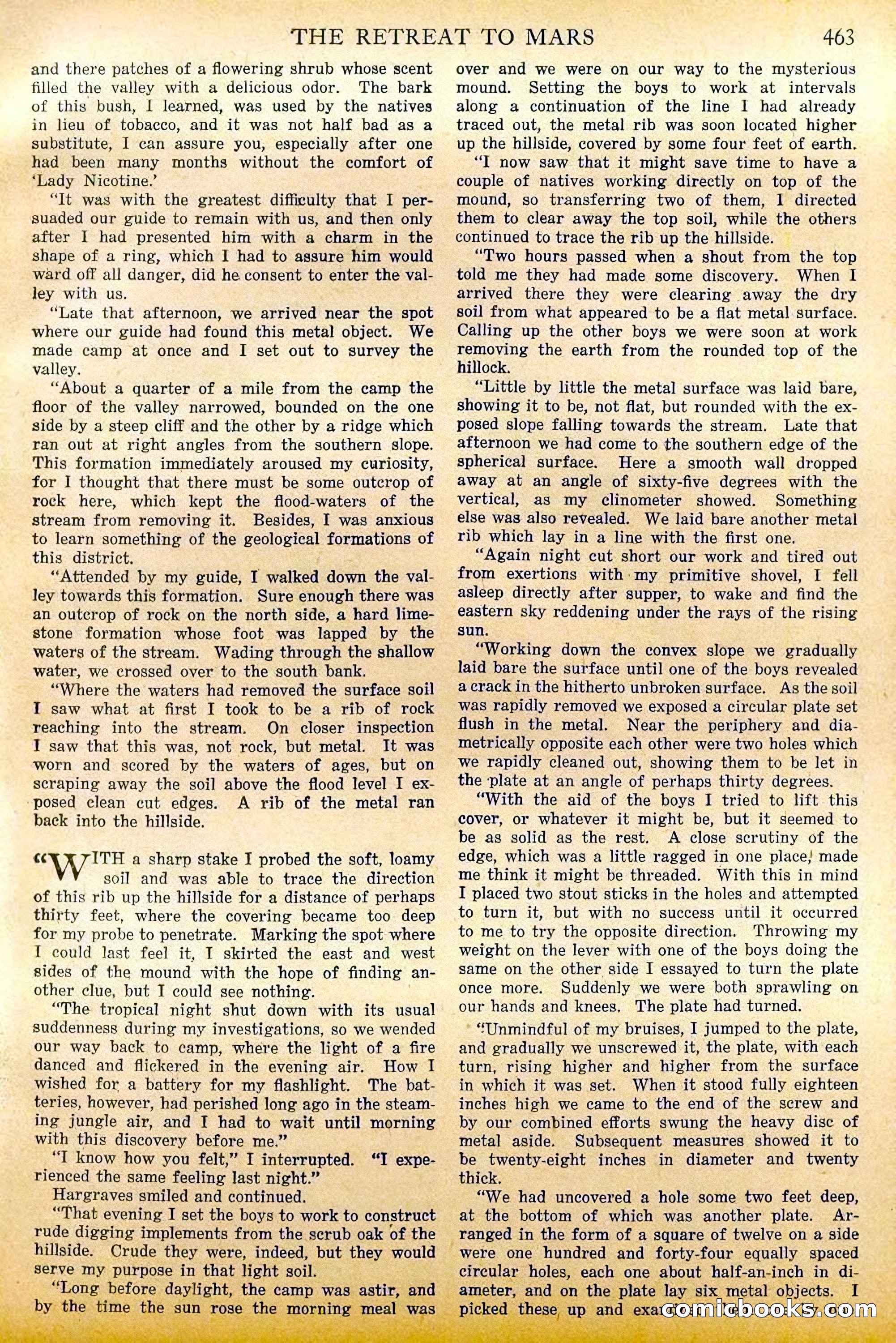
A restored page from Pulp Fiction, 1927. Page through the whole issue in the reader above.
📄 Transcribed text from this page (OCR, searchable)
Machine-transcribed from the original scan — historical spelling and the odd misread are preserved.
THE RETREAT TO MARS and there patches of a flowering shrub whose scent filled the valley with a delicious odor. The bark of this bush, I learned, was used by the natives in lieu of tobacco, and it was not half bad as a substitute, I can assure you, especially after one had been many months without the comfort of ‘Lady Nicotine.’ “Tt was with the greatest difficulty that I per- suaded our guide to remain with us, and then only after I had presented him with a charm in the shape of a ring, which I had to assure him would ward off all danger, did he consent to enter the val- ley with us. “Late that afternoon, we arrived near the spot where our guide had found this metal object. We made camp at once and I set out to survey the valley. “About a quarter of a mile from the camp the floor of the valley narrowed, bounded on the one side by a steep cliff and the other by a ridge which ran out at right angles from the southern slope. This formation immediately aroused my curiosity, for I thought that there must be some outcrop of rock here, which kept the flood-waters of the stream from removing it. Besides, I was anxious to learn something of the geological formations of this district. “Attended by my guide, I walked down the val- ley towards this formation. Sure enough there was an outcrop of rock on the north side, a hard lime- stone formation whose foot was lapped by the waters of the stream. Wading through the shallow water, we crossed over to the south bank. “Where the waters had removed the surface soil I saw what at first I took to be a rib of rock reaching into the stream. On closer inspection I saw that this was, not rock, but metal. It was worn and scored by the waters of ages, but on scraping away the soil above the flood level I ex- posed clean cut edges. A rib of the metal ran back into the hillside. a4) Vi a sharp stake I probed the soft, loamy soil and was able to trace the direction of this rib up the hillside for a distance of perhaps thirty feet, where the covering became too deep for my probe to penetrate. Marking the spot where I could last feel it, I skirted the east and west sides of the mound with the hope of finding an- other clue, but I could see nothing. “The tropical night shut down with its usual suddenness during my investigations, so we wended our way back to camp, where the light of a fire danced and flickered in the evening air. How I wished for a battery for my flashlight. The bat- teries, however, had perished long ago in the steam- ing jungle air, and I had to wait until morning with this discovery before me.” “T know how you felt,” I interrupted. rienced the same feeling last night.” Hargraves smiled and continued. : “That evening I set the boys to work to construct rude digging implements from the scrub oak of the hillside. Crude they were, indeed, but they would serve my pur; i “Long b “T expe- 463 over and we were on our way to the mysterious mound. Setting the boys to work at intervals along a continuation of the line I had already traced out, the metal rib was soon located higher up the hillside, covered by some four feet of earth. “T now saw that it might save time to have a couple of natives working directly on top of the mound, so transferring two of them, I directed them to clear away the top soil, while the others continued to trace the rib up the hillside. “Two hours passed when a shout from the top told me they had made some discovery. When I arrived there they were clearing away the dry soil from what appeared to be a flat metal surface. Calling up the other boys we were soon at work removing the earth from the rounded top of the hillock. “Little by little the metal surface was laid bare, showing it to be, not flat, but rounded with the ex- posed slope falling towards the stream. Late that afternoon we had come to the southern edge of the spherical surface. Here a smooth wall dropped away at an angle of sixty-five degrees with the vertical, as my clinometer showed. Something else was also revealed. We laid bare another metal rib which lay in a line with the first one. “Again night cut short our work and tired out from exertions with: my primitive shovel, I fell asleep directly after supper, to wake and find the eastern sky reddening under the rays of the rising sun. “Working down the convex slope we gradually laid bare the surface until one of the boys revealed a crack in the hitherto unbroken surface. As the soil was rapidly removed we exposed a circular plate set flush in the metal. Near the periphery and dia- metrically opposite each other were two holes which we rapidly cleaned out, showing them to be let in the plate at an angle of perhaps thirty degrees. “With the aid of the boys I tried to lift this cover, or whatever it might be, but it seemed to be as solid as the rest. A close scrutiny of the edge, which was a little ragged in one place} made me think it might be threaded. With this in mind I placed two stout sticks in the holes and attempted to turn it, but with no success until it occurred to me to try the opposite direction. Throwing my weight on the lever with one of the boys doing the same on the other side I essayed to turn the plate once more. Suddenly we were both sprawling on our hands and knees, The plate had turned. *“Unmindful of my bruises, I jumped to the plate, and gradually we unscrewed it, the plate, with each turn, rising higher and higher from the surface in which it was set. When it stood fully eighteen inches high we came to the end of the screw and by our combined efforts swung the heavy dise of metal aside. Subsequent measures showed it to be twenty-eight inches in diameter and twenty thick, “We had uncovered a hole some two feet deep, at the bottom of which was another plate. Ar- _ranged in the form of a square of twelve on a side were one hundred and forty-four equally spaced