
Pulp Fiction, 1927 · page 30 of 107
Amazing Stories, August 1927 — page 30: what you’re looking at
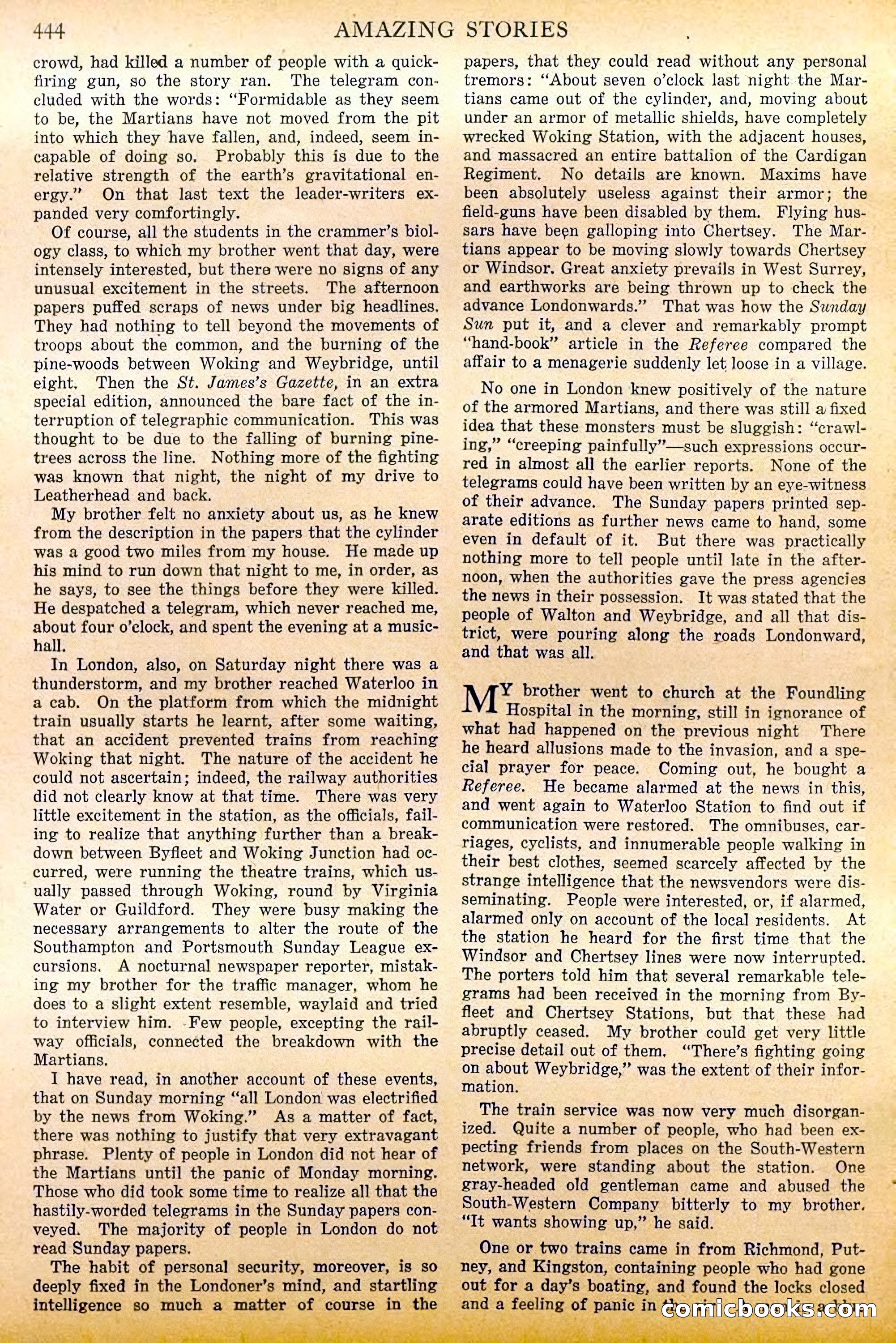
A restored page from Pulp Fiction, 1927. Page through the whole issue in the reader above.
📄 Transcribed text from this page (OCR, searchable)
Machine-transcribed from the original scan — historical spelling and the odd misread are preserved.
444 crowd, had killed a number of people with a quick- firing gun, so the story ran. The telegram con- cluded with the words: “Formidable as they seem to be, the Martians have not moved from the pit into which they have fallen, and, indeed, seem in- capable of doing so. Probably this is due to the relative strength of the earth’s gravitational en- ergy.’ On that last text the leader-writers ex- panded very comfortingly. Of course, all the students in the crammer’s biol- ogy class, to which my brother went that day, were intensely interested, but there were no signs of any unusual excitement in the streets. The afternoon papers puffed scraps of news under big headlines, They had nothing to tell beyond the movements of troops about the common, and the burning of the pine-woods between Woking and Weybridge, until eight, Then the St. James’s Gazette, in an extra special edition, announced the bare fact of the in- terruption of telegraphic communication. This was thought to be due to the falling of burning pine- trees across the line. Nothing more of the fighting was known that night, the night of my drive to Leatherhead and back. My brother felt no anxiety about us, as he knew from the description in the papers that the cylinder was a good two miles from my house. He made up his mind to run down that night to me, in order, as he says, to see the things before they were killed. He despatched a telegram, which never reached me, about four o’elock, and spent the evening at a music- hall. In London, also, on Saturday night there was a thunderstorm, and my brother reached Waterloo in a cab. On the platform from which the midnight train usually starts he learnt, after some waiting, that an accident prevented trains from reaching Woking that night. The nature of the accident he could not ascertain; indeed, the railway authorities did not clearly know at that time. There was very little excitement in the station, as the officials, fail- ing to realize that anything further than a break- down between Byfleet and Woking Junction had oc- curred, were running the theatre trains, which us- ually passed through Woking, round by Virginia Water or Guildford. They were busy making the necessary arrangements to alter the route of the Southampton and Portsmouth Sunday League ex- eursions. A nocturnal newspaper reporter, mistak- ing my brother for the traffic manager, whom he does to a slight extent resemble, waylaid and tried to interview him. -Few people, excepting the rail- way officials, connected the breakdown with the Martians. I have read, in another account of these events, that on Sunday morning “all London was electrified by the news from Woking.” As a matter of fact, there was nothing to justify that very extravagant phrase. Plenty of people in London did not hear of the Martians until the panic of Monday morning. Those who did took some time to realize all that the hastily-worded telegrams in the Sunday papers con- veyed. The majority of people in London do not read Sunday papers. The habit of personal security, moreover, is so deeply fixed in the Lo ney, and Kingston, AMAZING STORIES papers, that they could read without any personal tremors: “About seven o’clock last night the Mar- tians came out of the cylinder, and, moving about under an armor of metallic shields, have completely wrecked Woking Station, with the adjacent houses, and massacred an entire battalion of the Cardigan Regiment. No details are known. Maxims have been absolutely useless against their armor; the field-guns have been disabled by them. Flying hus- sars have been galloping into Chertsey. The Mar- tians appear to be moving slowly towards Chertsey or Windsor. Great anxiety prevails in West Surrey, and earthworks are being thrown up to check the advance Londonwards.” That was how the Sunday Sun put it, and a clever and remarkably prompt “hand-book” article in the Referee compared the affair to a menagerie suddenly let loose in a village. No one in London knew positively of the nature of the armored Martians, and there was still a fixed idea that these monsters must be sluggish: “crawl- ing,” “creeping painfully’—such expressions occur- red in almost all the earlier reports. None of the telegrams could have been written by an eye-witness of their advance. The Sunday papers printed sep- arate editions as further news came to hand, some even in default of it. But there was practically nothing more to tell people until late in the after- noon, when the authorities gave the press agencies the news in their possession. It was stated that the people of Walton and Weybridge, and all that dis- trict, were pouring along the roads Londonward, and that was all. M* brother went to church at the Foundling Hospital in the morning, still in ignorance of what had happened on the previous night There he heard allusions made to the invasion, and a spe- cial prayer for peace. Coming out, he bought a Referee. He became alarmed at the news in this, and went again to Waterloo Station to find out if communication were restored. The omnibuses, car- riages, cyclists, and innumerable people walking in their best clothes, seemed scarcely affected by the strange intelligence that the newsvendors were dis- seminating. People were interested, or, if alarmed, alarmed only on account of the local residents. At the station he heard for the first time that the Windsor and Chertsey lines were now interrupted. The porters told him that several remarkable tele- grams had been received in the morning from By- fleet and Chertsey Stations, but that these had abruptly ceased. My brother could get very little precise detail out of them, “There’s fighting going on about Weybridge,” was the extent of their infor- mation. The train service was now very much disorgan- ized. Quite a number of people, who had been ex- pecting friends from places on the South-Western network, were standing about the station. One gray-headed old gentleman came and abused the South-Western Company bitterly to my brother. “Tt wants showing up,” he said. One or two trains came in from Richmond, Put- itaining people who had gone and fo ks clo