
Pulp Fiction, 1927 · page 31 of 107
Amazing Stories, August 1927 — page 31: what you’re looking at
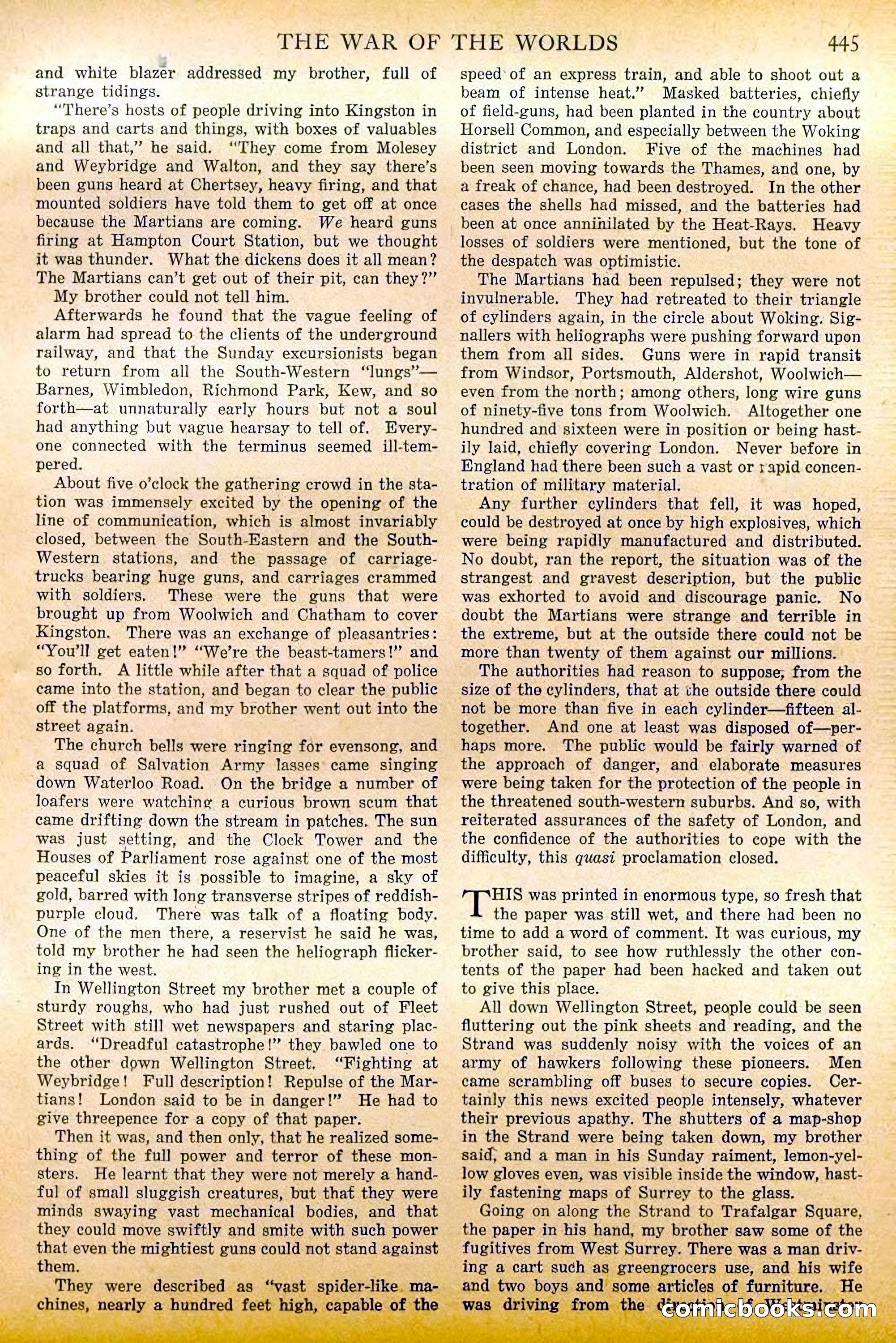
A restored page from Pulp Fiction, 1927. Page through the whole issue in the reader above.
📄 Transcribed text from this page (OCR, searchable)
Machine-transcribed from the original scan — historical spelling and the odd misread are preserved.
THE WAR OF THE WORLDS and white blazer addressed my brother, full of strange tidings. “There’s hosts of people driving into Kingston in traps and carts and things, with boxes of valuables and all that,” he said. “They come from Molesey and Weybridge and Walton, and they say there's been guns heard at Chertsey, heavy firing, and that mounted soldiers have told them to get off at once because the Martians are coming. We heard guns firing at Hampton Court Station, but we thought it was thunder. What the dickens does it all mean? The Martians can’t get out of their pit, can they?” My brother could not tell him, Afterwards he found that the vague feeling of alarm had spread to the clients of the underground railway, and that the Sunday excursionists began to return from all the South-Western “lungs’— Barnes, Wimbledon, Richmond Park, Kew, and so forth—at unnaturally early hours but not a soul had anything but vague hearsay to tell of. Every- one connected with the terminus seemed ill-tem- pered. About five o’clock the gathering crowd in the sta- tion was immensely excited by the opening of the line of communication, which is almost invariably closed, between the South-Eastern and the South- Western stations, and the passage of carriage- trucks bearing huge guns, and carriages crammed with soldiers, These were the guns that were brought up from Woolwich and Chatham to cover Kingston. There was an exchange of pleasantries: “You'll get eaten!” “We’re the beast-tamers!”” and so forth. A little while after that a squad of police came into the station, and began to clear the public off the platforms, and my brother went out into the street again. The church bells were ringing for evensong, and a squad of Salvation Army lasses came singing down Waterloo Road. On the bridge a number of loafers were watching a curious brown scum that came drifting down the stream in patches. The sun was just setting, and the Clock Tower and the Houses of Parliament rose against one of the most peaceful skies it is possible to imagine, a sky of gold, barred with long transverse stripes of reddish- purple cloud. There was talk of a floating body. One of the men there, a reservist he said he was, told my brother he had seen the heliograph flicker- ing in the west. In Wellington Street my brother met a couple of sturdy roughs, who had just rushed out of Fleet Street with still wet newspapers and staring plac- ards. ‘Dreadful catastrophe!” they bawled one to the other down Wellington Street, “Fighting at Weybridge! Full description! Repulse of the Mar- tians! London said to be in danger!” He had to give threepence for a copy of that paper. Then it was, and then only, that he realized some- thing of the full power and terror of these mon- sters. He learnt that they were not merely a hand- ful of small sluggish creatures, but that they were minds swaying vast mechanical bodies, and that they could move swiftly and smite with such power that even the mightiest guns ponld not stand pzalnst sug itives from ie Surrey. There was a man driv- a ae ile adh Cie i es .” * &alt 445 speed’ of an express train, and able to shoot out a beam of intense heat.” Masked batteries, chiefly of field-guns, had been planted in the country about Horsell Common, and especially between the Woking district and London. Five of the machines had been seen moving towards the Thames, and one, by a freak of chance, had been destroyed. In the other cases the shells had missed, and the batteries had been at once anninilated by the Heat-Rays. Heavy losses of soldiers were mentioned, but the tone of the despatch was optimistic. The Martians had been repulsed; they were not invulnerable. They had retreated to their triangle of cylinders again, in the circle about Woking. Sig- nallers with heliographs were pushing forward upon them from all sides. Guns were in rapid transit from Windsor, Portsmouth, Aldershot, Woolwich— even from the north; among others, long wire guns of ninety-five tons from Woolwich. Altogether one hundred and sixteen were in position or being hast- ily laid, chiefly covering London. Never before in England had there been such a vast or rapid concen- tration of military material. Any further cylinders that fell, it was hoped, could be destroyed at once by high explosives, which were being rapidly manufactured and distributed. No doubt, ran the report, the situation was of the strangest and gravest description, but the public was exhorted to avoid and discourage panic. No doubt the Martians were strange and terrible in the extreme, but at the outside there could not be more than twenty of them against our millions. The authorities had reason to suppose, from the size of the cylinders, that at the outside there could not be more than five in each cylinder—fifteen al- together. And one at least was disposed of—per- haps more. The public would be fairly warned of the approach of danger, and elaborate measures were being taken for the protection of the people in the threatened south-western suburbs. And so, with reiterated assurances of the safety of London, and the confidence of the authorities to cope with the difficulty, this quasi proclamation closed. id Bea was printed in enormous type, so fresh that the paper was still wet, and there had been no time to add a word of comment. It was curious, my brother said, to see how ruthlessly the other con- tents of the paper had been hacked and taken out to give this place. All down Wellington Street, people could be seen fluttering out the pink sheets and reading, and the Strand was suddenly noisy with the voices of an army of hawkers following these pioneers. Men came scrambling off buses to secure copies. Cer- tainly this news excited people intensely, whatever their previous apathy. The shutters of a map-shop in the Strand were being taken down, my brother said, and a man in his Sunday raiment, lemon-yel- low gloves even, was visible inside the window, hast- ily fastening maps of Surrey to the glass, Going on along the Strand to Trafalgar Square, the paper in his hand, my brother saw some of the