
Pulp Fiction, 1927 · page 29 of 107
Amazing Stories, August 1927 — page 29: what you’re looking at
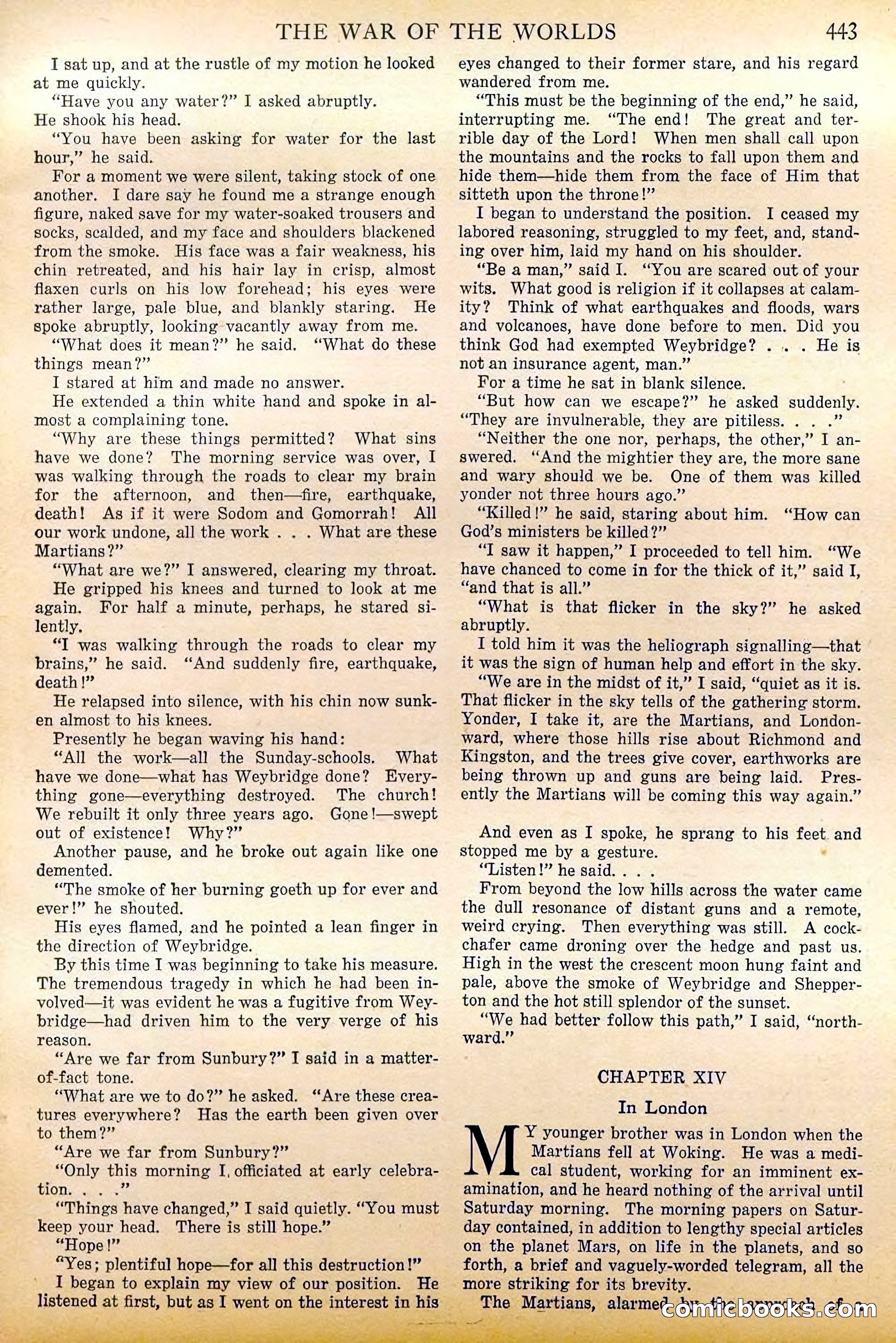
A restored page from Pulp Fiction, 1927. Page through the whole issue in the reader above.
📄 Transcribed text from this page (OCR, searchable)
Machine-transcribed from the original scan — historical spelling and the odd misread are preserved.
THE WAR OF THE WORLDS I sat up, and at the rustle of my motion he looked at me quickly. “Have you any water?” He shook his head. “You have been asking for water for the last hour,” he said. For a moment we were silent, taking stock of one another. I dare say he found me a strange enough figure, naked save for my water-soaked trousers and socks, scalded, and my face and shoulders blackened from the smoke. His face was a fair weakness, his chin retreated, and his hair lay in crisp, almost flaxen curls on his low forehead; his eyes were rather large, pale blue, and blankly staring. He spoke abruptly, looking vacantly away from me. “What does it mean?” he said. “What do these things mean?” I stared at him and made no answer. He extended a thin white hand and spoke in al- most a complaining tone. “Why are these things permitted? What sins have we done? The morning service was over, I was walking through the roads to clear my brain for the afternoon, and then—fire, earthquake, death! As if it were Sodom and Gomorrah! All our work undone, all the work . . . What are these Martians?” “What are we?” I answered, clearing my throat. He gripped his knees and turned to look at me again. For half a minute, perhaps, he stared si- lently, “T was walking through the roads to clear my brains,” he said. “And suddenly fire, earthquake, death !” He relapsed into silence, with his chin now sunk- en almost to his knees. Presently he began waving his hand: “All the work—all the Sunday-schools. What have we done—what has Weybridge done? Every- thing gone—everything destroyed. The church! We rebuilt it only three years ago. Gone!—swept out of existence! Why?” Another pause, and he broke out again like one demented. “The smoke of her burning goeth up for ever and ever!” he shouted. His eyes flamed, and he pointed a lean finger in the direction of Weybridge. By this time I was beginning to take his measure. The tremendous tragedy in which he had been in- volved—it was evident he was a fugitive from Wey- bridge—had driven him to the very verge of his reason. “Are we far from Sunbury?” I said in a matter- of-fact tone. “What are we to do?” he asked. “Are these crea- tures everywhere? Has the earth been given over to them?” “Are we far from Sunbury?” “Only this morning I, officiated at early celebra- TOD ee, ee “Things have changed,” I said quietly. “You must keep your head. There is still hope.” “Hope ‘had “Yes; plentiful hope—for all this destruction!” I began to explain my view of our Position. He Betoed at first, bu I asked abruptly. ‘ 443 eyes changed to their former stare, and his regard wandered from me. “This must be the beginning of the end,” he said, interrupting me. “The end! The great and ter- rible day of the Lord! When men shall call upon the mountains and the rocks to fall upon them and hide them—hide them from the face of Him that sitteth upon the throne!” I began to understand the position. I ceased my labored reasoning, struggled to my feet, and, stand- ing over him, laid my hand on his shoulder. “Be a man,” said I. “You are scared out of your wits. What good is religion if it collapses at calam- ity? Think of what earthquakes and floods, wars and voleanoes, have done before to men. Did you think God had exempted Weybridge? ... . He is not an insurance agent, man.” For a time he sat in blank silence. “But how can we escape?” he asked siddenry “They are invulnerable, they are pitiless... .” “Neither the one nor, perhaps, the other,” I an- swered. “And the mightier they are, the more sane and wary should we be. One of them was killed yonder not three hours ago.” “Yilled!” he said, staring about him. God’s ministers be killed?” “I saw it happen,” I proceeded to tell him. “We have chanced to come in for the thick of it,” said I, “and that is all.” “What is that flicker in the sky?” he asked abruptly. I told him it was the heliograph signalling—that it was the sign of human help and effort in the sky. “We are in the midst of it,” I said, “quiet as it is. That flicker in the sky tells of the gathering storm. Yonder, I take it, are the Martians, and London- ward, where those hills rise about Richmond and Kingston, and the trees give cover, earthworks are being thrown up and guns are being laid. Pres- ently the Martians will be coming this way again.” “How can And even as I spoke, he sprang to his tert and stopped me by a gesture. “Listen!” he said. . From beyond the low hills across the water came the dull resonance of distant guns and a remote, weird crying. Then everything was still. A cock- chafer came droning over the hedge and past us. High in the west the crescent moon hung faint and pale, above the smoke of Weybridge and Shepper- ton and the hot still splendor of the sunset. “We had better follow this path,” I said, “north- ward.” CHAPTER XIV In London Y younger brother was in London when the Martians fell at Woking. He was a medi- cal student, working for an imminent ex- amination, and he heard nothing of the arrival until Saturday morning. The morning papers on Satur- day contained, in addition to lengthy special articles on the planet Mars, on life in the planets, and so forth, a brief and vaguely-worded telegram, all the more striking for its previty: