
Pulp Fiction, 1927 · page 11 of 107
Amazing Stories, August 1927 — page 11: what you’re looking at
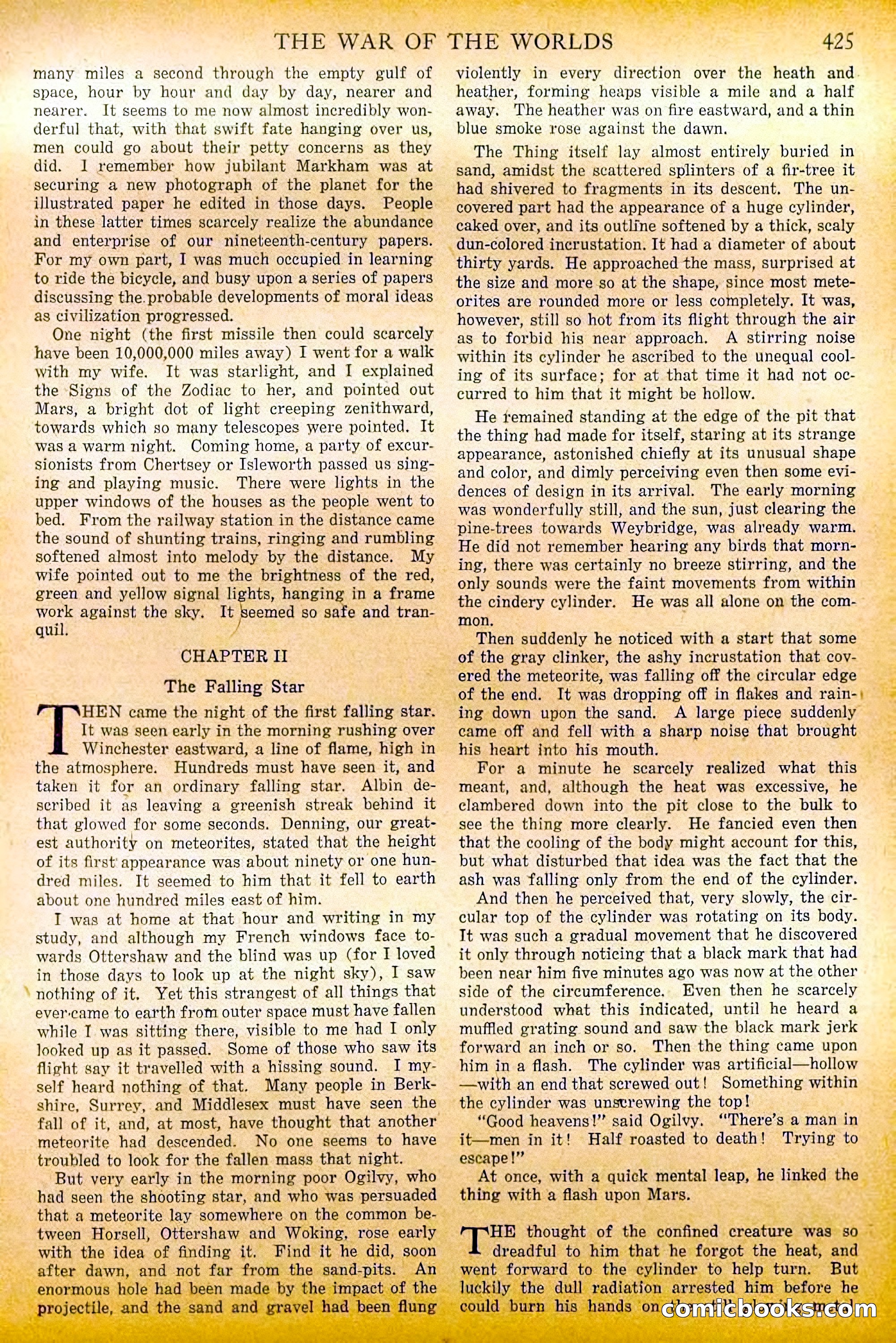
A restored page from Pulp Fiction, 1927. Page through the whole issue in the reader above.
📄 Transcribed text from this page (OCR, searchable)
Machine-transcribed from the original scan — historical spelling and the odd misread are preserved.
a _ tween ‘Horsell, id many miles a second through the empty gulf of space, hour by hour and day by day, nearer and nearer. It seems to me now almost incredibly won- derful that, with that swift fate hanging over us, men could go about their petty concerns as they did. I remember how jubilant Markham was at securing a new photograph of the planet for the illustrated paper he edited in those days. People in these latter times scarcely realize the abundance and enterprise of our nineteenth-century papers. For my own part, I was much occupied in learning to ride the bicycle, and busy upon a series of papers discussing the. probable developments of moral ideas as civilization progressed. One night (the first missile then could scarcely have been 10,000,000 miles away) I went for a walk with my wife. It was starlight, and I explained the Signs of the Zodiac to her, and pointed out Mars, a bright dot of light creeping zenithward, towards which so many telescopes were pointed. It was a warm night. Coming home, a party of excur- sionists from Chertsey or Isleworth passed us sing- ing and playing music. There were lights in the upper windows of the houses as the people went to bed. From the railway station in the distance came the sound of shunting trains, ringing and rumbling softened almost into melody by the distance. My wife pointed out to me the brightness of the red, green and yellow signal lights, hanging in a frame work against the sky. It seemed so safe and tran- quil. - om CHAPTER II The Falling Star HEN came the night of the first falling ste It was seen early in the morning rushing over Winchester eastward, a line of flame, high in the atmosphere. Hundreds must have seen it, and taken it for an ordinary falling star. Albin de- scribed it as leaving a greenish streak behind it that glowed for some seconds. Denning, our great- est authority on meteorites, stated that the height of its first‘ appearance was about ninety or one hun- dred miles. It seemed to him that it fell to earth about one hundred miles east of him. T was at home at that hour and writing in my study, and although my French windows face to- wards Ottershaw and the blind was up (for I loved in those days to look up at the night sky), I saw nothing of it, Yet this strangest of all things that ever-came to earth from outer space must have fallen while I was sitting there, visible to me had I only looked up as it passed. Some of those who saw its flight say it travelled with a hissing sound. I my- self heard nothing of that. Many people in Berk- shire, Surrey, and Middlesex must have seen the = fall of it, and, at most, have thought that another meteorite had descended. No one seems to have troubled to look for the fallen mass that night. But very early in the morning poor Ogilvy, who had seen the shooting star, and who w: that a meteorite lay somewhere 0 Ottershaw an THE WAR OF THE WORLDS persuaded es meio Hah ‘upon Mars. i +e fF violently in every direction over the heath and. heather, forming heaps visible a mile and a half away. The heather was on fire eastward, and a thin blue smoke rose against the dawn. The Thing itself lay almost entirely buried in sand, amidst the scattered splinters of a fir-tree it had shivered to fragments in its descent. The un- covered part had the appearance of a huge cylinder, caked over, and its outline softened by a thick, scaly ‘ dun-colored incrustation. It had a diameter of about thirty yards. He approached the mass, surprised at the size and more so at the shape, since most mete- orites are rounded more or less completely. It was, however, still so hot from its flight through the air as to forbid hig near approach. A stirring noise within its cylinder he ascribed to the unequal cool- ing of its surface; for at that time it had not oc- curred to him that it might be hollow. He temained standing at the edge of the pit that the thing had made for itself, staring at its strange appearance, astonished chiefly at its unusual shape and color, and dimly perceiving even then some evi- dences of design in its arrival. The early morning was wonderfully still, and the sun, just clearing the pine-trees towards Weybridge, was already warm. He did not remember hearing any birds that morn- _ ing, there was certainly no breeze stirring, and the only sounds were the faint movements from within the cindery cylinder. He was all alone on the com- mon, Then suddenly he noticed with a start that some of | the gray clinker, the ashy incrustation that coy- ered the meteorite, was falling off the circular edge FApt the end. It was dropping off in flakes and rain-) ing down upon the sand, A large piece suddenly came off and fell with a sharp noise that br’ ought his heart into his mouth. For a minute he scarcely realized what this — meant, and, although the heat was excessive, he clambered down into the pit close to the bulk to see the thing more clearly. He fancied even then that the cooling of the body might account for this, but what disturbed that idea was the fact that the ash was falling only from the end of the cylinder. And then he perceived that, very slowly, the cir- cular top of the cylinder was rotating on its body. It was such a gradual movement that he discovered it only through noticing that a black mark that had been near him five minutes ago was now at the other side of the circumference. Even then he scarcely understood what this indicated, until he heard a muffled grating sound and saw the black mark jerk forward an inch or so. Then the thing came upon him in a flash. The cylinder was artificial—hollow —with an end that screwed out! Something within the cylinder was unstrewing the top! “Good heavens!” said Ogilvy. ‘“There’s a man in it—men in it! Half roasted to death! escape!” At once, with i foul as leap, h e linked t a ali eke Ch? CaP weal bee < ree ve EY Cres Trying to