
Pulp Fiction, 1927 · page 12 of 107
Amazing Stories, August 1927 — page 12: what you’re looking at
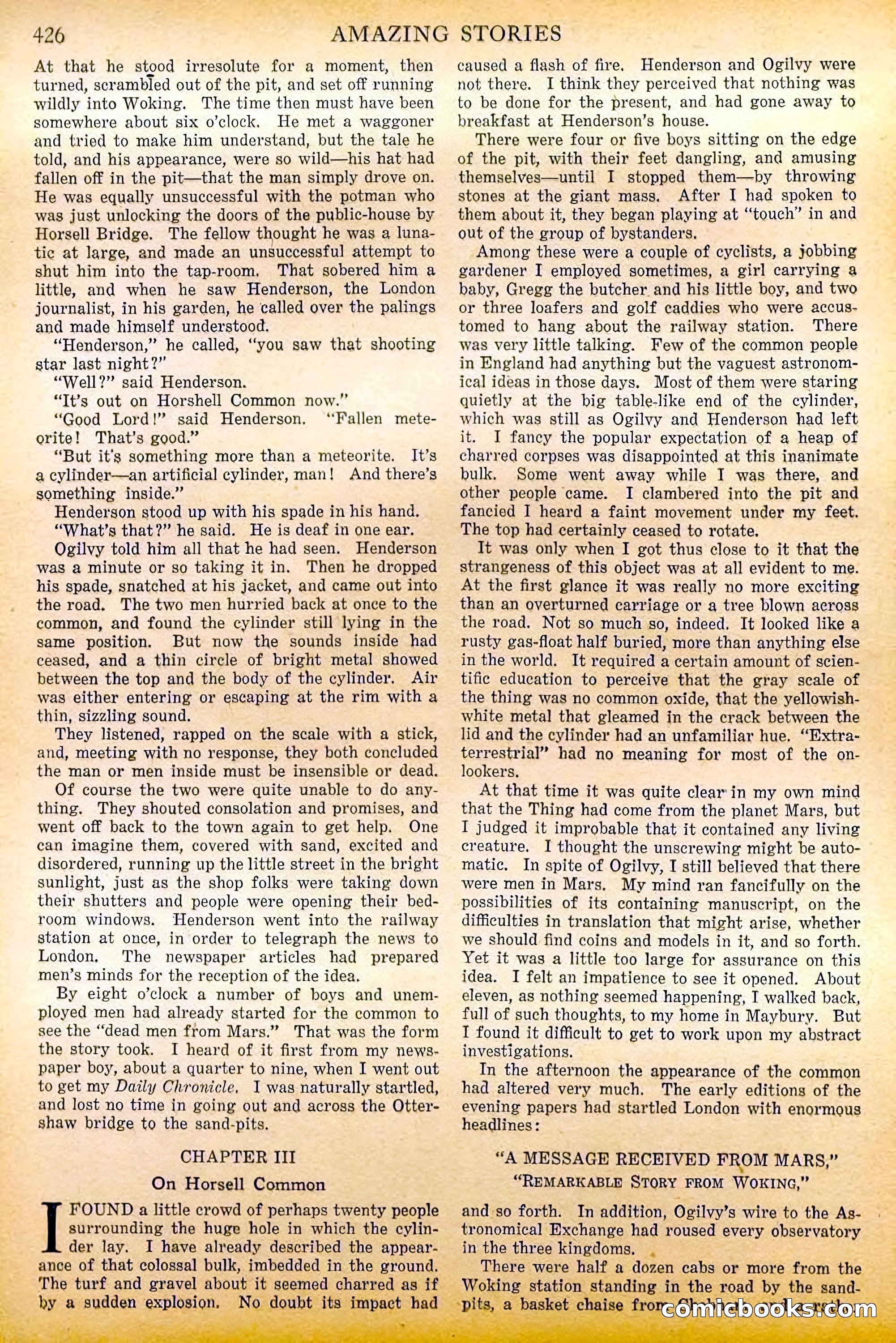
A restored page from Pulp Fiction, 1927. Page through the whole issue in the reader above.
📄 Transcribed text from this page (OCR, searchable)
Machine-transcribed from the original scan — historical spelling and the odd misread are preserved.
, > 426 At that he stood irresolute for a moment, then turned, scrambled out of the pit, and set off running wildly into Woking. The time then must have been somewhere about six o’clock. He met a waggoner and tried to make him understand, but the tale he told, and his appearance, were so wild—his hat had fallen off in the pit—that the man simply drove on. He was equally unsuccessful with the potman who was just unlocking the doors of the public-house by Horsell Bridge. The fellow thought he was a luna- tie at large, and made an unsuccessful attempt to shut him into the tap-room. That sobered him a little, and when he saw Henderson, the London journalist, in his garden, he called over the palings and made himself understood. “Henderson,” he called, “you saw that shooting star last night?” “Well?” said Henderson. “Tt’s out on Horshell Common now.” “Good Lord!” said Henderson, ‘Fallen mete- orite! That’s good.” “But it's something more than a meteorite. It’s a cylinder—an artificial cylinder, man! And there’s something inside.” Henderson stood up with his spade in his hand. “What's that?” he said. He is deaf in one ear. Ogilvy told him all that he had seen. Henderson was a minute or so taking it in. Then he dropped his spade, snatched at his jacket, and came out into the road. The two men hurried back at once to the common, and found the cylinder still lying in the same position. But now the sounds inside had ceased, and a thin circle of bright metal showed between the top and the body of the cylinder. Air was either entering or escaping at the rim with a thin, sizzling sound. They listened, rapped on the scale with a stick, and, meeting with no response, they both concluded the man or men inside must be insensible or dead. Of course the two were quite unable to do any- thing. They shouted consolation and promises, and went off back to the town again to get help. One can imagine them, covered with sand, excited and disordered, running up the little street in the bright sunlight, just as the shop folks were taking down their shutters and people were opening their bed- room windows. Henderson went into the railway station at once, in order to telegraph the news to London, The newspaper articles had prepared men’s minds for the reception of the idea, By eight o’clock a number of boys and unem- ployed men had already started for the common to see the “dead men from Mars.” That was the form the story took. I heard of it first from my news- paper boy, about a quarter to nine, when I went out to get my Daily Chronicle, I was naturally startled, and lost no time in going out and across the Otter- shaw bridge to the sand-pits. CHAPTER III On Horsell Common FOUND a little crowd of perhaps twenty people surrounding the huge hole in which the cylin- der lay. I have already described the appear- ance of that colossal bulk, imbedded in the ground, The turf and gravel about : AMAZING STORIES caused a flash of fire. Henderson and Ogilvy were not there. I think they perceived that nothing was to be done for the present, and had gone away to breakfast at Henderson’s house. There were four or five boys sitting on the edge of the pit, with their feet dangling, and amusing themselves—until I stopped them—by throwing stones at the giant mass. After I had spoken to them about it, they began playing at “touch” in and out of the group of bystanders. Among these were a couple of cyclists, a jobbing gardener I employed sometimes, a girl carrying a baby, Gregg the butcher and his little boy, and two or three loafers and golf caddies who were accus- tomed to hang about the railway station. There was very little talking. Few of the common people in England had anything but the vaguest astronom- ical ideas in those days. Most of them were staring quietly at the big table-like end of the cylinder, which was still as Ogilvy and Henderson had left it. J fancy the popular expectation of a heap of charred corpses was disappointed at this inanimate bulk. Some went away while I was there, and other people came. I clambered into the pit and fancied I heard a faint movement under my feet. The top had certainly ceased to rotate. It was only when I got thus close to it that the strangeness of this object was at all evident to me. At the first glance it was really no more exciting than an overturned carriage or a tree blown across the road. Not so much so, indeed. It looked like a rusty gas-float half buried, more than anything else in the world. It required a certain amount of scien- tific education to perceive that the gray scale of the thing was no common oxide, that the yellowish- white metal that gleamed in the crack between the lid and the cylinder had an unfamiliar hue. “Extra- terrestrial” had no meaning for most of the on- lookers. At that time it was quite clear in my own mind that the Thing had come from the planet Mars, but I judged it improbable that it contained any living creature. I thought the unscrewing might be auto- matic. In spite of Ogilvy, I still believed that there were men in Mars, My mind ran fancifully on the possibilities of its containing manuscript, on the difficulties in translation that might arise, whether we should find coins and models in it, and so forth. Yet it was a little too large for assurance on this idea. I felt an impatience to see it opened. About eleven, as nothing seemed happening, T walked back, full of such thoughts, to my home in Maybury. But I found it difficult to get to work upon my abstract investigations. In the afternoon the appearance of the common had altered very much. The early editions of the evening papers had startled London with enormous headlines: “A MESSAGE RECEIVED FROM MARS,” “REMARKABLE STORY FROM WOKING,” and-so forth. In addition, Ogilvy’s wire to the As- tronomical Exchange had roused every observatory in the three kingdoms. :