
Pulp Fiction, 1927 · page 10 of 107
Amazing Stories, August 1927 — page 10: what you’re looking at
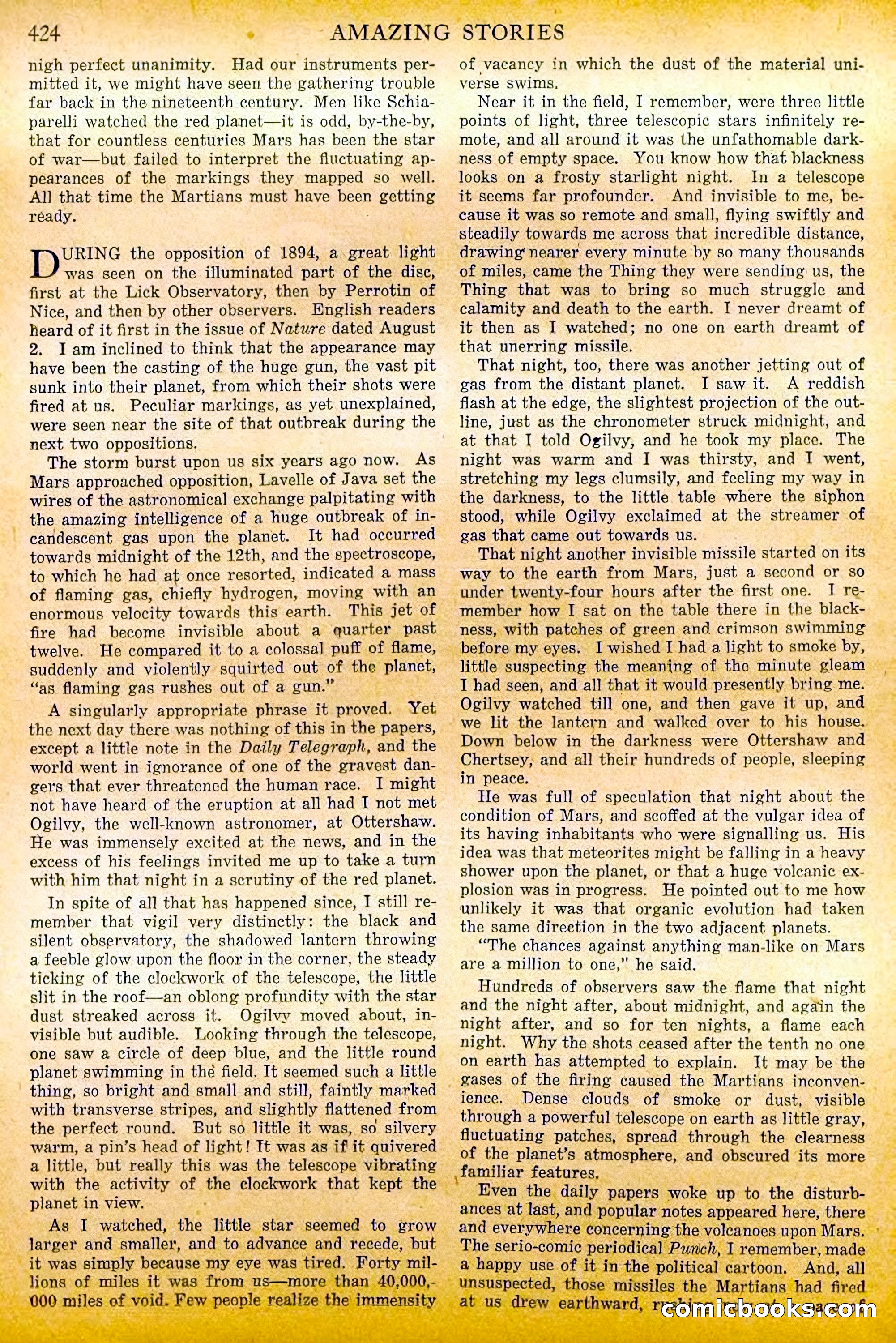
A restored page from Pulp Fiction, 1927. Page through the whole issue in the reader above.
📄 Transcribed text from this page (OCR, searchable)
Machine-transcribed from the original scan — historical spelling and the odd misread are preserved.
Bn ee Ye oe 424 nigh perfect unanimity. Had our instruments per- mitted it, we might have seen the gathering trouble far back in the nineteenth century. Men like Schia- parelli watched the red planet—it is odd, by-the-by, that for countless centuries Mars has been the star of war—but failed to interpret the fluctuating ap- pearances of the markings they mapped so well. All that time the Martians must have been a getting ready. Pos the opposition of 1894, a. great light was seen on the illuminated part of the disc, first at the Lick Observatory, then by Perrotin of Nice, and then by other observers. English readers heard of it first in the issue of Natwre dated August 2. I am inclined to think that the appearance may have been the casting of the huge gun, the vast pit sunk into their planet, from which their shots were fired at us. Peculiar markings, as yet unexplained, were seen near the site of that outbreak during the next two oppositions. The storm burst upon us six years ago now. As Mars approached opposition, Lavelle of Java set the wires of the astronomical exchange palpitating with the amazing intelligence of a huge outbreak of in- candescent gas upon the planet. It had occurred towards midnight of the 12th, and the spectroscope, to which he had at once resorted, indicated a mass of flaming gas, chiefly hydrogen, moving with an enormous velocity towards this earth. This jet of fire had become invisible about a quarter past twelve. suddenly and violently squirted ont of the planet, “as flaming gas rushes out of a gun.” ve A singularly appropriate phrase it proved. ‘Yet the next day there was nothing of this in the papers, except a little note in the Daily Telegraph, and the world went in ignorance of one of the gravest dan- gers that ever threatened the human race. I might not have heard of the eruption at all had I not met Ogilvy, the well-known astronomer, at Ottershaw. He was immensely excited at the news, and in the excess of his feelings invited me up to take a turn with him that night in a scrutiny of the red planet. In spite of all that has happened since, I still re- member that vigil very distinctly: the black and silent observatory, the shadowed lantern throwing a feeble glow upon the floor in the corner, the steady ticking of the clockwork of the telescope, the little slit in the roof—an oblong profundity with the star dust streaked across it. Ogilvy moved about, in- visible but audible. Looking through the telescope, one saw a circle of deep blue, and the little round planet swimming in thé field. It seemed such a little thing, so bright and small and still, faintly marked with transverse stripes, and slightly flattened from the perfect round. But so little it was, so silvery warm, a pin’s head of light! Tt was as if it quivered a little, but really this was the telescope vi with the activity of oe Beypue that kep ‘planet i in view. under twenty-four hours after the first one. of vacancy in which the dust of the material uni- verse swims, Near it in the field, I remember, were three little points of light, three telescopic stars infinitely re- mote, and all around it was the unfathomable dark- ness of empty space. You know how that blackness looks on a frosty starlight night. In a telescope it seems far profounder. And invisible to me, be- cause it was so remote and small, flying swiftly and steadily towards me across that incredible distance, drawing’ nearer every minute by so many thousands of miles, came the Thing they were sending us, the Thing that was to bring so much struggle and calamity and death to the earth. I never dreamt of it then as I watched; no one on earth dreamt of that unerring missile. That night, too, there was another jetting out of gas from the distant planet. I saw it. A reddish flash at the edge, the slightest projection of the out- line, just as the chronometer struck midnight, and at that I told Ogilvy, and he took my place. The night was warm and I was thirsty, and I went, stretching my legs clumsily, and feeling my way in the darkness, to the little table where the siphon stood, while Ogilvy exclaimed at the streamer of gas that came out towards us. That night another invisible missile started on its way to the earth from Mars, just a second or so I re- “member how I sat on the table there in the black- ness, with patches of green and crimson swimming He compared it {o a colossal puff of flame, _ before my eyes. I wished I had a light to smoke by, little suspecting the meaning of the minute gleam T had seen, and all that it would presently bring me. Ogilvy watched till one, and then gave it up, and Sh we lit the lantern and walked over to his house. | Down below in the darkness were Ottershaw and — Chertsey, and all their hundreds of people, sleeping in peace. He was full of speculation that night about the condition of Mars, and scoffed at the vulgar idea of its having inhabitants who were signalling us. His idea was that meteorites might be falling in a heavy shower upon the planet, or that a huge voleanic ex- plosion was in progress. He pointed out to me how unlikely it was that organic evolution had taken the same direction in the two adjacent planets. “The chances against anything man-like on Mars are a million to one,” he said. Hundreds of observers saw the flame that night and the night after, about midnight, and again the night after, and so for ten nights, a flame each night. Why the shots ceased after the tenth no one on earth has attempted to explain. It may be the _ gases of the firing caused the Martians inconven- dust, visible — through a powerful telescope on earth as little gray, ience. Dense clouds of smoke or fluctuating patches, spread through the clearness of the Beers, aahorph ere, and piacined sas more micbooks:com | eae