
Pulp Fiction, 1927 · page 9 of 107
Amazing Stories, August 1927 — page 9: what you’re looking at
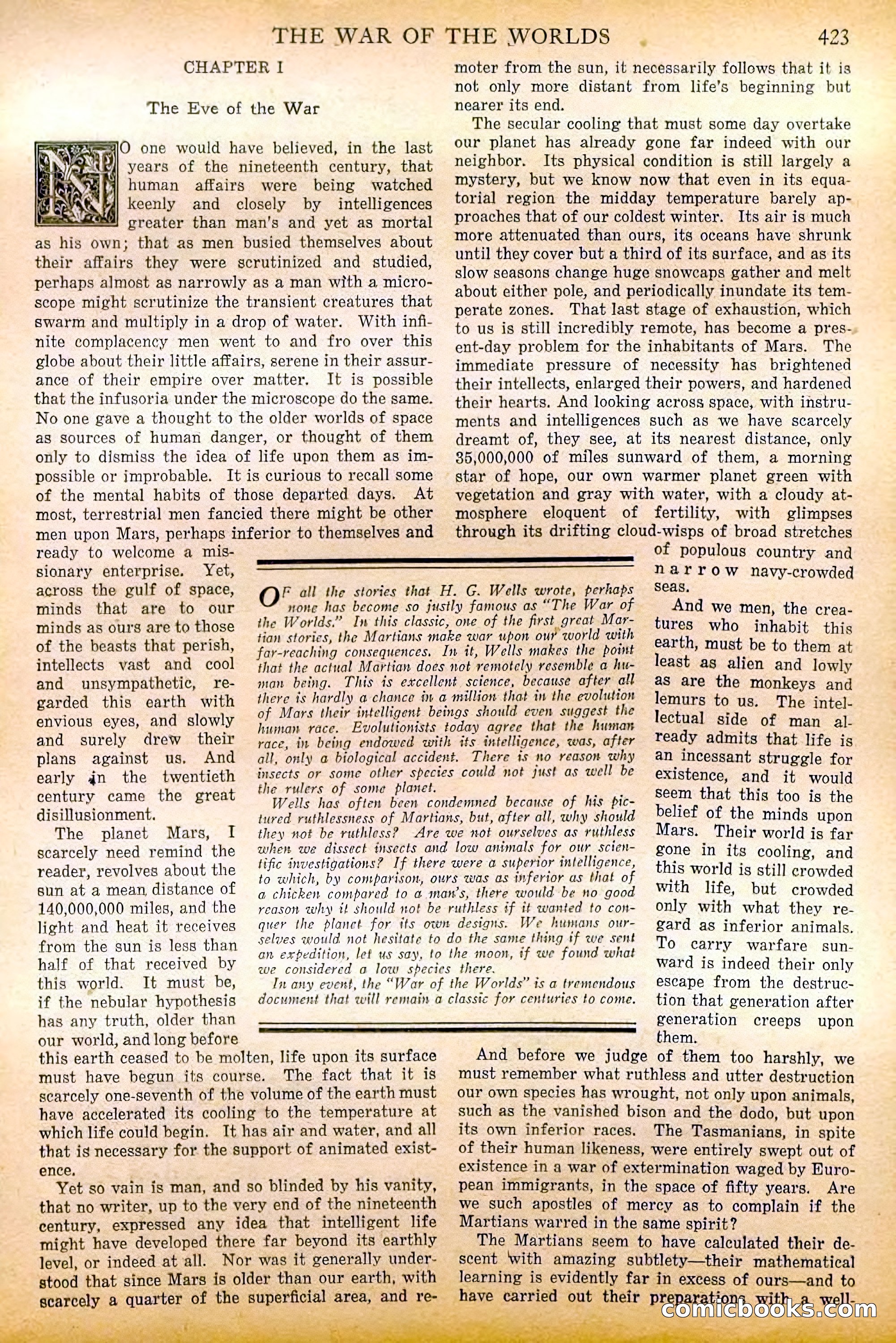
A restored page from Pulp Fiction, 1927. Page through the whole issue in the reader above.
📄 Transcribed text from this page (OCR, searchable)
Machine-transcribed from the original scan — historical spelling and the odd misread are preserved.
THE WAR OF THE WORLDS , CHAPTER I The Eve of the War etry] one would have believed, in the last oN) ip) years of the nineteenth century, that Ap ty] human affairs were being watched Kes) keenly and closely by intelligences Ae greater than man’s and yet as mortal as his own; that as men busied themselves about their affairs they were scrutinized and studied, perhaps almost as narrowly as a man with a micro- scope might scrutinize the transient creatures that swarm and multiply in a drop of water. With infi- nite complacency men went to and fro over this globe about their little affairs, serene in their assur- ance of their empire over matter. It is possible that the infugoria under the microscope do the same. No one gave a thought to the older worlds of space as sources of human danger, or thought of them only to dismiss the idea of life upon them as im- possible or improbable. It is curious to recall some of the mental habits of those departed days. At most, terrestrial men fancied there might be other men upon Mars, perhaps inferior to themselves and ready to welcome a mis- sionary enterprise. Yet, 9, a, aie ots 423 moter from the sun, it necessarily follows that it is not only more distant from life’s beginning but nearer its end. The secular cooling that must some day overtake our planet has already gone far indeed with our neighbor. Its physical condition is still largely a mystery, but we know now that even in its equa- torial region the midday temperature barely ap- proaches that of our coldest winter. Its air is much more attenuated than ours, its oceans have shrunk until they cover but a third of its surface, and as its slow seasons change huge snowcaps gather and melt about either pole, and periodically inundate its tem- perate zones. That last stage of exhaustion, which to us is still incredibly remote, has become a pres- ent-day problem for the inhabitants of Mars. The immediate pressure of necessity has brightened their intellects, enlarged their powers, and hardened their hearts. And looking across space, with instru- ments and intelligences such as we have scarcely dreamt of, they see, at its nearest distance, only 35,000,000 of miles sunward of them, a morning star of hope, our own warmer planet green with vegetation and gray with water, with a cloudy at- mosphere eloquent of fertility, with glimpses through its drifting cloud-wisps of broad stretches of populous country and narrow navy-crowded across the gulf of space, minds that are to our minds as ours are to those of the beasts that perish, intellects vast and cool and unsympathetic, re- garded this earth with envious eyes, and slowly and surely drew their plans against us, And early jn the twentieth century came the great disillusionment. The planet Mars, I scarcely need remind the reader, revolves about the sun at a mean distance of 140,000,000 miles, and the light and heat it receives from the sun is less than half of that received by this world. It must be, if the nebular hypothesis has any truth, older than our world, and long before OF all the stories that H. G. Wells wrote, perhaps none has become so justly famous as “The War of the Worlds.” Iw this classic, one of the first. great Mar- tian stories, the Martians make war upon ou? world with far-reaching consequences. In it, Wells makes the point that the actual Martian does not remotely resemble a hu- man being. This is excellent science, because after all there ts hardly a chance in a million that in the evolution of Mars their intelligent beings should even suggest the human race. Evolutionists today agree that the kwnan race, in being endowed with its intelligence, was, after all, only a biological accident. There ts no reason why insects or some other species could not just as well be the rulers of some planet. Wells has often been condemned because of his pic- tured ruthlessness of Martians, but, after all, why should they not be ruthloss? Are we not ourselves as ruthless when we dissect insects and low animals for our scien- tific investigations? If there were a superior intelligence, to which, by comparison, ours was as wmferior as that of a chicken compared to a snan’s, there would be no good reason why tf should not be ruthless if tt wanted to con- quer the planct for its own designs. We humans our- selves would not hesttate to do the same thing tf we sent an expedition, let us say, to the moon, if we found what we considered a low species there. In any event, the “War of the Worlds” is a tremendous document that will remain a classte for centuries to come. seas, And we men, the crea- tures who inhabit this earth, must be to them at least as alien and lowly as are the monkeys and lemurs to us. The intel- lectual side of man al- ready admits that life is an incessant struggle for existence, and it would seem that this too is the belief of the minds upon Mars. Their world is far gone in its cooling, and this world is still crowded with life, but crowded only with what they re- gard as inferior animals. To carry warfare sun- ward is indeed their only escape from the destruc- tion that generation after generation creeps upon them. this earth ceased to be molten, life upon its surface must have begun its course. The fact that it is scarcely one-seventh of the volume of the earth must have accelerated its cooling to the temperature at which life could begin. It has air and water, and all that ig necessary for the support of animated exist- ence, Yet so vain is man, and so blinded by his vanity, that no writer, up to the very end of the nineteenth century, expressed any idea that intelligent life might have developed there far beyond its earthly level, or indeed at all. Nor was it generally under- stood that since Mars is older than our earth, with scarcely a quarter of the superficial area, d % and re- — oy And before we judge of them too harshly, we must remember what ruthless and utter destruction our own species has wrought, not only upon animals, such as the vanished bison and the dodo, but upon its own inferior races. The Tasmanians, in spite of their human likeness, were entirely swept out of existence in a war of extermination waged by Huro- pean immigrants, in the space of fifty years. Are we such apostles of mercy as to complain if the Martians warred in the same spirit? The Martians seem to have calculated their de- scent with amazing subtlety—their mathematical learning 8 cyidently at in exeess of ours—and to SRS! OIMIGDOOkKSAGO ~,