
Pulp Fiction, 1927 · page 94 of 105
Amazing Stories, Vol. 2, No. 2 — page 94: what you’re looking at
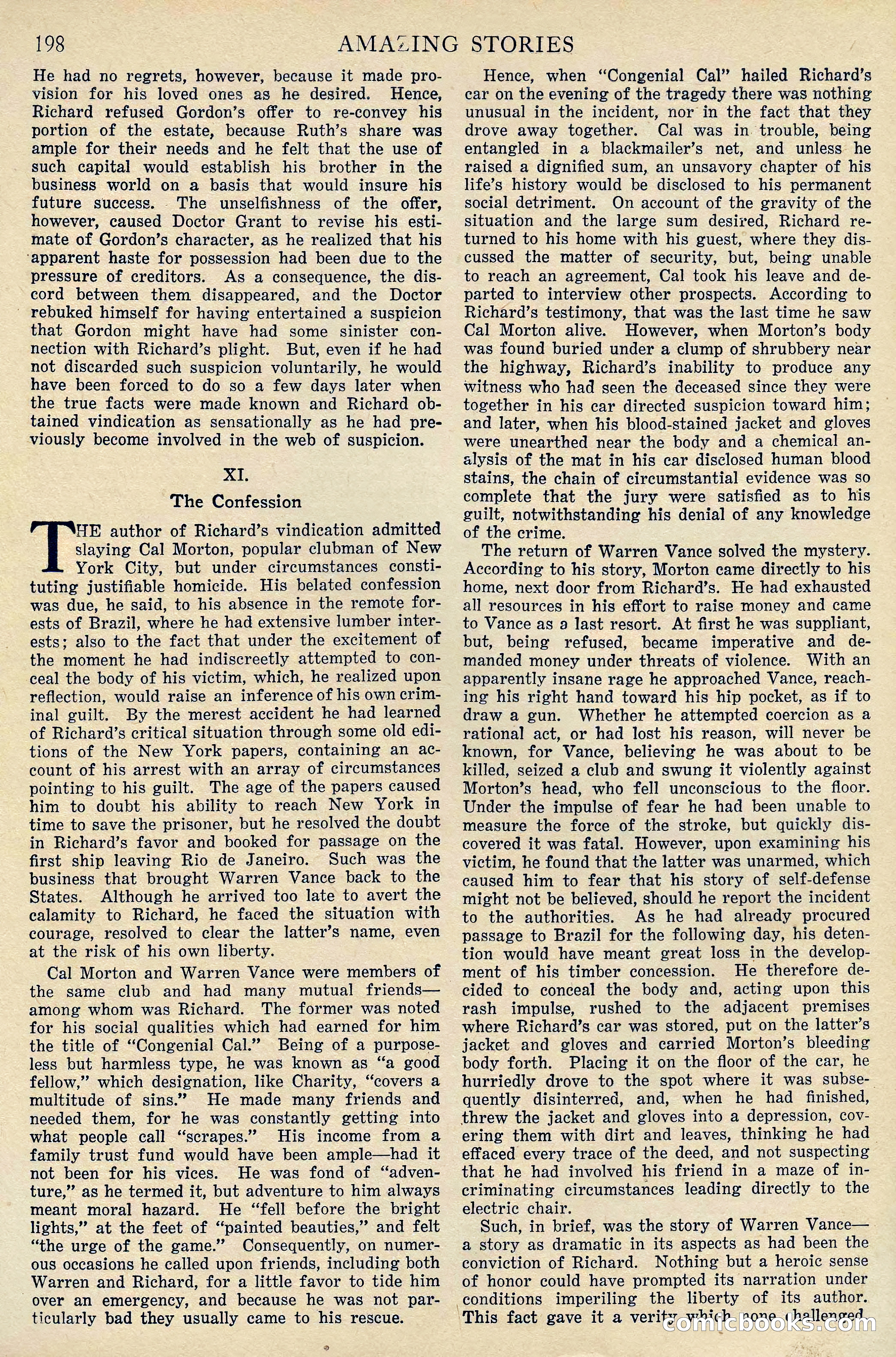
A restored page from Pulp Fiction, 1927. Page through the whole issue in the reader above.
📄 Transcribed text from this page (OCR, searchable)
Machine-transcribed from the original scan — historical spelling and the odd misread are preserved.
198 He had no regrets, however, because it made pro- vision for his loved ones as he desired. Hence, Richard refused Gordon’s offer to re-convey his portion of the estate, because Ruth’s share was ample for their needs and he felt that the use of such capital would establish his brother in the business world on a basis that would insure his future success. - The unselfishness of the offer, however, caused Doctor Grant to revise his esti- mate of Gordon’s character, as he realized that his ‘apparent haste for possession had been due to the pressure of creditors. As a consequence, the dis- cord between them disappeared, and the Doctor - rebuked himself for having entertained a suspicion that Gordon might have had some sinister con- nection with Richard’s plight. But, even if he had not discarded such suspicion voluntarily, he would have been forced to do so a few days later when the true facts were made known and Richard ob- tained vindication as sensationally as he had pre- viously become involved in the web of suspicion. XI. The Confession [es author of Richard’s vindication admitted slaying Cal Morton, popular clubman of New York City, but under circumstances consti- tuting justifiable homicide. His belated confession was due, he said, to his absence in the remote for- ests of Brazil, where he had extensive lumber inter- ests; also to the fact that under the excitement of the moment he had indiscreetly attempted to con- eal the body of his victim, which, he realized upon reflection, would raise an inference of his own crim- inal guilt. By the merest accident he had learned of Richard’s critical situation through some old edi- tions of the New York papers, containing an ac- count of his arrest with an array of circumstances pointing to his guilt. The age of the papers caused him to doubt his ability to reach New York in time to save the prisoner, but he resolved the doubt in Richard’s favor and booked for passage on the first ship leaving Rio de Janeiro. Such was the business that brought Warren Vance back to the States. Although he arrived too late to avert the calamity to Richard, he faced the situation with courage, resolved to clear the latter’s name, even at the risk of his own liberty. Cal Morton and Warren Vance were members of — the same club and had many mutual friends— among whom was Richard. The former was noted for his social qualities which had earned for him the title of “Congenial Cal.” Being of a purpose- less but harmless type, he was known as “a good fellow,” which designation, like Charity, “covers a multitude of sins.’ He made many friends and needed them, for he was constantly getting into what people call “scrapes.” His income from a family trust fund would have been ample—had it not been for his vices. He was fond of “adven- ture,” as he termed it, but adventure to him always meant moral hazard. He “fell before the bright lights,” at the feet of “painted beauties,” and felt “the urge of the game.” Consequently, on numer- ous occasions he ealled upon friends, including both Warren and Richard, for a little favor to tide him over an emergency, and because he was not par- ticularly bad they usually came to his rescue. = AMAzING STORIES Hence, when “Congenial Cal’ hailed Richard’s car on the evening of the tragedy there was nothing unusual in the incident, nor in the fact that they drove away together. Cal was in. trouble, being entangled in a blackmailer’s net, and unless he raised a dignified sum, an unsavory chapter of his life’s history would be disclosed to his permanent social detriment. On account of the gravity of the situation and the large sum desired, Richard re- turned to his home with his guest, where they dis- cussed the matter of security, but, being unable to reach an agreement, Cal took his leave and de- parted to interview other prospects. According to Richard’s testimony, that was the last time he saw Cal Morton alive. However, when Morton’s body was found buried under a clump of shrubbery near the highway, Richard’s inability to produce any witness who had seen the deceased since they were together in his car directed suspicion toward him; and later, when his blood-stained jacket and gloves were unearthed near the body and a chemical an- alysis of the mat in his car disclosed human blood stains, the chain of circumstantial evidence was so complete that the jury were satisfied as to his guilt, notwithstanding his denial of any knowledge of the crime. The return of Warren Vance solved the mystery. According to his story, Morton came directly to his home, next door from Richard’s. He had exhausted all resources in his effort to raise money and came to Vance as a last resort. At first he was suppliant, but, being refused, became imperative and de- manded money under threats of violence. With an apparently insane rage he approached Vance, reach- ing his right hand toward his hip pocket, as if to draw a gun. Whether he attempted coercion as a rational act, or had lost his reason, will never be known, for Vance, believing he was about to be killed, seized a club and swung it violently against Morton’s head, who fell unconscious to the floor. Under the impulse of fear he had been unable to measure the force of the stroke, but quickly dis- covered it was fatal. However, upon examining his victim, he found that the latter was unarmed, which caused him to fear that his story of self-defense might not be believed, should he report the incident to the authorities. As he had already procured passage to Brazil for the following day, his deten- tion would have meant great loss in the develop- ment of his timber concession. He therefore de- cided to conceal the body and, acting upon this rash impulse, rushed to the adjacent premises where Richard’s car was stored, put on the latter’s jacket and gloves and carried Morton’s bleeding body forth. Placing it on the floor of the car, he hurriedly drove to the spot where it was subse-- quently disinterred, and, when he had finished, threw the jacket and gloves into a depression, cov- ering them with dirt and leaves, thinking he had effaced every trace of the deed, and not suspecting that he had involved his friend in a maze of in- criminating circumstances leading directly to the electric chair. Such, in brief, was the story of Warren Vance—. a story as dramatic in its aspects as had been the conviction of Richard. Nothing but a heroic sense of honor could have prompted its narration under conditions imperiling the liberty of its author. This fact gave it a verirooynitre pone.( hallenged-