
Pulp Fiction, 1927 · page 93 of 105
Amazing Stories, Vol. 2, No. 2 — page 93: what you’re looking at
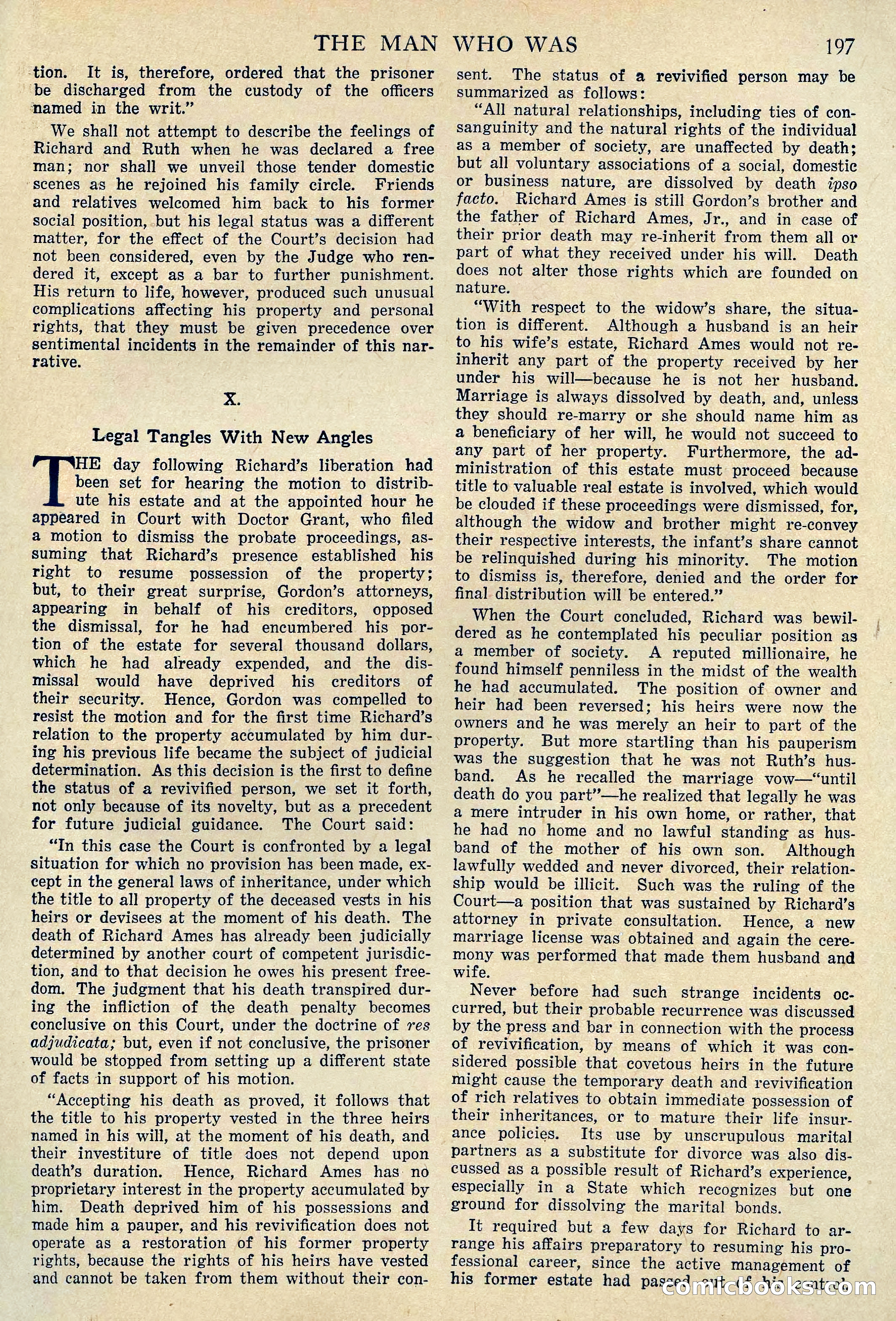
A restored page from Pulp Fiction, 1927. Page through the whole issue in the reader above.
📄 Transcribed text from this page (OCR, searchable)
Machine-transcribed from the original scan — historical spelling and the odd misread are preserved.
THE MAN -tion. It is, therefore, ordered that the prisoner ‘be discharged from the custody of the officers named in the writ.” ~ We shall not attempt to describe the feelings of Richard and Ruth when he was declared a free man; nor shall we unveil those tender domestic “scenes as he rejoined his family circle. Friends and relatives welcomed him back to his former social position, but his legal status was a different matter, for the effect of the Court’s decision had not been considered, even by the Judge who ren- dered it, except as a bar to further punishment. His return to life, however, produced such unusual complications affecting his property and personal rights, that they must be given precedence over sentimental incidents in the remainder of this nar- rative. X. Legal Tangles With New Angles HE day following Richard’s liberation had been set for hearing the motion to distrib- ute his estate and at the appointed hour he appeared in Court with Doctor Grant, who filed a motion to dismiss the probate proceedings, as- suming that Richard’s presence established his right to resume possession of the property; but, to their great surprise, Gordon’s attorneys, appearing in behalf of his creditors, opposed the dismissal, for he had encumbered his por- tion of the estate for several thousand dollars, which he had already expended, and the dis- missal would have deprived his creditors of their security. Hence, Gordon was compelled to resist the motion and for the first time Richard’s relation to the property accumulated by him dur-. ing his previous life became the subject of judicial determination. As this decision is the first to define the status of a revivified person, we set it forth, not only because of its novelty, but as a precedent for future judicial guidance. The Court said: “In this case the Court is confronted by a legal situation for which no provision has been made, ex- cept in the general laws of inheritance, under which the title to all property of the deceased vests in his heirs or devisees at the moment of his death. The death of Richard Ames has already been judicially determined by another court of competent jurisdic- tion, and to that decision he owes his present free- dom. The judgment that his death transpired dur- ing the infliction of the death penalty becomes conclusive on this Court, under the doctrine of res adjudicata; but, even if not conclusive, the prisoner would be stopped from setting up a different state of facts in support of his motion. “Accepting his death as proved, it follows that the title to his property vested in the three heirs named in his will, at the moment of his death, and their investiture of title does not depend upon death’s duration. Hence, Richard Ames has: no proprietary interest in the property accumulated by him. Death deprived him of his possessions and made him a pauper, and his revivification does not operate as a restoration of his former property rights, because the rights of his heirs have vested and cannot be taken from them without their con- WHO WAS AL. sent. The status of a revivified person may be Summarized as follows: “All natural relationships, including ties of con- sanguinity and the natural rights of the individual aS a member of society, are unaffected by death; but all voluntary associations of a social, domestic or business nature, are dissolved by death ipso facto. Richard Ames is still Gordon’s brother and the father of Richard Ames, Jr., and in case of their prior death may re-inherit from them all or part of what they received under his will. Death does not alter those rights which are founded on nature. “With respect to the widow’s share, the situa- tion is different. Although a husband is an heir to his wife’s estate, Richard Ames would not re- inherit any part of the property received by her under his will—because he is not her husband. Marriage is always dissolved by death, and, unless they should re-marry or she should name him as a beneficiary of her will, he would not succeed to any part of her property. Furthermore, the ad- ministration of this estate must proceed because title to valuable real estate is involved, which would be clouded if these proceedings were dismissed, for, although the widow and brother might re-convey their respective interests, the infant’s share cannot be relinquished during his minority. The motion to dismiss is, therefore, denied and the order for final distribution will be entered.” When the Court concluded, Richard was bewil- dered as he contemplated his peculiar position as a member of society. A reputed millionaire, he found himself penniless in the midst of the wealth he had accumulated. The position of owner and heir had been reversed; his heirs were now the owners and he was merely an heir to part of the property. But more startling than his pauperism was the suggestion that he was not Ruth’s hus- band. As he recalled the marriage vow—“until death do you part”’—he realized that legally he was a mere intruder in his own home, or rather, that he had no home and no lawful standing as hus- band of the mother of his own son. Although lawfully wedded and never divorced, their relation- ship would be illicit. Such was the ruling of the Court—a position that was sustained by Richard’s attorney in private consultation. Hence, a new marriage license was obtained and again the cere- mony was performed that made them husband and wife. Never before had such strange incidents oc- curred, but their probable recurrence was discussed by the press and bar in connection with the process of revivification, by means of which it was con- sidered possible that covetous heirs in the future might cause the temporary death and revivification of rich relatives to obtain immediate possession of their inheritances, or to mature their life insur- ance policies. Its use by unscrupulous marital partners as a substitute for divorce was also dis- cussed as a possible result of Richard’s experience, especially in a State which recognizes but one ground for dissolving the marital bonds. It required but a few days for Richard to ar- range his affairs preparatory to resuming his pro- fessional career, since the active management of his former estate had TE Omicoooks'com